Episodes

Jul 1, 2025
Jul 1, 2025
1 hr 5 min
What does it take to lead at every level and shape the leaders of tomorrow?
SUMMARY
Long Blue Line podcast host, Lt. Col. (Ret.) Naviere Walkewicz ’99 sat with Maj. Gen. Thomas P. Sherman ’95, the U.S. Air Force Academy’s vice superintendent, for a deep dive into leadership, humanity and building a world-class service academy. This episode is packed with wisdom for aspiring, emerging, and seasoned leaders alike.
SHARE
LINKEDIN | FACEBOOK
GEN. SHERMAN'S TOP 10 LEADERSHIP TAKEAWAYS
- Leadership is a human experience - focus on connecting with and caring about people.
- Love what you do and love the people you lead; passion inspires others to follow you.
- Embrace failures and challenges as opportunities for personal growth and development.
- Set the right culture and values within your team to build trust and mutual support.
- Be present and engaged with your team, understanding their motivations and experiences.
- Leadership is about more than rank or position - it's about earning genuine trust and respect.
- Invest time in understanding different generations, cultural nuances, and individual perspectives.
- Balance professional excellence with personal growth and life experiences.
- Support your team's development by providing encouragement and holding them accountable.
- Your legacy is built through individual interactions and the positive impact you have on people's lives.
CHAPTERS
00:00 Introduction to Major General Thomas P. Sherman01:29 Choosing Leadership Over Flying07:23 The Impact of Mentorship and Values12:46 Heritage and Evolution of Security Forces17:43 Personal Growth in Aviano, Italy24:17 The Importance of Work-Life Balance29:50 Culminating Command Experience at Bagram42:25 The Role of Family in Leadership51:29 Continuous Self-Improvement as a Leader56:27 Embracing Failure as a Growth Opportunity01:00:06 Legacy and the Impact of Leadership
ABOUT GEN. SHERMAN
BIO
Maj. Gen. Thomas P. Sherman is the Vice Superintendent of the U.S. Air Force Academy in Colorado Springs, CO. He is serving as the chief operations officer to the Superintendent and overseeing the Academy’s blend of military training, academics, athletics, and character development for cadets.
Gen. Sherman commissioned in 1995 from the Academy with a Bachelor of Science in Political Science. He built a distinguished career as a security forces officer. He’s held command at nearly every level.
His key assignments include leadership of the 88th Air Base Wing at Wright-Patterson AFB and critical staff positions at the Pentagon.
In May 2024, Gen. Sherman was tapped to serve as the Academy's Vice Superintendent
CONNECT WITH GEN. SHERMAN
LINKEDIN
ALL PAST LBL EPISODES | ALL LBLPN PRODUCTIONS
AVAILABLE ON ALL MAJOR PODCAST PLATFORMS
TRANSCRIPT
SPEAKERS
Guest, Maj. Gen. Thomas P. Sherman ’95 | Host, Lt. Col. (ret.) Naviere Walkewicz ’99
Naviere Walkewicz 00:00
Welcome to Long Blue Leadership, the podcast where we share insights on leadership through the lives and experiences of Air Force Academy graduates. I'm Naviere Walkewicz, Class of ’99 today. I'm joined by a leader whose career has taken him from the flight line to the halls of Congress and now back to the very institution that launched it all. Maj. Gen. Thomas P. Sherman currently serves as vice superintendent of the Air Force Academy, where he plays a critical role in guiding the development of our future officers and ensuring the Academy remains a world class institution for leadership, character and Day 1 readiness to win the future fight. A 1995 Academy graduate, Gen. Sherman has spent nearly three decades serving in key operational, strategic and command roles. He's led at every level, from squadron to wing command, and his assignments have included everything from nuclear security enterprise to homeland defense, policy development at the Pentagon, and legislative affairs at the highest levels of the Department of the Air Force. Prior to his role as vice superintendent, Gen. Sherman served in the Office of the Deputy Secretary of Defense, where he was a principal military assistant leading policy integration across joint staff, interagency services and combatant commands. He's perhaps best known in command circles for leading the 88th Air Base wing at Wright Patterson Air Force Base in Ohio, one of the largest and most complex wings in the Air Force, with a focus on people first, leadership and mission excellence. Gen. Sherman, welcome to Long Blue Leadership. We're so glad you're here too.
MAJ. GEN. SHERMAN 01:32
It is great to be here. Thank you.
Naviere Walkewicz 01:33
We're excited and we're going to dive right in, because I think what is so special for our listeners is really hearing these moments that have changed your life. I'd like to start at the Academy. You turned down a pilot slot. You were rated, but said no.
MAJ. GEN. SHERMAN 01:48
Well, actually it was a little bit before that. You know, it's kind of interesting, because that was the draw that brought me here, is I just had this incredible passion to want to fly, and I love flying, and I truly enjoyed it, especially through all the different airmanship programs and things like and things like that we had here. The experiences were fantastic. But, you know, as I was starting to learn more about myself going through the Academy, I was starting to feel my heart getting pulled in a direction of wanting to really lead people and really spend a lot of time working with the enlisted. And I think that came from a couple different areas. I think it was some really unique exposure that I got during my ops Air Force time, which I went to Ramstein Air Base in Germany, during ops, and just had our action officer that worked this, I think just did a phenomenal job. And I really started getting pulled to what was then called security police. That is actually when Laurie and I got together and started dating, because Laurie is here in Colorado Springs, but she grew up as an Air Force brat. My father-in-law is a retired Chief Master Sgt., and so there was a lot of mentorship that was taking place around dining room table when I was a young cadet. And I think one of the things that her parents really taught me was just the value of the enlisted force, and so I was feeling my heart really getting pulled. And so obviously, there's a conundrum. There's a conundrum on what were the root desires that brought me here — what were the things that I was learning as a cadet, my joy of flying, and also, particularly the culture at that time, was that that was really the job that you needed to aspire to be, that was the expectation of cadets. And so then to really kind of run counter to that strong current was really kind of a unique, you know, almost unnavigated area, right? And so to really kind of take the story out to its next level is that I'd really gotten to a point where talking with people there — we hadn't had the AMT program, but there were these NCOs that were kind of tangentially attached to cadet squadrons. And so I got a chance to talk to one of the master sergeants that was there who was a maintainer by background. And I was kind of pouring my heart out to him on, you know, what had I been talking to him with my now in-laws, about where was my heart pulling me? And so he said, ‘Give me just a second.’ And he picked up the phone, and he called my AOC and he goes, ‘Hey, you're gonna be there for a little while.’ And this was a Friday afternoon. He said, ‘I got a cadet that needs to come talk to you.’ And he hangs up the phone and he goes, ‘Now you go tell your AOC what you just told me.’ And so I ended up going to my AOCs office that day, and we had about a two-hour conversation about this. I sat down and really, kind of took the time to explain to him what was I feeling, And obviously, I really try to see the best in people. And so I think from a noble place, he was doing his best to convince me that I was making a grave mistake. And went on to talk to me about what his concerns were, the career field that I was looking at, things along those lines. And we can save that conversation for another time, but I think really where the foundation came in is where we started to talk about leadership. And you know, what I was asking him to do was to pull my rated recommendation form, so we had just submitted them, and I was asking him to pull my rated recommendation form. I didn't want to compete for it anymore. And so we started to talk about leadership. And he says, ‘Hey, Cadet Sherman, you need to understand that leadership in this Air Force is being the lead F-16 pilot on a bombing run, you know, putting iron on target.’ And that's true. It's a very important part of leadership. It is a very important part of tactical operational leadership in this Air Force. So he's not wrong in that space. But I was looking at it from a different lens, and I was looking at it, I think, on a larger level. And what I don't think he realized is that 30 seconds before I walked into his office, he set me up for success. I just happened to be waiting outside the office, and all of a sudden, I looked on his cork board, and somebody, and I don't know who it was, had pinned a note that was written to Airman Magazineby an airman first class. And this airman first class titled this, “I need a leader.” And this A1C felt so strongly about what they were feeling — and I have no idea who this person was — felt so strongly about it that they put pen to paper, and this would have been the fall of 1994, and sent this into Airman Magazine, and it says, “I need a leader.” Commissioning sources. ‘Send us lieutenants that we can look up to that will hold us accountable when we do wrong, that will encourage us when we do well, that will be an example that we can look up to, that will care about us as human beings, because you are not sending them to us now. Air Force, I need a leader.’ Like that 30 seconds just before I walked into his office — that changed my life, and it changed my life, because for me, at that moment, what I was getting ready to go ask my AOC to do, what I was looking at inside myself, that became my charge. And so as we spoke, you know, 20-year-old Cadet First Class Sherman — I might have been a 21-year-old at the time — Cadet First Class Sherman pushed back on my AOC, and I said, ‘Sir, I disagree.’ I said, ‘I want to be that guy. I want to be that guy that that A1c is asking for on your cork board outside, because that's leadership in this Air Force.’ And so, to his credit, he said, ‘Hey, I want you to go think about this over the weekend. You know, think about what you're doing. Come back to me on Monday. No questions asked. I'll pull it if you want me to.’ And I left there, and I remember feeling like, not like a weight had been lifted off my shoulder, but I almost felt like this sense of like, ‘Now I've got my purpose,’ because that little article has shaped me my entire career, and I mean to this day, and at a scale. You know, as a lieutenant, my scale is this big on what I'm affecting to help do and be what that A1C needs to a wing commander. I always keep it in the back of my head, and after all of these years, I am still thinking about, Am I doing right by that A1C that 31 years ago, felt so strongly about something that they wrote a note to Airman Magazine, and that became my charge.
Naviere Walkewicz 08:09
That is incredibly powerful. I'm a little bit without words, because I'm thinking about, first off, being brave enough to disagree with an AOC. I mean, I think that takes courage in showing your leadership there. Were you always like that? Have you always been someone that is steadfast in a decision and being able to kind of speak out?
MAJ. GEN. SHERMAN 08:30
So I get that from my parents. And, you know, I grew up in Corona, California. My mom and dad are amazing people. And we didn't grow up with a lot of money, and we grew up from a pretty meager background, and my mom and dad had made a decision early on in their marriage, when they had my sister and I, that my mom was going to focus to make sure that Nancy and I got an education, and my dad was going to work as many jobs as he had to to put food on the table. And sometimes my dad was holding down three jobs to make sure that we had nutritious food to eat, and my mom was working miracles to make sure that we were fed well, but that also that she was dedicated and had the time to volunteer for things like PTA, being involved as a class volunteer, making sure that we were involved in things and had exposure to things that what they did was they also instilled in me this really strong blue collar work ethic. And it was this aspect of, if I just roll up my sleeves and put in the work, anything is possible. And so on that line, this young kid growing up with a West Coast father and an East Coast mother, and just this, really neat family background that things for me, that I believed in I would go after with all of my heart and soul. And so I found out about the Academy when I was 12 years old. And so, you know, when I at 12 years — we were going to a community event there in Corona, and there was an officer recruiter — Capt. Craig. was her name — and we started talking. She says, ‘Hey, did anybody talk to you about the Air Force Academy?’ And I said, ‘No, this sounds great.’ So from there, I just made this decision as a 12-year-old, and I worked all the way through junior high and high school to get here, because to go to your point like, ‘I made a decision, I'm gonna see this thing through.’
Naviere Walkewicz 10:30
Whoa. OK, so you knew you were going to the Academy before you graduated high school.
MAJ. GEN. SHERMAN 10:35
Yes, in my mind, there was no other option.
Naviere Walkewicz 10:39
And so anyone in your family serve, or were you the first one in your family to serve?
MAJ. GEN. SHERMAN 10:43
So I am the first officer and career member of the family. My dad was drafted and went to Vietnam in 1967 and stayed through Tet of 1968. I had an uncle, Harry Lee Schmidt, who was a C-47 loadmaster in World War II and Korea, and my grandfather was actually a part of the initial kind of what was the foundation of the OSS and the Navy doing beach recon on beaches in the South Pacific, prior to island hopping campaign and island landings. And so there was this real heritage of service, right? Just not career service. But even then, as a kid, I always had in my mind, ‘OK, one way or another, I'm going to serve, and if I do an enlistment and then go to college afterwards —' but I had this idea that, ‘OK, I'm going to serve,’ and then all of a sudden, this became this amazing conduit that got me here, right?
Naviere Walkewicz 11:38
And they also had ties to aviation. How did they feel about your decision, your family?
MAJ. GEN. SHERMAN 11:43
It was interesting, because they knew how passionate I was about aviation growing up. I mean, we did not miss an air show at March Air Force Base, the Chino air show, which was planes of fame, which was all historic aircraft. I volunteered as a high school student to work there, and we helped restore airplanes with me and my friends. You know, it was interesting, because my parents were very supportive in ‘OK, where's your heart leading you? And, what makes you feel so strongly about this?’ Because when I first talked to him on the phone, I called him from Ramstein Air Base and said, ‘Hey, I think I know what I want to do in the Air Force. I want to go to security police. And my mom was like, ‘What's that? And, so, as time went by and I explained it, I think my parents probably all along knew that that was probably going to be a very good fit. And then after commissioning and at my first assignment, I think that they were certain of it, right? Yeah, they were absolutely certain.
Naviere Walkewicz 12:37
That is amazing. Well, I want to dive into this profession a bit, because it's interesting. You know, you've mentioned, when you came in, it was security police, and, security forces and you hear people saying defenders and peacekeepers. So there's this lineage and this heritage. Can you maybe talk a little bit about that and then maybe lead us into that next transformational moment that you might have had in this role?
MAJ. GEN. SHERMAN 12:58
OK, I'm very proud of the fact that, you know, I am part of an ever decreasing group of folks that came in when we were still security police, and that was really still the peacekeeper days, because this was all kind of the follow on on the Cold War. The peacekeepers were our cold warriors and that was a huge part. Our defenders came in and really, that name started to really grow in 1997 when the name changed from security police to security forces, and we were actually going back to some of our heritage that was in Operation Safeside, which was the combat security police squadrons in Vietnam. So when you think about the courage that was displayed during the Tet Offensive at places like Tan Son Nhat that those were safe side warriors that were a part of these combat security police squadrons. And so the very — part of the lineage of the very beret, and flash that we have is actually a tip of the hat to the lighter blue berets, and that flash with the Falcon and the crossed runways that goes back, actually, to our Safeside heritage days. The beret goes back even farther than that. It goes back to Strategic Air Command, Elite Guard back in the 1950s. So it's this great lineage. And so, you know, for me, part of it was like when I got my first beret, wow, that meant something to me. And then, you know, as we then kind of transformed along the way, and this amazing career field grew, and the aspects of this air based ground defense, which was really, I would say, was kind of the draw that got me into wanting to go into security police, was I really liked this idea of, ‘How do we do base defense?’ The law enforcement side was intriguing to me, but it was based defense that just had me just had me captivated.
Naviere Walkewicz 14:44
And was that something that you found out early in your career? After you graduate the Academy, you're now in security police. Is that when you kind of realized, ‘This is where I want to go in, air, base, ground defense.’?
MAJ. GEN. SHERMAN 14:54
It even happened at ops. So as we were spending time with the security police squadron, I ended up spending time with a captain who was heading up the Elite Guard, and there was an interaction we had as I was doing a ride along. He's like, ‘Hey, you need to come see me.’ And so I went and met up with him, and he took me around and introduced me to all of his airmen that were part of the guard. He knew something all about them. And then we went to his office and talked, and he had gone to Ranger School and Airborne and things like that, and said, ‘Hey, like, the future of the career field is actually us looking to the past.’ And really kind of got me fired up on what we call back then, air base ground defense. So when I got to McChord — McChord Air Force Base was my first duty station. And the great thing about going to AMC first is it AMC is a mobility — I mean, it is all about mobility and the operations associated with it. And so the first thing that that my task was as the second lieutenant in that squadron was, I was the air base ground defense flight commander. So that was, I mean — we would go out to Fort Lewis, and we would bivouac for days. And I had, you know, a 44 person team that was a base defense sector. I had specialized K-9 units heavy weapons. And back in those days, we had 81mm mortar teams and fire direction centers that we would set up. So I just got completely on board with the air base defense piece. And so that was that was very passionate for me, which then made the next step to Korea an absolutely logical next location, going to the wolf pack at Kunsan, not only getting a chance to then stand up Gwangju as a part of the first Air Expeditionary Unit to go back to Korea since the Korean War, but then doing the mobile reserve aspect of it. And it was just a great assignment.
Naviere Walkewicz 16:40
Wow. So you were right in from the very beginning. You got kind of just into it all.
MAJ. GEN. SHERMAN 16:45
So when we go back, when you were talking to me about, ‘Hey, when you make your mind up...’ So I had this five-year plan built out. And, you know, my five-year plan was ‘OK, I'm gonna do my first assignment at the first opportunity to PCS. I need to go remote. I need to go to Korea. And then, OK, how can I get another overseas assignment after that? And then what do I need?’ So the thought was, “Let me get to as many match comms as I can, as fast as I can in my career, and use that as a place — OK, because I want to build my experience base out. Because even as a lieutenant and young captain, I didn't want to come across as a one-trick pony. So my thought was, “Let me just get as much as I could under my belt early on.’ And so after I left Kunsan, I ended up going to Aviano Air Base in Italy, which, for me, when you look at like those moments in life that are transformational, this was transformational on a different level. You know, some assignments you go to are very much professional growth assignments. This assignment, for me, was very much a personal growth assignment.
Naviere Walkewicz 17:52
OK, so tell me more.
MAJ. GEN. SHERMAN 17:55
I mean, when you think about it, four years at USAFA, very uniquely focused on a plate that is overflowing with things that you need to get done. So you are, you're focused on, you know, everything from grades to military training to all of those things. And then I get to my first base, and I am just working, and I'm volunteering for everything, and we have got a heavy ops tempo of exercises and things like that. And my leadership was fantastic, because they were throwing me into every opportunity I could. And then, boom, I go to Korea, and that is a unique warfighting focused — and at Kunsan especially was heavily warfighting focused. So now all of a sudden I am spending really, when you think about it, the last almost seven years being uniquely focused on mission, right? And so I get to Aviano Air Base, Italy, and the first thing that happens is Operation Allied Force kicks off. So I get there in January, boom. Allied Force kicks off. I think it was in end of February, beginning of March. And wow, what? Again, what an amazing, mission focused experience. And then after we finished up Allied Force and the base returned back to more of its steady-state standpoint, it was the Italians that took me under their wings, that because I made a specific choice, because I grew up — my mom's side of the family are all Italian immigrants — and I was always at my Nonnie and Papa's house, and there was just a lot of that growing up, which is that whole, like, you know, West Coast dad, East Coast mom thing, but I didn't know, you know, my mom and her brothers never spoke Italian. And there was a lot of that, that thought back in those days that, you know, ‘Hey, we're here to be American, so we're going to learn English, and we're not going to speak, you know, the language that we came from,’ right? And so my mom and her brothers really never learned to speak Italian. And so my thought was, ‘Gosh, I grew up with this as such a strong part of my childhood that I need to put myself in a position where I can learn the language and start to kind of get an appreciation on the culture. Together.’ And so I specifically — and really lucked out on a location, but I was about 20 kilometers away from Aviano. I was in an amazing town. I was the only American living in the complex that I was in. So I was like, ‘If I'm going to learn, I need to just dive in the way that you do, in the way that I do, and just start learning.’ And so I ended up kind of building this support group of Italian families that all kind of took me under their wings.
Naviere Walkewicz 20:27
Wait, I have to ask you a question, because back when you're at the Academy, you said you spoke to your now in-laws. So was Laurie not a part of this?
MAJ. GEN. SHERMAN 20:35
So Laurie and I, right. So that's an important part of the story. Laurie and I dated for two years while I was a cadet, and when I was in tech school, her and I made the very difficult decision — and as painful it was — to part ways, so her and I actually parted ways for a few years. I was single at the time. Laurie was still here in Colorado Springs, and I was getting a lot of assignments under my belt, which, to be honest with you, you know, in retrospect, it was very fortunate, because I may not have made the same assignment choices had I been married at the time. And because I wasn't married, there were no other variables that I needed to factor in, other than personal experience goals, right, that I wanted to play into, and so I could just put down whatever assignment I wanted, and that allowed me the opportunity to just focus on job. And while Laurie and I stayed in touch, and I stayed in touch with her parents over the years, I was in Aviano, and her and I were not together at that point,
Naviere Walkewicz 21:39
That makes sense. I was like, why were you alone in Italy?
MAJ. GEN. SHERMAN 21:43
It's a fair question. But I also think that being single in that environment allowed me — and that's where I think it helped me develop as a person. And so there are a lot of, I think, really wonderful things that happened during that time, and that was because I was so uniquely mission focused. It was these, this amazing group of Italian friends together, that really kind of taught me about there, there's a time to relax, you know, there's a time to work, there's a time to relax, and there's also a real human need to enjoy life and enjoy time together, which is quintessentially Italian. And so, as my pool of this, these amazing people — that by the way, for the last 25 years, we've been going to visit. It’s the same families that took me under their wings when I was a lieutenant, are the same families that were all tuning in as we were doing a live stream of me pinning on my second star. And so I've never been stationed anywhere else in my career where I felt more at home. And so I think this sense of like, ‘Wow. This like independently as my own person, this feels like home.’ And as time went by and I started to get an appreciation for actually things that were a part of my childhood. Because, you know, we would have these long, huge meals, we would spend four or five hours at the table as a family. And for me, this was all normal. Well, that was also a part of kind of normal Italian life and normal Italian culture. You're not going out to dinner with your friends unless you're investing at least three hours at the restaurant. But for me, this was all — this felt normal to me. And so it was about, you know, you don't need to eat your food in five minutes.
Naviere Walkewicz
So contrary to USAFA, by the way.
MAJ. GEN. SHERMAN
You know, you don't need to chew no more than seven times and swallow. So it was about experiencing that, and learning even just some things that became personal passions. Like, you know, how wine is made and why wine pairing matters, and how is this process? And so all of a sudden, this personal experience — and I think growing as a human being was taking place there, and I was maturing as a human being because I had gotten all of this phenomenal job experience under my belt, but this was where I was growing as a human being. And you know what's interesting, as time has gone by, I have noticed just how impactful that time was, because there are things that I've noticed, even as a senior officer, that I feel very strongly about, that I don't think I felt as strongly about as a junior officer, and it was because of that experience, and it was the aspect of when people are on leave, let's let them take leave. There is a part of the human experience that you need to enjoy time with people that you care about, because what it does is you're not slacking off from work. You're not leaving everybody hanging. What's happening is that, because you're taking some time to just enjoy life with people you care about, when you come back, the restorative effects that have taken place because you simply breathe and you enjoyed what it was that you were doing and whatever your passion was, you know, unencumbered, you could enjoy that. And we all realize that there are times, especially as you get into positions of authority, that, hey, they're going to need to call you periodically. But what was interesting is that, especially, I mean, I'll give an example as a wing commander. As a wing commander, despite realizing how important that mission is and how big Wright-Patt was, we, Laurie and I took leave, and we took two weeks of leave, and we went back to Italia and visited our friends and enjoyed life, because the culture helps us to slow down. But what it also did is I gave my staff some parameters. ‘Hey, here are the things that I think are important, like on a scale of one to 10. Here are the things that I think are an eight. So an eight or higher, call me. Don't text me.’ I said, ‘Physically call me, because I will answer the phone knowing it's for — and then you have my undivided attention.’ But what it also does is it means that my vice wing commander who is there, that I am empowering my vice wing commander and showing to everybody else I trust this leader to lead this wing in my absence. And if it's something that really needs my involvement, they'll get a hold of me. But I think our junior leaders need to see that at the senior most levels, that I can physically trust and emotionally trust my vice, my deputy, to hold things down while I'm gone, and that I'm not irreplaceable, and that if I did my job as a leader, I set the conditions that allowed the wing to thrive in my absence, and didn't mean that the wing had to hang on every decision I made or every word that I said, that I set the conditions that allowed them to be successful and fostered the leadership that allowed them to lead in my absence. And I felt great while I was gone, because I knew the people that we had there, and I knew the investment that we made in them. So that was kind of a long, you know, trip around this…
Naviere Walkewicz 27:26
I mean, I think it was so powerful that you kind of learned that about yourself in Italy. And then would you say that there was anyone that you saw emulating that? Or was it just something over time, you developed this realization that you need to enjoy life and you need to allow people the space to do so.
MAJ. GEN. SHERMAN 27:43
So I would say the people that I was emulating in that aspect were a lot of the families that were there. I have been fortunate that I have worked for some commanders who, at different times in their life felt the same way. Conversely, I also worked for commanders that did not feel the same way. And, you know, an interesting case in point on something that on an experience I had in a command bill and after I had left Aviano — this is when Laurie and I were back together; we were married at this point. I had a group commander that was frustrated about me taking leave and called me every day at 1500; every day at 1500 I got a telephone call. And you know what that does is now all of a sudden, you're eating lunch, and the clock is getting closer to 1500 and you start to get that knot in your stomach and you're like, ‘OK, what are we going to talk about today?’ And so, unfortunately you don't see some of the same appreciation for that across the board. So how do we deal with it? The best thing that we deal with it is that that's where the buck stops. We don't pass it down to our people. So after I got the call from him, I didn't call back to the squadron. I got the call from him. We went through the call, we answered the questions, and I didn't then immediately turn around and call back to my ops officer who was running the Squadron at the time, and say, XYZ. And we just left it there, because at that point in time, the bucks got to stop it at that point. So I think that that's kind of the, you know, the alpha and the omega of learning and then also having your own personal resilience and courage to say, ‘I accept that the buck stops here, and I'm not going to let this roll downhill to my people.’
Naviere Walkewicz 29:41
That's an excellent leadership lesson, because I was going to ask you, ‘What does that look like, and how would you how would you handle that?’ And so you went right into that. Thank you so much for that. So what has it been like leading security forces — defenders? What's it been like? Has there been a moment in time where — a particular assignment or something's really stuck into your mind or into your heart, because it's just really affected you?
MAJ. GEN. SHERMAN 30:05
Absolutely. I will tell you, as we go back, as we were kind of talking about decisions that you make in your youth, and that critical decision that I made in the fall of ’94 I mean, I have worked with some of the most amazing people I've worked in my life. I have gotten a chance to go to places I never thought that I would see. And so, when you kind of roll up, I would say it was my final squadron command, and I would say that that was a real culminating squadron command. So I commanded four squadrons, and we command early, and we command often, and there's a lot of responsibility that that's placed on us as young officers to command as a young officer. And so having the opportunity to command two times as a captain, or one time, you know, as a major-select, then as a major, then as a lieutenant colonel. So that culminating command would have been Bagram Airfield in Afghanistan in May of 2012 to May of 2013 and you know, it was interesting because all of my previous squadron commands had all been vested in either the contingency response or the kind of combat contingency environments. And it was almost like all of those were leading me to this moment. So let me just kind of set the conditions on what Bagram was like at that point in time. We had grown the squadron to about a 1,200-person squadron, huge squadron. And what we were also responsible for is we had taken over battle space ownership from the Army. So the Air Force was controlling 220 square miles of battle space throughout Parwan province, which is a huge. I mean, it's twice the size of Washington, D.C., if you want to try to give a comparison, more or less is fair to look at that level as just a huge amount of terrain in which our airmen were responsible from everything from humanitarian operations and goodwill outreach to engagements to literal kinetic action and combat in the battle space. And so a part of this culmination was, was an environment where as the defense force commander — as that squadron commander to them as a lieutenant colonel at that point — I mean how we are weaving ourselves into their lives, and how we are working with their section commanders, and how we're working and managing the value of our perimeter defenses with our teams that were going outside of the wire doing legitimate patrolling and engagement and things along those lines, was huge. And I think that that is an example. And when you look in the rearview mirror to say, ‘Gosh, now this, a lot of this makes sense, like all of these assignments, whether by design or whether by fate, somehow gave me an experience that at this moment, I needed it most.’ And I think, as I talk, we've really enjoyed being here with the cadets and talking to them about, how does a leader really develop trust, and how does trust really manifest itself? And so, through the time that we were there, and the engagement as their leader — not just the leader who's just simply circulating, because that's important, but they also need to see your decision making and your strategic thought. And how do you react under pressure? How are you reacting as we've got incoming in, and what do you do being the person in the joint defense operations center, helping to manage that, and how are you both taking care of people, and how are you managing mission? And they see that. And so I would say that the development of that level of trust, especially in an environment where you are literally dealing with high costs, is huge. And so I think there was one, situation that really rests on my heart that and I don't talk about this to give validation, but I think I talk about it on it's about how people connect, and why do I feel so strongly that leadership is a human experience, like this is a what we are doing as a human experience. And so I was retiring my chief. So I was asked by my chief at Bagram — this was some years later. He's out of the 105th Base Defense Squadron out of the New York Air National Guard, and him and I were a phenomenal team there. Dave Pritchard and I just made a great team. And so he was retiring, and asked me to come back and do his retirement. So we had done the retirement ceremony. We were at the VFW afterwards, having his after-party and so forth. And so I had gone into the bathroom for a comfort break and washed my hands and things like that. And I noticed, as I was kind of moving towards the bathroom, there was kind of a young man who was kind of floating. You know, floating around. And so I came out of the restroom as I was finished, and he was waiting there at the exit of the restroom for me, and kind of, you know, got in front of me, and he stood there, and he looked at me, and he goes, ‘Hey, sir, I just, I needed to let you know this, that I was one of the airmen in one of your patrols that got hit by an IED, and he said, your investment in us, and the words that you used and when you came to talk to us, and the faith that you had in us gave me the courage to go back outside of the wire when you asked us to go back outside.’ And so why that rests so heavy is when you think about what, what is the what is the con? The consequence there is that somebody believed in you so much that when you spoke to them and said the word, they were going to go back out and do it again, in spite of what had just happened to you. And I don't think there is any stronger level of trust that you can ask from somebody than to have one of those moments. And so that moment just resides very, very heavy on my soul, because I think it puts into real, tangible context, what is the responsibility of leadership? What is your responsibility of leadership?
Naviere Walkewicz 36:42
I'm letting that sit a little bit, because I can't even imagine the amount of feeling that you had first for him, the courage to share that with you. Because I'm sure that he really wanted to share that. I'm curious if you can remember perhaps, what he might have been referring to, like what you were sharing with the men and women there.
MAJ. GEN. SHERMAN 37:02
So, you know, it was also a part of things that, in times after Bagram have really been used for me as a senior leader on why I reinforced the importance of values. And, this was one particular incident there that really comes to mind is, and I use this when I when I talk to people, because I again, it's the consequence, and it's why our responsibility as leaders to set the right conditions and culture and all of that is so incredibly valuable. And so I talked to people about a story about we had had a situation where we had some real destabilization in the battle space. There was a particular village that we were having some unique challenges with, and we were doing a lot of kind of battlefield shaping, and we were doing some particular village engagement, and the engagement just wasn't happening. And so we were now kind of starting to escalate our interaction with the village a little bit more and as we were doing that, we were now going to start doing more shaping operations. So it just so happens that one of these nights —this was in the late fall, early winter of 2012 — and we were sending one of our patrols outside to do some shaping and engagement operation there. But this was in the evening. This was a different aspect that we were working for this particular mission. And so mounted up that the airmen are ready to go. They're pushing outside, they're right on time, and everything is going according to plan, and they are getting close to what we call the objective rally point. So that was where they were going to rally up before they actually moved into the village after that. And so everything was going according to plan. And the only thing they needed to do before they got to the objective rally point was really kind of go down a small gully over a rise, and then they meet at their objective rally point at that point. And so teams are moving out. First truck over the rise, getting to the point. Second truck over, everything's going fine. Third truck over, fourth truck after that, BOOM, off goes the IED. And what had happened is, they were waiting for this opportunity, and they knew exactly what to do. And that is, if you hit the last truck in the movement, you've got three trucks that are gone ahead of time, and now we've got folks in a very precarious situation. And so what I talk to people about, when we talk about conditions and the real impact that a leader has, is I'll talk to them about who was in that truck, who was in that MRAP that we were sending down at that point in time. And inside that MRAP was the face of America. And the explosion was significant, and it did some considerable damage. It threw the engine out of it, penetrated the hole, ripped one of the doors off the side in the front. And so, you know, the truck commander was National Guard from, actually from Tennessee, and he had gotten injured, broken an arm because that door had peeled back. And as the door peeled back, his arm got caught and broke his arm. The driver, Asian American coming out of the state of California, active duty. He had injuries to his legs because of the penetration of the hole. We had a gunner up in the turret, African American female from the New York Air National Guard. She had a broken pelvis at the time, and she just stayed on the gun the entire time despite her injuries. We had our radio operator. European American female coming from the Midwest. She was actually Air Force Reserve. She had a case of TBI from the explosion, and she was still making calls on the radio. We had two of our riflemen in the back, both came from Hispanic heritage, one of them from Puerto Rican heritage, one of them from Mexican heritage. They were very fortunate that while they got tossed around the back and had some minor TBI issues, they were more or less bumps and bruises, and they were all by themselves. Yeah, because they were all alone, they were in the middle of Afghanistan, they had just gotten hit. And so for me, what's so important about that story is that if we did not set the right culture and the right values and the right expectations and be in a leader by example, and they were harassing each other on Bagram, and they were assaulting each other on Bagram, and they weren't respecting each other on Bagram, and they didn't care about each other on Bagram, they would have died out there that night. But they treated each other like a family, and they cared about each other like a family, and they took care of each other like a family that night, and they lived and they all came home. So for me, if we're going to talk about what is the true consequence of leadership — and I use consequence deliberately, because oftentimes that's used in a pejorative manner — but this is the true result of your actions, that if you don't set those conditions, then you are legitimately putting your people at risk. And so that whole experience at Bagram, and in so many ways that we all carry our scars and our bruises and things like that. I wouldn't trade that experience for the world, but that was tough. And I often describe it as a tale of two cities. You know, it was the best of times. It was the worst of times.
Naviere Walkewicz 42:34
I think a lot of times, when leaders go through experiences like that, they have some more fortunate than others, but a support network. And I would guess it would be your family. How has your family played a role in these moments in your life, in helping you as a leader?
MAJ. GEN. SHERMAN 42:54
So I will say it's primarily my wife. I have got this wonderful support of parents and my in-laws and so forth. And what's been truly fortunate is how close I am with my in-laws. Because when Laurie and I were dating while I was a cadet, anytime I had an overnight or weekend pass, I was over at her mom and dad's house and so I think that being married to somebody that has truly known you from the beginning, you know, where, whether we got a training weekend going on, or something like that, or I'm working first BCT or whatnot, that Laurie was a unique part of all of these things. And I would say that it has been incredibly heartwarming to watch her interact with the cadets here, because it's fun, because her and I do everything together. And so as we're going to events, I'll have a group of cadets that I'm talking to, and then I'll look over and Laurie's surrounded by a group of cadets who are asking her just very insightful questions about our experiences together, and ‘Was it tough sending them away on deployments?’ Or how, you know, in those tough times, ‘How do you how do you keep your marriage together?’ Just really insightful questions to ask, but she has just been so central to everything that I do. And so going back a little bit and talking about, like the strength of our relationship and how much that helps, we actually needed to have that breakup period as horribly painful as that was, and wow, was I carrying a torch for her all of those years. I mean, I remember, you know, as time was going by, I would talk to my mom, and I'd be like, ‘Mom, I just wish that Laurie could see the man that I become.’ But we needed that time because oftentimes, and what we found in ourselves, we didn't know it at the time, because you're living in your environment and you can't see it, right? Is that in youth, things are often absolutes. And you often will get to a place where you're starting your marriage, your relationship is growing. And if you start to talk about marriage, there are things that we have found were absolutes for us. You know, certain things that we did, how we practiced our faith. Did we open up presents on Christmas Eve or Christmas Day, but the expectation was somebody was going to have to give up their particular tradition to conform to the tradition of one of the spouses. And in your youth, that seems reasonable, and I think we needed that time to be apart, having had that time together at such an important time in each of our lives here. But we needed that time apart, because I think we needed that frame of reference as we grew as people into adults. Grew as young adults. And now all of a sudden here I'm getting multiple assignments, and now being thrust into leadership positions with accountability and authority, and then coming back to that, all of a sudden, you're realizing, ‘Gosh, the world just isn't always in absolutes. And maybe a marriage doesn't have to be zero sum, but maybe a marriage can be positive sum.’ And do we really have to make somebody give up something that is important to them, that is a part of their identity? Because somehow you feel like you have to conform your marriage into one side or the other. And so, I think for us that was that was so incredibly important. So to kind of get to that story is that, you know, I left Aviano and I went to Al Dhafra. I was in Al Dhafra actually for September 11. It was my first squadron command, but it was a squadron command I wasn't expecting, because I came there as a chief of security forces for about a 70-person security forces flight as a part of the 763rd Expeditionary Air Refueling Squadron at Al Dhafra. And then all of a sudden, 9/11 happens, and we went from about 400 people on Al Dhafra to about 4,000. And you know, U-2s came in, ISR platforms came in. Everything changed. And all of a sudden, this 70-person security forces flight that I had grew into about a 350-person security forces squadron. And AFSET said, ‘Hey, Sherman, you built it, you keep it, and we'll replace you with a major when you leave.’ And I was a six-year captain, and so then finishing up that assignment, and I got picked up for — there was a point to that story — but it was about coming back, is that, hey, I got these new, unique experiences that grew me under my belt. And then I came back to do an AFIT program at Cal State San Bernardino. And that was the moment that brought Laurie and I back together.
Naviere Walkewicz
In what way?
MAJ. GEN. SHERMAN
And so, I had a health scare. Nobody knows what it was. We never figured it out. Doctors never figured it out. But it was one of those things, like, all of a sudden, I shotgun something out to everybody I knew. I said, ‘Hey, doctors are a little bit concerned, you know, keep me in your thoughts.’ And so Laurie, Laurie is like, ‘Holy cow, you can't just send a one liner and leave it at that.’ So she called my mom and dad and said, ‘What's his phone number?’ And so it started to turn into ‘Hey, give me all of your test results after you get it back.’ Then pretty soon we're talking a couple times a week, and then pretty soon we're talking every other day, and then we are talking every day. And the beauty of this was that we already knew each other, so we already knew what everybody's favorite color was — by the way, Laurie's is purple. We knew what music each other liked. We knew things about each other. And some of the things that actually drew us together when we were dating here was, you know, we had things like some common family traditions, like, you know, Italian fish on Christmas Eve and sitting around the table for hours and stuff like that were all things that we had in common. So we already knew that about each other. Now, her and I on the phone, we're getting into some real, like substantive discussions, children, faith. How do you how you raise children? How do you know, what are we going to do for different traditions? What happens if I have to take a remote; what does that mean? And so we were getting into these really, deep conversations. And, you know, I would come back from either class or then when I PCs to the security forces center out at Lackland, you know, I would come home from work, and this was in the old flip phone days where you had a battery that came off the back. So I would have one battery in the charger, and then I would have an earbud in, and I'd have the phone in my pocket. Yeah, and I'd come home and to call her, and we would just go throughout the evening. So I'm ironing BDUs at the time, shining my boots and stuff like that, and so, and we were just talking. And then we were just kind of like living life together. And, after that point, it became very clear that those two young people who sincerely cared about each other, now, each of us grew up and had experiences in a place that allowed us to really appreciate each other and really love each other. And you know, we were married just a little over a year after that. And it has been phenomenal, her support. And I think one of the great testaments to that was, 10 days after we got married, I went to Baghdad, but she's like, ‘I grew up in the Air Force. I know how this works. We're gonna move the house. I'll get the house put together.’ And she's also a professional in her own right, which is great. So she was working in a legal office here as a paralegal and legal assistant here in Colorado Springs, and has been a GS employee for the last 18-plus years. So what's great is she, too has her own aspect of service. What I love about it is that in the jobs that she's in and then the jobs that I'm in, we can talk shop, and then we cannot talk shop, right? And so she's the first person I go to if I have to ask a question, she's the first person that I'll go to say, ‘Hey, did I do that right? Or do I need to backtrack on that a little bit?’ Because she knows me, and she knows me completely, and that level of trust and love and faith that we have for each other has truly enabled me to be able to serve our airmen on a level that I don't think would have been possible without her.
Naviere Walkewicz 51:59
Would you say that she's had a role in your development as a leader, in the way that you lead.
MAJ. GEN. SHERMAN 52:05
Oh, absolutely, absolutely, because, and I love it, because her experience as a brat and her dad as a chief gives her a very unique lens to look through. And so the advice that she gives me she can give me from her teenage self in some way, you know, from that experience, watching how her dad interacted with something or knowing her aspect about this. And then as she's developed professionally, working on the E-Ring at the Pentagon a couple different times, working for very senior leaders, knows how to navigate that space. So then I'll go to her for advice, like, ‘Hey, how did your boss handle something like this?’ ‘Well, let me tell you what, how we work through this...’ And so I would absolutely say that that Laurie has uniquely influenced and helped me to become the best version of myself that I can be.
Naviere Walkewicz 53:03
Wow. Well, I want to ask you a little bit about developing yourself as well, because one of the questions we like to ask is, what are you doing every day to make yourself a better leader? Can you share what that might be?
MAJ. GEN. SHERMAN 53:17
I've said it a couple times during this: I truly believe that leadership is a human experience, so for me, it's about the interaction. And so oftentimes, advice that I've given to people — like there are amazing resources abound that can help people, give people leadership perspectives, and we can either learn it from history, or we can learn it through study. We can learn it through analysis. We can learn it through books. And I've always talked to people about use the external tools that help to grow you, but make sure that you're using it to influence the personality that you already have. Because oftentimes what happens is, is that people will have this really strong desire to say, “OK, I want to make sure that I do this right. And so in doing this right, let me make sure I've got my checklist, and so I'm going to greet them, I'm going to ask them how their family is, I'm going to ask them if the kid did all right in the baseball game. And I'm going to go through my checklist, and if I do that, I fulfill my leadership obligation.’ Now not everybody does, and I'm making generalities on but, but I think that there can oftentimes be the allure that when you are focusing on what may be the theory or the principle of the day, and not using it to supplement and grow and mature your personality, that there is a strong allure to want to wholesale replicate what it was that you learned, and you're doing it in a noble place. It's not nefarious. It's being done in a noble, genuine place. But there's that allure to say, ‘OK, good, I really like what I've learned. I'm going to do these things and step through.’ And so why I talk so much about the experience, and why I talk so much about the interaction, is that the more that you know the people that you may be influencing by just simply being there and understanding what that means. It means you're eternalizing the value of your presence. You're listening to their stories, and you're understanding for them, what are the things that are motivating them? What are the things that they value? Because each generation, each environment, each condition is going to require something a little bit different from you, and if you don't take the time to understand your environment or generation or cultural nuances or things like that on where you're at, then you are missing that opportunity to develop trust, where they start to believe in you as a person, and not just the rank and position that you hold, because they'll do the right thing for the rank and position that you hold. That's the caliber of people that we have in this Air Force of ours. They'll do the right thing. But if you transcend that in the fact that they believe in you wholeheartedly and trust you, oftentimes with their own lives, it means that you've invested something into them, where they truly know that you care. And that goes back to that A1C on the cork board that said, ‘I need somebody who cares about me as a person.’
Naviere Walkewicz 56:41
You know, as I think about what you've experienced through your career and the lessons you've learned, both professionally and personally, what would you say to yourself back then that you should be doing back then to get to where you're at now? Because we have listeners that are like, ‘What can I start planting today, that will bloom down the road?’
MAJ. GEN. SHERMAN 57:03
Absolutely. And so I think if I was to go back and put my arm around Cadet First Class Sherman, I think what I would do is — because it is, it is oftentimes easy to look in the crystal clear mirror of hindsight, right? But I think instead, what I would do is I would put my arm around him and say, ‘Keep following your heart and let the failures happen, because the failures are going to grow and let the stumbles happen and enjoy the triumphs with people and be appreciative for what got you there.’ And I think it would be more of the encouragement of like, ‘You have laid out a path for you take the path wherever it goes, the joy, the pain, the triumph, the failure, all of those things, because all of that helps to develop the leader.’ And oftentimes you want to go back and say, gosh, if I was going to talk to my previous self, then I would say, ‘Ah, don't do that one thing,’ right? But I'm looking at it saying that if I didn't do that one thing, then I'm not sure that I would be where I'm at at a time to make sure I didn't do that thing at a moment that was incredibly catastrophic. And so while we have this desire to want to prevent ourselves from the failure, I think that what we have to do is say you're going to fail and you need to fail, and it's going to sound — relish in the failure, because it is often emotionally troubling, especially those of us that come here because we are Type A perfectionist, and that's part of the draw of coming to this amazing place. Is there a certain personality traits that help us to be successful here, but not all of those personality traits make us uniquely successful in all situations outside, and so you've got to have that failure at some point in time. And the failure that you can get up and say, ‘OK, I did this. This happened. My soul is bruised. My ego is bruised. I may have to take a little bit of accountability for this. OK, now I need to have the courage to take the next step forward again.’ Because I could easily retreat back to a safe place, and I could become risk averse, and all that does is hurt the people around you. OK. I have to have the courage to breathe and take the step again and get back in there. So I would tell my — I don't think I would want to prevent myself from doing anything. I think even the growth that took place while Laurie and I were apart — and, like I said, that torch that I carried for her — I think if I had whispered in my ear and said, ‘Hey, just relax, you're gonna marry her.’ I think I needed that torch, because that in my own mind and my own emotion was me needing to become a better man, and so I think I needed to go through — like, sometimes you need the struggle, and sometimes the things that are most valuable are the things that you had to go through the struggle for, right? And I think that's where my blue collar ethics background comes in. It's like, I'm just going to roll up my sleeves and I'm going to work through the struggle.
Naviere Walkewicz 1:00:36
Wow. Well, we took a look back. I just want to ask you a question forward. So do you think about legacy? And what do you want your legacy to be? Is that something that plays in your mind as you wake up each morning or go to lead people?
MAJ. GEN. SHERMAN 1:00:50
I think the way that I look at it is, I look at it in a in a different aspect, and the way that I look at it is in a very confined point to point. It's not about what is going to be Tom Sherman's legacy when he retires someday, but was that interaction that I had with somebody to give them some encouraging words when they fell down, did that matter to them at that moment? Because there are people for me in my failures that were commanders, that were leaders, that were mentors, that were senior enlisted, that, you know, grabbed that lieutenant by the arm and helped to lift me up. And their memories are etched in my fabric. And so I think that it's about that individual event that your legacy will live in the people in which you made a difference to them.
Naviere Walkewicz 1:01:49
Well, I'll share with you, I was telling my son — he's a cadet, a third-class cadet, actually, now he’s about to be a C2C — that I was doing this podcast with you, and he said, ‘What an incredible leader, Mom, he motivates me. He's so inspiring.’ So your legacy is already through my son—
MAJ. GEN. SHERMAN 1:02:05
Thank you! That means — thank you so much for sharing.
Naviere Walkewicz 1:02:10
—that you really made an impact. So we're going to get to your final thoughts here in a little bit. But before we do, I want to make sure that you know our podcasts publish on every second Tuesday of the month, and you can certainly listen to Gen. Sherman in any of our other podcasts on longblueleadership.org. So Gen. Sherman, what would you like to leave our listeners with today? This has been incredible, by the way. Thank you.
MAJ. GEN. SHERMAN 1:02:32
I have truly enjoyed this, and it's just been — it was just wonderful having the conversation with you, and it's in real honor to be a part of this. I truly believe in what you're doing here.
Naviere Walkewicz 1:02:43
Thank you. It's my pleasure to help share your story and help inspire others. And is there anything we might leave with our listeners that that they can part with tonight?
MAJ. GEN. SHERMAN 1:02:51
I think, for me, you need to love what you do and love I think, is one of the most powerful words in language. And I don't just say the English language. I say in language because of the strength behind the meaning and how wide the meaning can be impactful. If you love what you do, people will feel that your very presence will make a difference. They'll feel that if you love what you do, then you're being, you know, internally, inspired by the love that you have for what you're being a part of, right? If you love and care about your people, they will follow you to the ends of the Earth, because they know the passion that you have and the belief that you have in them. So I think that as we go back to these things, we oftentimes look at the terms of courage and love may seem diametrically opposed, and I would attest that you can be most courageous and that your courage will be most effective only when it's buttressed by the love that you have in what you do and who you do it with.
Naviere Walkewicz 1:04:08
Thank you, sir, for that. Thank you for being on Long Blue Leadership.
MAJ. GEN. SHERMAN 1:04:11
Absolutely. Thank you. This was a wonderful time. It was a real honor.
Naviere Walkewicz 1:04:14
Thank you. Well, until next time, I'm Naviere Walkewicz. We'll see you on Long Blue Leadership.
KEYWORDS
Leadership, Air Force Academy, Major General Thomas P. Sherman, mentorship, personal growth, security forces, work-life balance, family support, continuous improvement, legacy
The Long Blue Line Podcast Network is presented by the U.S. Air Force Academy Association & Foundation

Jun 17, 2025
Jun 17, 2025
48 min
In this episode of Long Blue Leadership, Dr. John Torres shares his inspiring journey from being the first in his family to attend college to becoming NBC's senior medical correspondent.
SUMMARY
Dr. Torres discusses the challenges he faced at the Air Force Academy, the pivotal moments that shaped his leadership skills, and the influence of his family values. He reflects on his unconventional experiences, including survival training and falconry, and how these experiences prepared him for a successful career in medicine and media. His story is a testament to resilience, curiosity, and the importance of mentorship in leadership. In this conversation, he shares his journey from dealing with hantavirus outbreaks in New Mexico to becoming a prominent medical correspondent during the pandemic. Dr. Torres discuss the challenges of communicating complex medical information to the public, the importance of empathy when delivering bad news, and the role of family support in his career. Finally, he emphasizes the need for continuous improvement in leadership and the value of instilling positive values in the next generation.
SHARE THIS EPISODE
LINKEDIN | FACEBOOK
DR. TORRES' TOP 10 LEADERSHIP TAKEAWAYS
- Lead with empathy: Understand where people are coming from, recognizing that anger often stems from fear and underlying concerns. - Communicate clearly: Break down complex information into understandable terms, whether speaking to patients, soldiers, or the public. - Be willing to admit mistakes: True leadership means having the courage to acknowledge when you're wrong and take responsibility. - Develop a "no excuse" mentality: Take ownership of situations, even when they're not entirely your fault. - Build trust through peer-to-peer interactions: Treat people as equals rather than using an authoritarian approach. - Continuously learn and adapt: Stay current in your field and be open to new experiences and perspectives. - Support your team's individual growth: Encourage people to pursue their passions and provide guidance without pressure. - Match your emotional delivery to your message: Ensure your communication is authentic and appropriate to the content. - Lead by example: Demonstrate the values and work ethic you expect from others through your own actions. - Focus on purpose over position: Leadership is about making a positive impact and helping others grow, not about title or status.
CHAPTERS
00:00 Introduction to Dr. John Torres02:01 Overcoming Challenges at the Academy05:03 Discovering Leadership Through Survival Training08:33 Influence of Family Values on Leadership10:42 Unconventional Experiences at the Academy13:41 Transitioning from Pilot to Medical Doctor20:06 Lessons Learned as a Flight Doc23:58 Becoming an NBC Correspondent24:37 Hantavirus and Early Medical Experiences26:00 Transitioning to Media: From ER to TV27:23 The Pandemic: A Super Bowl for Medicine29:05 Communicating Medical Information Effectively32:29 Delivering Bad News with Compassion34:41 Teaching NATO Special Forces Medics37:02 Family Support and Legacy39:58 Instilling Values in the Next Generation41:56 Continuous Improvement as a Leader45:52 Final Thoughts and Future Aspirations
ABOUT DR. TORRES
BIO
Dr. John Torres ’82 is currently Senior Medical Correspondent for NBC News and a graduate of the United States Air Force Academy. With a career spanning more than 30 years in emergency medicine, military service, and national media, Dr. Torres brings a rare blend of clinical expertise, crisis leadership, and public communication to every role he takes on. Before joining NBC, he served in the Air Force, deploying to combat zones and responding to humanitarian crises around the globe.
After retiring from the military, Dr. Torres transitioned to civilian emergency medicine and later began sharing trusted medical insights with millions of viewers through his work in broadcast journalism. On camera and off, he is known for making complex medical issues accessible and relevant, especially during moments of national concern like the COVID-19 pandemic.
A seasoned leader shaped by experience in the field, the ER, and the newsroom, Dr. Torres exemplifies the values of service, clarity under pressure, and lifelong learning—principles he credits in large part to his upbringing in rural New Mexico, foundational Academy education and military experiences.
CONNECT WITH DR. TORRES
LINKEDIN
ALL PAST LBL EPISODES | ALL LBLPN PRODUCTIONS
AVAILABLE ON ALL MAJOR PODCAST PLATFORMS
TRANSCRIPT
SPEAKERS: Guest, Dr. John Torres ’82 | Host, Lt. Col. (Ret.) Naviere Walkewicz ’99
Naviere Walkewicz 00:11
Welcome to Long Blue Leadership, the podcast where we share insights on leadership through the lives and experiences of Air Force Academy graduates. I'm Naviere Walkewicz, Class of ’99. In this edition of Long Blue Leadership, we're joined by someone whose journey is as inspiring as it is unconventional — Dr. John Torres, USAFA Class of ’82. You might know him as NBC’s senior medical correspondent, but long before he was delivering public health insights to millions of viewers on national television, he started military life as a young cadet at our Air Force Academy, navigating his own path of purpose and transformation. Dr. Torres story begins with life in a tight-knit Latino family with roots in northern New Mexico extending back to the 1500s, where he became the first in his family to go to college. He entered the Academy from a high school where gangs and drugs were common, but it was a structure at USAFA and one pivotal summer of survival training that lit a fire in him as a pilot. Dr. Torres discovered a calling beyond the cockpit, thanks in part to a chance conversation on a three-hour flight, leading him to medicine, where he would serve as a flight doc for more than two decades. Dr. Torres’ leadership story extends beyond the emergency room, whether mentoring NATO's special forces medics, stepping in front of a camera to deliver critical public health guidance, or reflecting on 43 years of marriage, he is fueled by his relentless curiosity about all things possible. I'm honored to welcome Dr. John Torres to Long Blue Leadership. His is a path that reminds us that leadership is a series of grounded values and bold steps. Dr. Torres, welcome to Long Blue Leadership.
Dr. John Torres
Thanks for having me here.
Naviere Walkewicz
Absolutely. We're really excited to jump in. And I want to go back to something we talked about. You were the first in your family to go to college. However, there was a period of time where you might have left the Academy. Can we jump right in there.
Dr. John Torres 02:01
It's actually pretty interesting, because intuitively, it doesn't make sense for anybody that went through it, but it was my first year as a doolie year, as anybody who's gone through the doolie year, it's a tough year to go through, especially— you come out of high school. I remember I had hair down to my shoulders, and you come in here, they shave it off right away, and your parents leave, and you're sad, and everybody's sitting there going through the same stuff, but at same time, you know, it's just a tough thing to go through. And so I went through that. I went through basic training, and I was kind of like, “I don't know if this is really where I want to be.” I started the Academy. I went to school, like you mentioned, a high school— it wasn't one of the best high schools in the country by any stretch of imagination. So when I came here, it was kind of an eye-opener, because I had— I was here with people who had gone to very good high schools, and so I was a step behind academically, so I had to catch up as well through that. And so that made it a little bit tougher. So not just physically, not just mentally, academically, everything was kind of, you know, just tough that year and something as a 18-year-old, you're not used to a 19-year-old. And so I started looking at other schools, thinking I want to leave. And I talked to my dad, and he was an amazing person. He's always been one of my heroes in my life. And my dad, surprisingly, didn't say anything. He didn't say, like, “You need to stay there.” You know, he was an Air Force— he retired Air Force, and you know, he really was proud that I was here, but at the same time, thankfully, he just said, “You know, you need to do what you need to do, and I'll back you regardless. I think you should stay there back regardless. But do me a favor, go through survival training. Go through SERE, because that will always stick with you for the rest of your life, whether you stay in the at the Academy or not.” And I felt like I owed him at least. I'm like, “Let me go through SERE.” Well, I went through SERE. I was the sixth, the second iteration of summer, and—
Naviere Walkewicz 03:39
And just a reminder, SERE is survival, evasion, resistance and escape.
Dr. John Torres 03:42
So I was the second iteration during the summer. You know, you have three weeks, three weeks, three weeks. It was the second three weeks. And so I went through SERE, and it's not fun, it's certainly not. And I grew up in the outdoors. My dad was a big hunter. We used to go hunting together, a lot of camping, you know. So I was used to outdoor things, but SERE is just a little bit different from that. Surprising though, I really enjoyed it.
Naviere Walkewicz
You enjoyed SERE?
Dr. John Torres
I enjoyed SERE, which is kind of bizarre. And when I went through it gave me that sense of accomplishment, that I had really done something. And I looked back and I said, “You know, I am in a lot different place than I would be even in this year I've been here — a little over a year. I think I'm gonna stay.” And so I ended up staying here at the Academy, and that just kind of set the trend for the rest of my life.
Naviere Walkewicz 04:27
I can't imagine anyone saying that they wanted to stay because of SERE, because of survival training versus, you know —that is unique in itself.
Dr. John Torres 04:35
It was just one of those things when you got through— and the Academy did this time and time again. And this led into other things in my life, where you push hard through these adverse situations, and it gives you that sense of accomplishment. “I can do these things.” And it taught me that I could pretty much do anything in life I want, and I did a lot of things that, like you mentioned, are a little less than traditional, and were not always easy on myself or the family, but with the backing of, in this case, of my parents, throughout the life of my family, you can do anything.
Naviere Walkewicz 05:03
Well, we're going to dig into that, but I want to ask you, was there a moment during survival training that you learned something about yourself? Because obviously it made you want to stay at the Academy and continue that journey. But was there anything you learned?
Dr. John Torres 05:14
You know, what I did learn— because you don't learn this in high school. You know, there were a few things. I was in different clubs and stuff, because even though the school I went to wasn't the best, we still had the different clubs and Honor Society and those kind of things. But I wasn't really a leader in any of those. I was just a participant in all those. Well, when I went through survival training, I found out that I was actually a leader in a lot of things. It just popped up. And, you know, I guess I could use the words “natural leader.” And part of it was, if you remember, during survival training, one of the things we had to do is, we had a rabbit, you end up having to kill the rabbit to eat the rabbit, to show you that you need to survive on these things, and it's OK to kill these animals to eat if you're trying to survive. Again, I grew up hunting, and so I'm used to hunting animals and cleaning the animals and butchering them down and those things. And so when we had the rabbit, I was with other people, and nobody wanted to do anything with a rabbit. And we even gave it a name,
Naviere Walkewicz
What was the name?!
Dr. John Torres
I can't remember— Oh, no, the name was Stu, for obvious reasons. Rabbit stew. So people were petting the rabbit, and then when it came time, they're like, “OK, now somebody needs to kill a rabbit.” They're all sitting there. So I said, “OK, fine, I'll do it, you know, give it to me.” I did that. And then, “OK, now somebody needs to skin the rabbit,” and they're all looking— I'm like, “Give it to me.”So I ended up gutting, skinning, killing the whole rabbit and all those things. And then when we did the hiking part of survival training, the evasion part, it was the same thing where I ended up leading the group we were with through a lot of the situations we were in, and so it just showed me that I had that leadership potential that I didn't know was there. And that was one of the things, I think, that clicked during that survival training.
Naviere Walkewicz 06:49
That's amazing. And you'd mentioned that your dad also served in the military. So talk a little bit about how he was a hero for you, I guess, in your journey as well.
Dr. John Torres 06:58
So he came— like you mentioned, I was the first one to go to any kind of college or university. He actually dropped out of high school when he was 15 because his mother had died earlier. His father died at that point. He had eight siblings, and he was trying to raise all this… no, I'm sorry, he had 10 siblings or 11 children. He was trying to raise all the children, so he became essentially their surrogate father. And the best way he could do that, that he thought, was to go into the military and then send a lot of his money back to help out the family. Very, very poor childhood. Very, very poor family. And so he was doing that and then he had us as a family. And so he was taking care of two families, working extra jobs, doing all these things. And yet he was super dedicated as far as the military went. And if you look — I ended up getting his military records to look at him a few years ago. And, you know, two Bronze Stars, recommendations everywhere. Everybody loved him. He took care of an orphanage when we were in Greece, and that's where I was born, when he was stationed there. And there's letters from the orphanage thanking him for taking care of them. I mean, this man did amazing amounts of things, and he did that. He grew up in a very adverse situation, a very harsh situation, and he overcame that. Never was bitter about anything. Always was looking at other things he could do, and always really encouraging. And us, his children, “You can do anything you want to do. You can be anybody you want to be. You just have to really put your put your nose to the grindstone and really do it.” And he was adamant about that, as far as, “You're not just— can you do anything you want to do, but you have to earn that ability to do what you want to do. You have to figure out a way to do that.”
Naviere Walkewicz 08:33
Wow. So his value is really aligned with the Air Force Academy and kind of the values that we are brought up through. Talk about your time at the Academy, because I like it. You use the word “unconventional.” Let's talk about a little bit of unconventionality at the Air Force Academy.
Dr. John Torres 08:48
So I went to the Air Force Academy. I was in 27th Squadron my first, my doolie year, and ended up going to 39th, the Jedi Knights the other years. And bizarrely— so, my roommates of the my doolie year ended up, one of them ended up being my roommate all four years, which is really unique. That doesn't happen. We ended up staying together, best friends. This guy is fantastic. And so, you know, we helped each other get through the whole thing, and you sit there the whole time, especially your doolie year, learning certain things about yourself. And one of the things that I learned, and I talked about here at the Academy a few months ago, is what I call the “no excuse” saying. And it's tough, because when you're growing up as a teenager, you're always like, you know, giving excuses for everything. You know, “Why'd this happen?” “Well, my sister did it and I didn't.” It wasn’t my fault.” And if you remember, at the Air Force Academy, anytime they would ask you a question, you know, “Why did this happen? Why did you do this? Why was that wrong?” Your only answer could be, “No excuse, sir” or “no excuse, ma'am.” You couldn't give an excuse. And at the time, I was like, “That's dumb, because I didn't even do it. My roommate did it. So I should tell them, my roommate did it,” and all that stuff. And then over time, I realized, especially when I became an upperclassman. But what that is doing is that is instilling in you the fact that, “Hey, I have to take responsibility for this. It might have been my roommate that did it, but I'm part of this room too. I'm part of this team. I need to take responsibility.” And so that just started the whole program of going through then when I was a freshman, you do intramurals and you look at other things you can do. I went and looked at Honor Society, and I did that for a little bit, and that wasn't really my cup of tea. Wasn't really something I wanted to do. And then I ended up— somebody told me about being a falconer, and I never really heard about the falcons. And so I went down there,
Naviere Walkewicz
And you knew not to hunt this one.
Dr. John Torres
I knew not to hunt. Exactly. So I went down there and I started working with them, and just fell in love with it. So I became a falconer while I was here as well.
Naviere Walkewicz
It's really competitive.
Dr. John Torres
That is very competitive, yeah, I forgot; I think there were 20 or 30 of us that started out, and they picked four of us. Yeah. And so in the first year, you're just taking care of the chickens they eat. You're cleaning up falcon poop. I mean, you're just doing the things that nobody wants to do. And every now and then you get to hold a falcon and learn about them, and then they pick the ones who are going to stay. And then you start working with falcons for the next few years. Fantastic. And that helped throughout my life as well.
Naviere Walkewicz 11:02
How would you say that that's helped throughout your life? I mean, what a unique experience. Would you say that that's guided you to kind of try new things, or has it guided you in other ways?
Dr. John Torres 11:11
Well, both. One, to try new things. Because, again, this falls into that thought of, “If I really want to do this, I can do it again.” There were so many people competing for it, that you just really have to make that extra effort. You really have to be consistent with what you're doing. You really have to commit and so I did all those things. Obviously, they saw that I was somebody who would do that, and they picked me. But the other thing it did, and like you mentioned, I've been a huge communicator the last 10, 15 years on TV, upwards of 10 million, 15 million people watching me, and it's a public health message I'm getting out there. So I have to be very accurate in what I say. I have to be very— you also have to be slightly entertaining, because people won't listen to you if you're dull, right? So you have to be a little bit entertaining, but you have to get the information across in a very timely fashion, and that's what falconeering taught me at the Academy. Because being a falconer, when you talk to people, you have to be able to elaborate on the falcon. And I distinctly remember this: Col. Schott, he was our AOC, and this is back in the ’80s. He— ’70s and ’80s. He— one time I was with the peregrine falcon that we had, which is an endangered species. And we had one of them, and the government let us have that one just to take care of it and raise it. And I was at a game with a peregrine falcon, and somebody came up to me, and I was a third-year, somebody came up to me and they said, “What kind of Falcon is that? And I said, “Well, it's a peregrine falcon.” They're like— we kind of stared at each other, like, oh, it was a family with kids. And they're like, “Oh, thanks.” And then they turned and walked away. And Col. Schott was with me. He came over, he's like, “You completely missed the boat.” I'm like, “What are you talking about?” He said, “You need to use that as an opening because they need to understand these falcons are endangered and all that stuff.” He said, “So let me show you how to do this and try it yourself.” And so what he eventually taught me is to use that as opening lines, but then to go ahead and get into, essentially, my spiel of things that are important for them to understand. And so somebody came up and said, “What kind of falcon is that?” You know, “This is a peregrine falcon, here's something you might not know. This is the fastest animal on Earth. They can dive at 180 miles an hour. But they're also an endangered species, so something we really need to take care of, you know, blah, blah, blah.” And just keep that dialog going as long as you can or as long as you need to, and not just answering the question with a simple answer. And so when I got into television, and especially since I give across medical information — which can be confusing and can be, even in some places, controversial — you learn, I learned from there how to adjust the answer to the question, but also getting in the information I think needed to be got in.
Naviere Walkewicz 13:41
Well, I certainly hope that the peregrine falcon details were not in Contrails. I didn't remember that. I learned something.
Dr. John Torres 13:48
Yeah, it's very fast. They're amazing.
Naviere Walkewicz 13:50
That's incredible. And that's— what a neat story to how that's actually led into the way you communicate. But let's talk about a day in the life now. So you're an NBC correspondent, you're a medical doctor. What's a day in the life like?
Dr. John Torres 14:01
So it changes depending on the situation. So if we go back a couple years during the pandemic, that was kind of, as somebody put it, that was kind of my Super Bowl of the pandemic. Because I was on every day. I think in the three years of the pandemic, I had a total of five days off because it was just a Monday-through-Monday-through-Monday kind of thing where you're just constantly on. My claim to fame is one day I was on 27 times, to the point where my producer, thankfully for my wife, she was there helping. She was part camera person, part, you know, helping me out with other things. And my producer would call my wife and say, “Get him a peanut butter sandwich. He looks like he's hungry.” You know, we have a minute and a half between hits. And so, you know, the pandemic, if you remember, things were happening fast and furious, and so I was always having to keep on top of the information, get that information out as accurately as possible. So that was the pandemic. Well, now it's gotten more relaxed, and so now the main thing I do is get on air. I have a studio in my house here in Colorado, and I'll get on air probably five or six times a week and talk about various medical things that are happening. Like, you know, recently with former president, Biden, and his prostate cancer. You know, get on and discuss why the PSA test might not have caught it. What does that mean? What does that mean for— and then I use that like I talked about with the falcon. I use that to give other people— “Well, here's what men need to understand, and the women in their lives need to understand about signs they could look at that might preclude them to going to, you know, might urge them to go to the doctor,” right? And so you learn these things as you go along. And right now, that's what I'm doing. I'm mainly focusing on whatever the news of the day is, and going ahead and getting on air and describing what that means for people, but describing kind of both sides of the story, because we found out during the pandemic that people want to hear both sides. They don't want to just hear me as a doctor telling them what to do. They want to hear the pros and cons to certain things, and then help them make a decision.
Naviere Walkewicz 15:55
Well, it's interesting how you became a doctor, because I mentioned in the opening that you were a pilot. So maybe we can visit that correlation, how that happened. Because, you know, you are unconventional. How did this come about?
Dr. John Torres 16:07
So I went to the Air Force Academy. And actually, it's interesting, when I went to the Academy, I wanted to be an architect, as bizarre as that can be. And mainly because when I was in high school, I had taken a drafting course, and I was like, “This is really fun. I really enjoy this kind of stuff.” And so when I got here, I'm like, “I want to be an architect.” And they're like— this is how little I knew about the Academy. They're like, we don't have—
Naviere Walkewicz 16:28
I was gonna say—
Dr. John Torres 16:30
We don't have architects here. So I was like, “OK, let me see what else I can do.” And then it was one of those things, “Well, everybody's gonna be a pilot, so I might as well be a pilot.” But I got my degree in engineering mechanics, and so I thought, “That's as close as I can get, and I'll go ahead and do the pilot thing.” So I did the pilot thing. I was flying C-130s at the time, and one of my fellow pilots, we were on the plane together. We're heading to the plane. He's got his helmet bag, and inside, I look at his helmet bag, and he's got a chemistry book in there. I'm like, “Dude, what are you doing with chemistry book?” He's like, “Oh, I'm studying for the MCATs.” And I'm like— this is how little I knew. I'm like, “What are the MCATs?” He goes, “It's the Medical College Admission Test.” I'm like, “What does that mean?” He goes, “I want to go to medical school and be a doctor.” I'm like, “What? You can do that?” He's like, “Oh, yeah, I'm just studying for it. I'll take the MCATs in another year or two.” And so we had a three-hour flight, and I just picked his brain about it and said, “Why are you doing this?” And then afterwards, over the next couple days, I'm like, “I'm as smart as this guy. I could go to medical school.” And so I started looking into it too. And then I made the huge step, which was talking to my wife about it. Because she was like, you know, “Are you going to go in the airlines? What are you going to do?” And she was 100% not even questioning. “If that's what you want to do, let's do it.” I said, “It's not going to be easy.” And you find out in med school that — for anybody out there who might think about going to med school or your kids are — it has to be a calling, because it's not easy. And my friends are all flying for the airlines, are making good money. They're having great vacations, raising family. I'm raising a family, but we're living in a, you know, 500-square-foot apartment. There's four of us, and barely living off loans. And so it's definitely a calling and I think the Academy helped me with that as well, of going again, that, “If I really want it, I really have to earn it.” But it's that three-hour flight with that fellow copilot that started the process.
Naviere Walkewicz 18:22
I'm curious. You said it really needs to be a calling. What was it about it to you? You hadn't thought about it before that flight.
Dr. John Torres 18:27
So the only thing— going back in my life, when I was in high school, again, this is at the high school you were talking about, I had a biology teacher that came up to me one day, and he said, “You're pretty smart. You should think about becoming a doctor.” And he's the only person ever to have told me that, and I had no idea what that really meant. And I was like, “Yeah, whatever.” When I graduated from medical school, I actually invited him to my graduation, and he came, and I honored him with the graduation. And so it was really neat, because he was the first one — a guy named Mr. Grabard — he was the first one to do that, to say anything to me, the first one to mention it. And so when I was— after the flight, I was talking to my wife, and it started going, “Wait, I remember him saying this. So he must have seen something in me. Maybe…” You know, I wasn't the best academic person at the Air Force Academy, but you know, then you come to find out that, hey, not being, you know, being kind of middle of the road at the Air Force Academy puts you at a pretty high status across the country compared to other colleges, and then when I went to apply for the Academy, I was surprised, and this is the first time I'd seen anything outside of the military that I was surprised at how well received having gone through the Academy was both the fact that academically, I'd gotten through it, but also the fact that they knew that that meant that, yes— because I would get through medical school, I would get through residency, and I'd be able to do what it takes to be a doctor. Because the last thing they want to do is bring somebody on board who, two years later, is going to quit, because that's a spot that somebody else could have taken.
Naviere Walkewicz 19:52
Right. Well, gosh, I mean being a flight doc, I mean you had some high-pressure moments. I can't even imagine some of the things you’ve experienced and seen. But, maybe talk about what you've learned about yourself in that period, or, you know, maybe the leadership journey in that space.
Dr. John Torres 20:07
Being a flight doc was fantastic, especially the fact that I had been a pilot before. And so, for those pilots that are out there, we used to always have a saying as a pilot, that when you go to the flight doc, the best you can do is break even, meaning the best you can do is come out the same way you went in. Otherwise, they're going to find something, and you're going to be grounded, and all these other things. And so I remember that, and when I was a flight doc, that pilots coming in, they tend to be a bit nervous, and they tend to be a bit skeptical, and they tend to hold back information, because, you know, they want to make sure they break even, they want to make sure they go back to flying. And so I would always talk to them about, “Hey, I was in your shoes. I fully understand. So let's talk about these things that we can talk about and freely. And if there's things you're holding back, as long as it's not endangering you, or you're flying, you know, I understand.” You know, at the same time, the hardest thing was to deliver news to a pilot that like, “Hey, we're going to have to, you know, ground you for a while, and this might be permanent because of some medical condition that came up. I fully understand, because I was in the same boat. But look also, at the same time, you can do other things in your life. You know, you don't necessarily—“ You know, like most pilots being, not being a pilot isn't the end of things, right? Even though you think it might be. And so it gave me that ability to discuss that as well.
Naviere Walkewicz 21:18
So would you say at that juncture— you're obviously a leader. Would you say that there's some of them are almost peers, or you're always kind of in a in a supervisor kind of role in that?
Dr. John Torres 21:29
As a flight doc— so I think you're in a peer position, and you should treat it as a peer position. Because if you treat it as a leadership supervisory position, then you're coming down. And it's the same thing now with medicine in 2025 versus medicine in 1960 or ’70. In 1960 or ’70, the doc was the authority figure. It was very uncommon for anybody to talk back to a doctor and say, “I don't agree with that.” What we've learned over the years that people want a discussion, they want a dialog. They want to make their own medical decisions which they should make. And it's the same thing here with being a flight doctor. Last thing I want to be is the authority figure that says, “Here's what you're going to do.” I want to be the figure that sits there with him as a peer and say, “Here's what medicine is saying. If we go down this avenue, this will happen. If we go down Avenue B, this will happen. If we go down Avenue C, this will happen. Which avenue do you think we should go down? You know, based on you and your life and your and where you are right now.” Because everybody's an individual; you don't know where they are in their life, and you want to make sure that you don't assume where they are in their life.
Naviere Walkewicz 22:27
Did you come into the role with that mentality and that way of communicating and working with them? Or was that something that you learned over time? Did you see that from another leader?
Dr. John Torres 22:37
No, I think it was a combination of the two. I think part of it was growing up, and again, with my father, always encouraging me to do things, and always encouraging me to make sure that— “There can be things that are going to be hard, but you can get through that, and you can earn that. And don't ever let anybody tell you you're not good enough, because you are, and you need to show them that. But you're also on— you're also taking on a bit of a different step than other people, because there are some racial components to things. And being Latino, you know, you tend— oftentimes you're a step back, and so you want to make sure that you're putting the best step forward.” And so going through life kind of learning that, but also watching leaders and how they did things, both when I was here at the Academy and when I was in the Air Force, and even through medical school, the doctors that were good and talk to people appropriately, the leaders that were good, and they had the men and women following them because they wanted to follow them, versus following them because they had to follow them. And, as you know, there's a huge difference there. And I tried to model myself after the ones who had people that followed them because they wanted to follow — they respected them. They earned that respect. They earned that that loyalty. And to me, that was always an important thing. And so when I transitioned over to medicine, especially being a flight doc, I wanted them to do the things that medically were important for them because they wanted to, because they trusted me, and they understood that I was looking out for them, and not just their career or not just their flying, but looking out for them and their families and their health in particular.
Naviere Walkewicz 23:58
Wow, you certainly led with compassion. So how did you get into becoming an NBC correspondent? Because, I mean, again, I'm just trying to follow this road, and I have to, like, hop onto another track.
Dr. John Torres 24:08
Yeah, it's a very, very bizarre road. So when I was in the emergency room, I was working down in Pueblo, an emergency room there. This is in 2000 or 2001 and we had a hantavirus outbreak. And for those who don't know what Hantavirus is, it's a mouse-borne virus. The time when it was first discovered in the ’90s, had a 70% mortality rate. Now it's down to about 40%, so still pretty deadly. And so for those that recently remember the news, Gene Hackman’s wife, she ended up dying from hantavirus in Santa Fe, New Mexico. So it's very common. It's not common, but it happens in New Mexico. When I went to med school and residency, that's when they discovered the first cases. And at the time, we had no idea what it was. So, you know, being a resident, being a student, you're involved in a lot that's going on, especially being a resident. Ended up taking care of a lot of hantavirus patients. Well, when I was in Pueblo, again, 2000, 2001, we had hantavirus outbreaks, and you would get five a season, eight a season kind of thing. And we had a cluster of five, which obviously made the news. And so they kept coming to the emergency room, talking to us, and they wanted to talk to a doctor, and I was on shift, and all the other doctors, number one didn't want to be on camera. Number two didn't know anything about hantavirus, so they kept putting me in front of the camera. And again, doing the full circle. I would think back to my falconer days of like, “OK, how do I get this conversation across eloquently with good information and not just the answer, a yes or no answer?” And so I channeled that, and after about the fifth time, I said, “You know, I'm really busy here in ER, don't you have your own doctor that you can use?” And they’re like, “No, do you want to do it?” And I'm like, “OK, I'll try.” I was absolutely horrible.
Naviere Walkewicz
Oh my gosh. I can’t imagine you being horrible.
Dr. John Torres
Unbelievably horrible. I would stumble, I would stop, I would freeze up at the camera. And then you learn over time that, hey, you know what they say: Just pretend like you're talking to a person. Don't pretend like you're talking to a camera. Pretend like you're talking to a person, and my thing is always, always, I would always sit there going, “OK, if I had somebody in my room, in the clinic room, and I was talking to him as a patient, how would I talk to them?” And so that's what I do on TV. I just talk like that. And so that started very sporadically, a station here in Colorado, and then it moved to a station in Denver, and then NBC saw me in 2015 they said, “Hey, why don't you come over here and try out, you know, just give us an audition.” So I went over there, did an audition. They're like, “We want you.” And I was like, “I don't know what that means.” And so it was full time. And then obviously, 2020, the pandemic broke out. And then that was super-full time.
Naviere Walkewicz 26:38
So going back to an earlier comment, you said it was like the Super Bowl for you at that that time during the pandemic. So oftentimes, and you know, in sports, the Super Bowl is like the highest and you strive to get back there. So what does that look like for you now? I mean, I don't think we want to go back to the pandemic. So what would the Super Bowl look like for you?
Dr. John Torres 26:57
Would never strive to go back there, but it was a Super Bowl, and the fact that it was it one, it brought a lot of attention to medical issues and medical concerns. Because up until then, we were kind of like a peripheral service for the media. If there was a big medical story, they would hit it every now and then, you know, this was happening every now and then, and I would go weeks without being on TV because not much was happening. Well, what happened is then— and again I'm using the Super Bowl analogy as more of the attention that it got; medicine became the focus. And so for two years of the three years, medicine was a sole focus. And we were, you know, the tip of the spear for media every day. Something medicine came out every day and every— the way it works, especially at the national channels, is they have different— they have, like, a biz, tech unit, a climate unit, a health unit, all these different units. And every unit would want some information about what the what medicine meant, like tech would want to know, “OK, what's happening with the vaccine, because it could affect the prices of the stock?” You know? The climate would want to know, is climate affecting the way that's spreading?” You know? And what does that mean? And so we were feeding in all this information and going on air and talking about it. And so after the pandemic, medicine still stayed in the frontier, in the forefront here. And so now it's one of those things, when you look at it, it's probably one of the— at least the top three, if not top two, of you know, they always want to know something about medicine, about health, and because people are very interested in their health. But it did switch things a little bit, because again, before it was more an authoritarian, “Here's what you need to know afterwards, during and afterwards.” It became more of a conversation of, “Here's the information — pros and cons — you're going to need to make a a decision. But the decision is based on information, accurate information, and for you, it might be different than it would be for me.
Naviere Walkewicz 28:43
So I'm thinking about you delivering this information to millions of viewers. I mean, just the thought of being the voice of information, and you know, the pressure — you're really focused on accuracy, but also helping them understand it, because medical terms can be very confusing. What is that like for you? Is that challenging? Or do you just kind of think about it as a one-person conversation?
Dr. John Torres 29:06
It's interesting, because you always go back in life to things that were turning moments in life. And like I mentioned, the turning moment was the copilot I was with, you know, being a falconer with that peregrine falcon. You know, these different ones that the high school biology teacher that was like, “You should be a doctor.” All these different things. Well, the turning point here is, essentially, you know, how do you end up looking at these things, and how do you end up talking about these things? And when I was in medical school or residency, I can't remember which I had an attending physician one time that would basically every four or five days during our— you do rounds. And so in the morning, you go in there and you do rounds, and you present to the attending— so you're just either the student or the resident, and you have this, you know, well-seasoned attending doctor who's been there on whatever round it is, and you tell them about the patient, the condition, here's the test you ran, here's the test you want to run, and here's what you think that we should be doing over the next 24 hours. And they critique you on it. And we can get back to this because it was interesting, because people were like, “You can tell you went to an Academy because of the way you handle this.” But one attending I had in particular used to say, “Today, pretend like I'm your 85-year-old grandfather. So explain to me like I'm 85 years old.” And you'd say something like— you know, like in medicine, if somebody has a fever, we said they're febrile. And we go, you know, “This patient is febrile, huh? Oh, I'm sorry, they have a fever.” “Oh, OK, you know, yeah, we're going to do this.” And so we'd have to— so I learned to explain to people on terms that they would understand, and not using medical terms, because it's its own dialog. It's its own language, yes. And so he was fantastic, because again, every time you used anything medical, he would just, “What? Huh? I don't understand.” And so you'd have to bring it to a level that they understood, meaning you had to talk to them, unlike physicians talk to each other. And so I channel that on air of like, “Let me explain to you…” And I try very hard not to use statistics or medical terms that somebody might not understand. Or if I do, I try to explain them as best as possible.
Naviere Walkewicz 30:59
What an incredible lesson. I mean, that's fantastic. I think listeners, in general, it can be across any kind of, you know, function or specialty, really, just think about how someone needs to receive the information, understand.
Dr. John Torres 31:13
Interesting side note is, when I was going through— so when you're going through rounds every night, oftentimes you get a physician who isn't the nicest person on Earth, and they'll yell at you, or they're yelling at you for right reasons, you did something wrong, and yell at you, and you do it right. Awesome. And there's usually four other either students or residents, on rounds with you, and they would yell at all of us. And one day, my fellow residents, or students, I can't remember where we were, they said— you know, I think it was med students. They're sitting there going, “You know, it's really interesting.” They said, “When the attending yells at us, you're the only one— it doesn't seem like it affects you at all. Everybody else is sitting there quaking in their boots, and you don't seem to— it doesn't seem to bother you.” And I said, “OK, here's the deal.” I said, “I went to the Air Force Academy.” I said, “I was yelled at by the best.” And so after a year, you know, a good, almost full year of getting yelled at, you get kind of used to it. And so this is nothing.
Naviere Walkewicz 32:06
That’s fantastic, that would indicate— that's great. Wow. So that's a really unique story. And how you share information, I'm really curious. How have you dealt with having to give sometimes negative or bad news, and still— you talk about being energetic and sharing information, but if it's not good news.
Dr. John Torres 32:29
So one of the things I learned a long time ago is you have to match how you're feeling to how you're looking. And so if I'm talking about a subject that's the death rate from breast cancer, I have to make— so one time somebody told me that they were… This is early on; this is back when I first started, you know, 15 years ago. They said, “You were talking about death rates from breast cancer, and you were smiling, and it was kind of creepy.” And so I learned at that point, I'm like, “You know that's true, because this is an audio-visual thing, and so the audio and the visual have to match.” And not that you're being fake, not just you're being incorrect, but just that you're being honest with yourself, and how do you feel inside? And so I try to get that emotion behind what I'm talking about as well, and make sure that if I'm talking about something that is not happy, that I'm not smiling and joking around. Definitely never try to be clownish. I might joke around a little bit, and I like, I love dad jokes, and so I'll joke around. I'll tell dad jokes. I'll tell those kinds of things. We do a program for kids, and I'll be with kids. I'm always joking around and keeping things as lighthearted— especially during the pandemic, because they were scared about a lot of things and trying to bring it to a level where, you know, like, the big question, you know, they said old people are gonna die. “Is my grandma and grandpa gonna die?” I'm like, “That does not mean your grandma and grandpa are gonna die. That just means that, typically, older people are the ones that are more likely to have issues from this.” So you just want to be careful around them, you know, that kind of thing. So you learn how to do that. And I also learned from medicine when I was doing the emergency room — because oftentimes you had to deliver bad news to patients’ families, you know, that the patient had passed away — and so I was always, at least in my mind, very cognizant of the fact that when I went in there, they're looking at everything. They're looking at me, they're listening to me. And this is going to be something that's going to be imprinted in their mind for the rest of their life. I want to make sure that I handle it emotionally correctly.
Naviere Walkewicz 34:26
Wow, the gravity of that for sure, you know. So talking about what you've had to do as an NBC correspondent, and then also we talked about, you're doing some training right now as well.
Dr. John Torres 34:37
I am. It's the other facet of my life I’m doing as well.
Naviere Walkewicz 34:40
And so the like a diamond, we just turn it, and let's talk about this side now.
Dr. John Torres 34:44
Now, my wife calls me the chameleon. “You're going out there, you're doing this.” So I teach NATO special forces medics and supporters of the medics. And so we go out there and we teach a lot of different classes. One of the biggest ones I teach right now is what we call an instructor development course, where I teach TCCC, which is tactical combat casualty care, how to survive on the battlefield. But I also teach them how to teach other people. So train the trainer method, but it's a trainer method for special forces, which is a bit unique. And the way they train people, in the way they get trained, because their hierarchy is a bit different, and the way you approach things are a bit different, and the things they care about, and more particularly things they don't care about, vastly different, because these are the ones that— these are folks, especially in NATO, and we're talking across all the countries of NATO that are out there — you know that nobody really knows about — are doing things that nobody really knows about, that are very dangerous, right? And so the these guys are very serious about what they do and how they do it, and they just want to know the information they need. They don't want to know the information they don't need, and they want to know how to use that to keep themselves and their fellow soldiers alive.
Naviere Walkewicz 35:52
Dare I ask how that came about?
Dr. John Torres 35:54
Oh, that came about, actually, at an Academy football game. So I was at an Academy football game — this is years ago — and I met this fellow doc, a friend of mine, and we were talking, and he said, “You know, I'm starting up this program teaching NATO special forces medics. I think you’d be a great teacher, especially being an ER doc. Do you want to do that?” And I was like, “Well, let's talk more about it.” And so we talked more and went out there, and we started this program back in 2010, 2011, and then just work this program through. And now we have a variety of courses we teach. I go out probably four or five times a year and teach different courses. And these guys, again, are phenomenal, because we teach medical planning, we teach tactical combat casualty care and how to instruct tactical combat casualty care. And the guys we're teaching are just amazing.
Naviere Walkewicz 36:42
So yeah, one of the things you said earlier, I think it was during your 27 appearances in one day, your wife was bringing you peanut butter sandwiches. I would love to talk about the role of your family in all of these different experiences you've had in leadership and your impact. What's that been like for them?
Dr. John Torres 37:02
You know, one, it's been great, because they love the ride. They love going along. My wife's always like, “I'm just curious what's gonna happen next,” because I always take her everywhere with me. We always go together, and she's, you know, obviously, very, very integral part of my life. We got married right at the Academy, right after graduation. I met her at the Academy, and she went to the University of Colorado, and we met actually, in Monument when I was a junior, when I was a second-year. And then we got married after graduation, been married ever since. She went through all the pilot training with me, all the different assignments, you know, some good, some not as good as, you know, in the military, the deployments and everything. And then when I sat down and said, “You know, I'm thinking of going to med school.” She was like, 100% behind us. “Do it. Do what we need to do.” And it was huge sacrifice on her part. We opened up a couple clinics, and she was the business manager behind those, which is phenomenal. And the kids were behind us. They worked in there, and they did stuff. And the kids have never really been complaining about it. They've always looked forward to it. And now I see them as adults going through a variety of things themselves, where they keep looking for different adventures, basically. And I think that's part of, the way they grew up. And so now they're looking at it going, “Hey, I could do this.” And the mindset I always try to put in them and my wife and I together is, “If you want to do something, do it.” You know, the last thing you want to do is be 80 years old and going, “I wish I'd really done that one thing.” And so just do it. Life is short. Just make sure you do it. But could not have done it without the family. And can't overstate that. They are definitely the driving factor behind all this. And then when I went from medicine to NBC again, sat down with them and going, “They want me,” and my wife is actually the one like, “You're doing this.” And I'm like, “Well, I don't know if…” “No, you're doing this. You've been you've been talking about this for a while. You're gonna go.” And so, yeah, the rest is history.
Naviere Walkewicz 38:46
Wow. Well, we've seen the values passed on. Well, 300 years of your family, right? Extended family, through your dad into you. What would you say that the legacy, or maybe the traits beyond adventure have you shared with your children and that you're seeing through them now?
Dr. John Torres 39:04
You know, I think the biggest things are the one we just talked about. If you think you want to do something, you really want to do it, then go ahead and do it. Both my children are physicians now, and so they both— it was interesting, because neither one of them wanted to be physicians. And I think they didn't want to be physicians because they didn't want to be like dad, right? They wanted to do their own thing. And then partway through college, they both came to me individually and said, “You know, I think I want to do this.” I'm like, “Hey, if you do, like I mentioned, you really got to want to do— you really want to have to want to do this. You can't do it just on a whim, because it's going to take a lot of effort and a lot of work.” And they've seen that, but they're all happy where they are right now, which is great. The other thing I think I instilled in them is to, you know, essentially just be a good person. Be kind to other people. Always think about other people and where they are in life, and always realize that, one, as a physician, but also as just a person, especially as a father or husband or wife, that if somebody is coming at you angrily, or somebody is coming at you awkwardly, you think about where they might be right now. And my wife has a great quote I always attribute to her, because she used to always tell our staff this when we were had had a couple clinics, is people would come in, patients would come in angry and shouting and screaming. She was an elementary school counselor, and so one of the big things she learned, that she always instilled in us and me and the children is the outward expression of fear is anger. And so they're angry probably because they're afraid of something. And it could be they're afraid of the medical condition they have. The medical condition you might be telling them they have. The finances they have in their life, if it's not medicine, if you just meet somebody that you know, outside, you know, there's something in their life that's driving that fear, which is driving that anger, and so basically, give them a break. You know, it's easy to take a step back. And the other thing I've always tried to instill in them is, you know, two things. One is always, just take a breath. Don't knee-jerk react. Always just take a breath and take a step back and think about the things you're going to do. And the other one is realizing that tomorrow's another day, and tomorrow you can really think about what happened today and put it in a different perspective.
Naviere Walkewicz 41:11
That's fantastic advice. And I'm going to take that quote. I think that's wonderful. I really like your wife.
Dr. John Torres 41:16
Oh, she's fantastic.
Naviere Walkewicz 41:17
Yes. So one of the things we like to ask our guests is basically how you get better each day to be a better leader. So what are some of the things you're doing on a daily basis to be better?
Dr. John Torres 41:26
So one thing for medicine in particular, the one thing I do is, as you saw when I came in here, I'm on the phone. I'm looking because there's some committee meetings right now, medical committee meetings that might be important, might not, but I always keep on trying to keep in touch, or keep in touch with the latest news and the latest developments, especially at the higher levels of what's going on in the country, in research in the scientific field, because I want to make sure I get that information across as best as possible. And then just on a daily basis, just kind of look at where I am and what I've done, what I've talked to other people about, and where I want to go from here. And it's, you know— one of the big questions I get from people all the time is, “When are you going to retire?” And I'm 65 right now, and my answer to them is that, you know, I never want to be and, you know, some people can do this, and fantastic for them, they can do this, but I never want to be the person that's on my deck, in their chair, just staring out at the landscape and just sitting there going, “This is life.” For some people, fantastic. For me, I always want to be essentially paying it forward, giving it back, and talking to other people and trying to give them some information I might know, or at least help them get the information that I think they should know or might need to know.
Naviere Walkewicz 42:42
That’s fantastic advice. What might you share then that others can do as they're trying to aspire to become better leaders? What's something that they can do to get there?
Dr. John Torres 42:51
So a couple things. One is look at the leaders you have right now and see which ones you like and which ones you don't really want to model yourself after, because oftentimes it's pretty obvious. And the ones you like, just start looking at that and experimenting with a little bit and saying, “OK, in this case, you know this happened, let me tweak my answer a little bit. Let me tweak my approach a little bit.” And then one of the things that always— the other thing I always instill in my children is, and I got this from my father too, and my mother was— I call it the “Does this make sense?” rule. And so when things are happening, especially if you get some information that you're going to pass on to your subordinates, or you're going to pass on, in my case, patients or the public— always look, always take a step back, take that breath and go, “Does this make sense?” You know, does it make sense? For lack of anything else to say, you know, back when there were the theories about chips in the vaccines, you know, it doesn't make sense that they would put chips into vaccines. From an overall perspective, probably not. And so start looking at things like that and just taking a step back and saying, “You know what I'm about to do? Does that make sense, the information I got? Does that make sense on a basic level?” And if it I think it doesn't make sense, dig into it a little bit more, because it might but it might not, right? But at the same time, it gives you that step to go forward with it. And then, as a leader, always be willing to say, “I was wrong.” That's one of the toughest things. As a doctor on TV, I've had to do it a couple times. Always be willing to go, “Yeah, I was wrong. What I told you, what I said, was not accurate.” Or, you know, “I shouldn't have yelled at you guys yesterday for whatever I yelled at you for. That was incorrect; that was inappropriate.” But if the decision you made was wrong, if the information you got was wrong, just being able to say that and basically step up and go, “This one's on me.”
Naviere Walkewicz 44:44
Was that something you saw in someone, or you just learned that things went a little bit better when you kind of accepted that?
Dr. John Torres 44:50
So it was a combination of both. And this goes back to medical school too. The doctors that you really aspired to be like were the ones that were willing to sit there and go, “You know, I was wrong about what I thought you have. And here's what we're going to do now. Here's what I think.” And you sit there really going, “Wow, this is a tough thing to say,” especially as a doctor, because you're supposed to be this figure, like, you know, everything. And then I extended that into both television and my military issues as well, of going, you know, you see those leaders that are willing to go, “Hey, you know, I was wrong about the decision. Let's move on and do something correctly now.”
Naviere Walkewicz 45:24
That's fantastic advice. Well, we're going to get to your final thoughts here shortly, but before we do, I want to invite you to watch Long Blue Leadership on Tuesdays every month in both video and audio, and it's available on all your favorite podcast platforms. Be sure to watch, listen and subscribe to all episodes of Long Blue Leadership at longblueleadership.org. So Dr. Torres, we've had an amazing time together, but I want to get some final thoughts from you. What might you want to share with our listeners that we didn't cover today?
Dr. John Torres 45:51
You know, I think the big thing is kind of summarizing what we did cover is that essentially, if you want to do something, then do it. The Academy— oftentimes, while you're at the Academy, you often question why you're there. After the Academy, you sometimes question, “Why did I go through that? All my friends went through fun stuff, and I didn't.” You know, that kind of thing. But I think you need to realize that that gives you that leg up in life. It gives you a different approach, a different thing you've done in life that other people don't do, and it gives you that confidence of like, “I can do these things. I can do anything I want to do, because look what I went through already.” You know, these other people that I'm a bit jealous of because they went to a regular university and they had a blast for four years and all that fun — they didn't have to go through these strenuous things I went through. They didn't have to jump through these hoops I went through. They didn't have to accomplish these things I accomplished. And so, you know, not that I'm a better person than them, but I've already proven that I can do these things and I can do the things I want to do. And I think that's probably the biggest thing. And then when you're out there and you're leading other people — because at some point in life, you will lead other people — remember the leaders that you really looked at and you really appreciate it, and use them as mentors, even if they're not here for how they dealt with things. And then just experiment around, experiment around a little bit, and if you have to pull back and say, “That's probably not the route to go,” then go somewhere else.
Naviere Walkewicz 47:11
Wonderful. Well, I'm not going to ask you when you're going to retire, but I'll ask you: What's next for you?
Dr. John Torres 47:16
So next for me is essentially just keeping up with this, you know, the NATO special forces training. We're actually accelerating that a little bit. TV, continuing to do that as well, and then hopefully read more books and just enjoy life a little bit more. Which, number one, I enjoy it phenomenally, but just take a little bit of a breather.
Naviere Walkewicz 47:35
Wonderful. Well, we appreciate you so much. Thank you for being on Long Blue Leadership. I'm Naviere Walkewicz, thanks for joining us and until next time.
Thank you for joining us for this edition of Long Blue Leadership. The podcast drops every two weeks on Tuesdays and is available on all your favorite podcast apps. Send your thoughts, comments and guest ideas to us at socialmedia@usafa.org, and listen to past episodes at longblueleadership.org.
KEYWORDS
Leadership, Air Force Academy, Dr. John Torres, survival training, medical correspondent, family values, unconventional journey, overcoming challenges, mentorship, public health, Hantavirus, medical communication, pandemic, media, family legacy, leadership, teaching, NATO, bad news delivery, continuous improvement
The Long Blue Line Podcast Network is presented by the U.S. Air Force Academy Association & Foundation
Jun 3, 2025
Jun 3, 2025
52 min
In this edition of Long Blue Leadership, we’re exploring the evolution and elevation of leadership with a leader who knows what it means to build champions in every sense of the word.SUMMARYJemal Singleton ’99 is a mentor, a motivator and has mastered the grind. From the military to NFL locker rooms, he has forged a path rooted in service, strength and success. Learn more about masterful game planning and get ready to be inspired!
SHARE THIS EPISODE
LINKEDIN | FACEBOOK
COACH SINGLETON'S LEADERSHIP TAKEAWAYS
- Coach Singleton emphasizes the importance of leading with conviction. - He learned to connect with people through immersive cultural experiences. - The Super Bowl victory was a culmination of focus and teamwork. - Growing up as a military brat shaped his adaptability and leadership. - Family dynamics played a crucial role in his development as a leader. - Discovering the Air Force Academy was a pivotal moment in his life. - Basic training taught him valuable lessons about overcoming fear. - His leadership style evolved through experiences at the Academy. - Transitioning from military to coaching was a significant decision. - Failures in his career have provided the greatest learning opportunities. - Success and failure are both essential for growth. - Belief in others can significantly impact their performance. - Understanding individual motivations is key to effective leadership. - Mentorship plays a crucial role in shaping leaders. - Building relationships is foundational to leadership success. - Balancing family and work is vital for personal fulfillment. - Grit and resilience are important traits in leadership. - Investing in personal growth enhances leadership effectiveness. - Daily routines help maintain focus and discipline. - Leadership can be demonstrated from any position.
EPISODE CHAPTERS
00:00 Introduction to Leadership Insights04:30 Jamal's Early Life and Military Influence08:00 Family Dynamics and Leadership Development11:35 Basic Training and Leadership Challenges14:52 Growth at the Air Force Academy18:58 Transitioning from Military to Coaching21:34 Navigating Career Decisions22:57 Facing Failures and Learning from Them26:18 Navigating Success and Failure27:38 The Power of Belief in Leadership29:58 Understanding Individual Motivations32:40 Influences and Inspirations in Leadership34:05 Building Relationships as a Leadership Foundation36:02 Balancing Family and Professional Life38:23 Lessons in Grit from Home40:38 Investing in Personal Growth42:41 Daily Routines for Effective Leadership44:36 Striving for Continuous Improvement47:27 Leading from Any Position49:14 Final Thoughts on Leadership and the Academy
ABOUT JEMAL
BIO
Jemal Singleton ’99, is a veteran coach with over 20 years of experience at the collegiate and professional levels. He is currently the Philadelphia Eagles' running backs/assistant head coach. Under his leadership, the Eagles have made four consecutive playoff runs, capturing two conference titles and the Super Bowl LIX Championship. From 2021–24, Philadelphia led the NFL in rushing touchdowns (108) and ranked among the top three in rushing yards per game (153.9) and yards per carry (4.7). Singleton helped three different running backs earn Pro Bowl honors during this span.
In 2024, Singleton coached a historic ground game led by Saquon Barkley, who rushed for 2,005 yards in the regular season and 2,504 total, earning AP NFL Offensive Player of the Year and first-team All-Pro honors. The Eagles set a league record with 3,866 team rushing yards.
Previously, Singleton helped guide D’Andre Swift (2023) and Miles Sanders (2022) to their first Pro Bowls, with both ranking in the top five in rushing yards. In 2021, Philadelphia led the league in both rushing yards and touchdowns.
Before joining the Eagles, Singleton coached running backs for the Bengals (2019–20), Raiders (2018), and Colts (2016–17), mentoring talents like Joe Mixon, Jalen Richard, and Frank Gore. His collegiate experience includes Arkansas (2015) and Oklahoma State (2011–14), where he coached standout backs such as Alex Collins and Joseph Randle.
Singleton began his coaching career at the Air Force Academy, his alma mater, spending nine years in various roles and helping the Falcons consistently rank among the top rushing teams in the nation. A former team captain and honorable mention All-WAC running back, Singleton led Air Force to consecutive 10-win seasons and a conference title.
A San Antonio native and son of a retired Air Force Sergeant, Singleton holds a degree in social sciences and lives with his wife, Jennifer. He has two daughters, Morgan and Mallory.
- Bio excerpted from philadelphiaeagles.com - Image credit: Mr. Ryan Hall
CONNECT WITH JEMAL
LINKEDIN | PA EAGLES
WITH OUR SPECIAL APPRECIATION TO THE EAGLES' PRODUCTION TEAM
Eagles Team (Center L-R): JohnPaul Beattie | Wes Lauria | Kelleher | Haley Mccullough | Alex Barson
(L) LBL Host, Lt. Col. (Ret.) Naviere Walkewicz ’99 | (R) Guest, Jemal Singleton ’99
- Image credit: Mr. Ryan Hall
ALL PAST LBL EPISODES | ALL LBLPN PRODUCTIONS
AVAILABLE ON ALL MAJOR PODCAST PLATFORMS
TRANSCRIPT
SPEAKERS
GUEST: Jemal Singleton ’99 | HOST: Lt. Col. (Ret.) Naviere Walkewicz ’99
Naviere Walkewicz 00:12
Welcome to Long Blue Leadership, the podcast where we share insights on leadership through the lives and experiences of Air Force Academy graduates. I’m Naviere Walkowicz, Class of ’99. I’m honored to join you from the NovaCare Complex, the training facility for the Super Bowl-champion Philadelphia Eagles, here in Pennsylvania. But I’m especially excited to bring you a conversation with my Air Force Academy classmate and friend, Jemal Singleton, the Eagles running backs and assistant head coach. Both on and off the field. Coach Singleton brings a wealth of leadership experience gleaned from his time in the U.S. Air Force and the NFL. This unique blend has made him a builder of high-performance teams, as well as a standout mentor and motivator. Jemal and I will dive into what it means to lead with conviction, to earn trust in high-pressure environments and to acquire the mindset needed to bring out the best in people, whether you’re on the gridiron, battlefield or in the boardroom. We’ll talk about how Coach Singleton learned to connect with people through immersive cultural experiences. We’ll talk about the coaches in his life who helped him see players for the people they’re becoming first. And we’ll discuss how a rocky start in professional football ultimately taught him patience and perseverance. So get ready to be inspired. Let’s talk leadership, game planning and more with Coach Jemal Singleton. Jemal, welcome to Long Blue Leadership, my friend.
Jemal Singleton
Oh, thank you so much for having me. I can’t tell you how awesome this is, to have the opportunity to be on this show that in the past couple years, some of the people that have sat in this chair have been unbelievable. I mean, yeah, Lt. Henderson, or, excuse me, Captain America, on the show, which was awesome. There’s two men that that I have great respect for with Gen. Gould and Gen. Clark. They were also on this show. So to have little old me sitting up here is really an amazing thing. I kind of feel like, with us, we’re like, the meme, the Paul Rudd meme. So this is a definite joy and honor for me to be here.
Naviere Walkewicz
Well, thank you so much for that. I feel like we blinked and 25 years went by, but here we are together again. So I’d like to take us right to the moment. I mean, most recently, Super Bowl champions. It was kind of a two-season road, right? Let’s talk about the moment maybe on the field where you knew you guys were about to win. Can you talk us through what that moment was like?
Jemal Singleton
I tell you, it’s one of those highs in life that I’ll obviously always remember. The greatest thing was really how the game played out. Not very often in the NFL, are you up, are you kind of having some backups in the game because of the parity in the league. So for us to be on the world’s biggest stage, the world’s biggest game for us in football, and to have a little bit of a moment, to just take a deep breath, look around the stands, look at the sidelines, and just take it all in, was unbelievable. So just to come away with that victory and have that opportunity, you don’t get that to sit back and look and say, “Oh my gosh, we just won.” You know, the game hadn’t ended, but it was kind of done at that point. So such an amazing feeling, such an amazing vibe, and just so many different storylines that led to that great finish. So just an unbelievable day.
Naviere Walkewicz
What was the leadership, coaching words that you shared with the team before the start of the game? Because you had come from a season where you got to that spot and you lost. What would you share with the team before this game?
Jemal Singleton
You know, I think— part of it is you had so many guys that had been to the previous Super Bowl with us and lost. So we had experienced getting to the pinnacle and not finishing. And really there wasn’t a whole lot that had to be said. You know, my role, I talk about ball security and protection, so I have a lot of presentations during the week that I give. But that week leading up, when we’re in New Orleans, there was a level of focus in the men’s eyes that was awesome, as a coach, to see. “Oh, they don't need to be hyped up. They don't need to be pushed. This team is exactly where it needs to be.” It was an amazing moment. So again, to have the Super Bowl win and that feeling— also to have kind of a coaching moment, to see a team so motivated and so dialed in, made it even more special.
Naviere Walkewicz
So you talk about it being a journey and coming to that moment of focus. Let’s talk about your journey. Let’s go back in time a little bit. Jemal. Who are you? What were you like as a kid?
Jemal Singleton
You know, I really had an interesting background growing up, and part of it was the military. My dad was in the Air Force, enlisted. He actually retired after 20 years, but met my mom when he was stationed in England. They moved to Turkey, and there’s where I enter the picture. Being born in Turkey, my mother wanted me to have a Turkish name. Wanted me to take the spelling of it, and it wasn’t Jemal originally. I think she had Ahmet Mustafa, was the name. And my father was like, “No, we’re not doing that.” So thanks to my dad for helping me. We stuck with Jemal. So Jemal David is my first names and really took the Turkish spelling, so J, E, M, A, L, that in Arabic, it is referred to as “the good looking one.” So hopefully I’m living up to my name a little bit. But that was the start. That was kind of the start and from there, just the journeys and the travels that we did through the military. So as a military brat, and I know there’s quite a few out there in this world, but moved a lot, jumped around. We went back to England. So that’s really my first memories. I don’t remember anything of Turkey, just know I was born there, but we went to England, and those were my first memories started. And that was kind of like home. My mom, being from there, had a lot of family and relatives over there, and that just kind of started to shape the rest of my life. And coaching kind of was very military, like we were moving. I was going to different places, and I think I was prepared for a lot of that movement stuff when I was a kid.
Naviere Walkewicz 05:54
Wow. So you were moving a lot. You talked about how that kind of parallels, and we’ll talk about this probably later in coaching — what that looks like — but as a military dependent, as a kid in the military, what was that like? How did that form you as maybe someone who adopts or adapts to things, and did you start to earn like early on, shape your leadership ways as a kid?
Jemal Singleton 06:15
I think so. I think for some brats, the lifestyle is not great. You know, you struggle. You’re moving every three years; you’re making new friends. But really, for me, I think it really shaped me. It allowed me to build a personality that I could be engaging, to build a personality and an athletic ability to play sports. And that’s usually how walking as the new kid in the room, I was able to build friendships, was through sports and through teams and all that. And like I said, every three years there was— we were moving and doing it, so I got to rehash that every three years of “OK, how do I make new friends? How do I compete in sports again?” But it really did help me, I think, to be able to exist in those environments and build those relationships as a kid. And I think it’s allowed the same thing even as an adult. I go back to some of those same ways of how I connected with people when I was a young man.
Naviere Walkewicz 07:03
I love that. And so was your family very active in your athletic pursuits when you were a child, or that kind of happened later in life?
Jemal Singleton 07:10
Absolutely. So I had an older brother that was living with us that also he was very active in sports. So He’s eight years older than me, so there’s a good separation, so I kind of got to see some things kind of play out before I ever got to them. But yeah, sports was always a part of our family, from everything from golf to football to track to basketball, all the things you could play. I mean, when you grow up overseas, on bases, you have to play all the sports if in order to put together a full team, there’s not that many people there. You need all hands on deck to be able to do that. So played a lot of sports growing up in Europe. So people, “Oh, when did you get into football?” I’ve been playing football my whole. Football my whole life, and it didn’t stop in Germany. It didn’t stop in England. It didn’t stop in the other places that we were able to live.
Naviere Walkewicz 07:47
So you talk about athletics being a big part of who you are. You mentioned that your mom and dad, like your dad gave her some feedback on the name she initially, initially wanted talk about that dynamic a little bit. How have your parents shaped you as who you are and as a leader?
Jemal Singleton 08:00
It’s just as unique as my upbringing, where we lived and where he moved, I think, is really the house that I lived in, you know, my mother being a very posh British lady, and then my dad from Louisiana down Baton Rouge, kind of coming from the south. It was very unique, not only culturally, just personality wise, you know. So I think I’d really took things from both of them. You know, I do kind of laugh. My mother was big on etiquette, so at the Academy, the etiquette training wasn’t a big deal for me. I already knew it. I’ve had my knuckles smacked with a spoon a couple times, but, uh, so just that— it was a really dynamic and even living in England and growing up, went to plays at these amazing theaters, and got to see kind of the art side. And then I really know the way to put it, but more the street sense of my father and just, you know, growing up, just kind of how he grew up, maybe rough neighborhood, and, you know, the military changed his life trajectory. And I think just having the most combinations of things is kind of who I am.
Naviere Walkewicz 08:54
So was it your father who then helped you see the Academy as the potential next step for you?
Jemal Singleton 08:59
Um, you know, you would think so, but it’s funny. My Academy story is a little bit different. It was when I got a recruiting letter from Air Force when I was playing high school ball. This is bad. I didn’t know the Academy existed. My dad was in the military travel, but I didn’t know. I definitely didn’t know that they played Division I college football and had a football team. So that was the first and I just remember my mom, like, oh. She was like, “Oh, the Air Force Academy.” Like, it was a big thing. And as crazy as my dad was always like, you know, if you go to the military, “I’d really like you to get your education and be an officer.” So both of my parents were kind of happy. And it wasn’t right away. I was like, “Yeah, this is definitely something I’m going to do.” It just kind of a process that went and the more I learned about I was like, what’s not to like? I’m going to have an opportunity to play Division I college football, which is something that’s big for me. I’m going to have a great career, be able to get be in the military when I graduate. I’m going to have a chance to get a great education while I’m at school. I was like, “OK, What’s the catch? What’s going on?” And it was something. That really kind of opened my eyes to that. And really was the main school that was recruiting me at the time. I had some Ivy Leagues because of grades, but, you know, I wanted to play, play at Air Force and put the bolts on my helmet.
Naviere Walkewicz 10:11
So what was it about— you said, you know, the fact that both your parents were really supportive, but was there a moment where you just knew, besides the fact that they were heavily recruiting you, was there something that intrinsically you just knew, like, I want to go here?
Jemal Singleton 10:22
You know, it’s funny. I’ve always been, ‘Hey, I’m going to make a decision and I’m going to go all in.’ And that was it. When I decided, hey, Air Force is where I'm going to school, that was it. And I wasn’t really highly recruited. I didn’t take a recruiting trip or anything. The first time I showed up at the Air Force Academy for Prep School was inprocessing. I didn’t need to see it. I had made up my mind. That’s where I was going, and that’s what I was doing. So it wasn’t anything that was going to hold me back from that. And gosh, I just look back and how thankful I am that as an 18-year-old kid, I was able to make a decision that was going to impact my life so greatly. And I just so thankful every day when I think about it.
Naviere Walkewicz 10:57
Gosh, I mean, I’m going back in time a little bit, and I’m picturing you now arriving at the Academy for the first time, and you went to the Prep School, right?
Jemal Singleton
Yes, ma’am.
Naviere Walkewicz
So let’s talk about that experience. I imagine it was a little bit of shell shock then having not actually stepped foot there before. What was that experience like for you?
Jemal Singleton 11:13
It was great, and I felt like I was prepared for the reason my dad and my brother had actually served in the Air Force as well. So he did a stint, enlisted as well. And I just remember it was almost like we’re sitting at the table talking football-type stuff. But they’re like, yeah, when you get to basic training, you have to do this. So they’re like, hyping me up for how hard and how tough basic training is going to be and what I got to do. And so part of me is like, “Well, take this challenge. I’m gonna go.” I’ve had these same conversations after football game. So I had two coaches, really, but it really felt I was somewhat prepared. I was prepared for the physical nature of it, the military lifestyle wasn’t something I wasn’t afraid of wearing a uniform or those type of thing. And it was, was a great it was a great opportunity for me. I was surrounded by some great people, both, you know, cadet candidates and you know, some of the officers and military training officers we had there, plus some of the prior enlisted members that go there. You know, the chance to learn from them. They’ve been in the Air Force, they’ve done it, and now they’re taking this new trail. So it was great. It was a great opportunity for me to kind of start my journey in the military and through leadership.
Naviere Walkewicz 12:15
Well, and early on, you’re identified as a leader. You were the Bravo Squadron commander for the Prep School. What was it like leading your peers, right? So you had, you just mentioned, you know, whether they came in as cadet candidates, through athletics, through prior enlisted members, they were your peers. How did you do that?
Jemal Singleton 12:30
Yeah, you know, I’ve kind of been like— the leadership stuff I’d always had surrounding football, you know, I’d been a team captain and those type and kind of knew how to lead in my voice in that realm. This was a total departure of that because really nobody in that building cared that I played football. And being the squadron commander at that point is like, “OK, well, how do I lead people that are really my peers?” As you mentioned, same age, same group. And then not only that, I’m leading some guys that have already done the Air Force. They have been in the Air Force for multiple years, are older. How do I do it? And that’s, I think that’s the first place that I really learned that, hey, you have to be able to lead people from where they’re at. You know, it’s becoming a part of who they are, connecting with them, because then that they’re not going to care how your leadership style is if they don’t feel that you care about them. And I really felt that, OK, I was going to lead by example, and then I was going to try and connect with as many people in the building as I possibly could, in a way beyond what I’ve done before in my lifetime. And so it was a great experience for me. It was tough, you know, some hard times, and spent some late nights, doing some things, preparing for inspections. But honestly, that being able to lead in a totally different environment than what I was used to, and for my peers was tremendous in my growth.
Naviere Walkewicz 13:43
Can you share an example of how that came about? Because, was it something you just adopted on the fly? Was it something you saw from another leader, perhaps your parent or a coach? But what helped you realize I can approach this the way I’ve always approached it on the field?
Jemal Singleton 13:57
Well, I just— right from the get go, like I could lead by example, on a football field, relatively easy. I just work hard. That’s it. Work hard and do some things. And I was fortunate enough to be a relatively good player that allowed me to make plays. So there’s, there’s that piece. Well, how can I make that conversion in a military environment, in a squadron with some non-athletes? And really there were some similarities. But as I go back to is like, OK, I was going to make friends on a football team because we work together. We’re doing the exact same experience. Well, I’m not going through the exact same experience as everybody in that building, a lot of different backgrounds, a lot of different thought processes and all that. So it really kind of hit me in the face. It’s like, you can’t lead the same and it that has helped me tremendously when it comes to coaching players, is, you know, I can’t coach every player the exact same way. And I’ve always felt I can stand in room and say, “This is my way. This is how I do it,” and I’m going to lose half of my room, whereas when I can learn to connect and learn, OK, what motivates this person? What gets them to reach their full potential? What do I have to do? And it’s individual for everyone, it helps. And I really kind of try to take that mode way back then. And I think there was some success. People didn’t hate me that I know of, but it was, it was just an unbelievable time of just learning a different type of leadership that allowed me to kind of grow and do some better things as I move forward
Naviere Walkewicz 15:21
That’s fascinating. So then you went on to the Air Force Academy, you did four years there, and talk about a little bit your own personal growth journey there as a leader, because you had some very quick wins, I think in the Prep School. Were there moments where you further grew at the Academy?
Jemal Singleton 15:37
Yeah. I mean, I think the Academy can test you. It truly can. And I think it’s sometimes in a very positive way that sets you up for success, but other ways where you’re going to fail. And I think part of the curriculum, part of that is you have to experience some of that failure in order to grow potentially. I mean. I bring up a story, and it does affect me. As a kid, when I was coming through there, first time you go to basic training, and I was like, “Yeah, I’m athletic. I’m a football player. I can do all this stuff.” Well, I get stuck in a tunnel, and it's basic training. You’re in there, and I’m in this tunnel with dirt, and I’m stuck. And I literally think “I’m about to die.” I’m stuck. My arms are caved in. I’ve got the rubber ducky yard, rubber M-16, and I’m holding my helmet, falling on my face and all. And I went through some life moments in that tunnel of dirt. And it’s funny to tell you, I was like, I was gonna die, and I had to really adjust my mindset. I had to get all the panic out of me. I had to breathe and then continue on. And it’s like an obstacle like that seems simple, seems very strong. I always looked at like— I’ve done tough things in my life, right. And some of it was set up by the Air Force Academy. But being able to overcome those things by taking a deep breath, assessing exactly what’s going on. “Let’s evaluate this issue, and let’s find the best way to do this.” And I think that has just set the stage for that. And it’s funny. Like said, a funny story as a cadet, funny now, I can laugh now, but it was— and but those little steps, those little situations, showed up all the time where the Academy— you truly get extended. You get pushed beyond your limits to see what your limits truly are, and whether that’s in water survival, whether that’s—
Naviere Walkewicz 17:28
Let’s go back to water survival for a moment, because I remember jumping off the 10-meter, having to swim underwater, just preparing, “Well, this might be it for me.” Let’s talk about that experience for you.
Jemal Singleton 17:39
I don’t know why all these great stories are where I think I’m gonna die, but there are multiple. So, I’m in the water. I’m not a great swimmer. Never been a great swimmer. I started out in basic swimming, all that good stuff. Well, I’m a little bit stocky, a little thick, so I don’t float well either. Part of the training was, we were learning how to get BTUs on, take my pants off, do the flip, get the flotation device. Well, jump in the deep end. And I start to remove my pants to be able to do that, not realizing I’ve sunk to the bottom of this pool. And I start to swim. I don’t have enough breath. I’m not going to make it to the top of this water. So I’m doing everything I possibly can. I’m like, the instructor sees me struggling. I finally get stopped, yanks me up and pulls me up there. And I’m like, “What am I doing? This is crazy.” But again, it’s basically facing a big fear. And it’s then I learned to swim better, and then I got a little bit better working, and I jumped off of the big 10-meter, 5-meter? 10-meter. We had to jump off of and all those things. But it’s funny: When I look back, and it’s really this conversation is bringing out a lot of these memories of, you know, the little things, the little notches in time, of me doing something at the Academy that I would have never done anywhere else, being in basic training, going through a tunnel, almost drowning in water, survival in soaring, flying in a glider. My thought jumping out of an airplane when I took the jump program, all those little things are, like, just pile up and like, build your strength, your power, your stamina, all these amazing things that are— And then you throw in the fact of college football and athletics and bunch of the things that had to go on there. Man, pretty cool time.
Naviere Walkewicz 19:19
Well, I don’t know if my time was as fun, I’m just kidding. I think it’s pretty remarkable. And you talked about and then going into athletics, because your path is not very common, and we usually have a five-year commitment or 10 if you go on to pilot training. What was that like for you when we graduated then? And how did you get into this space?
Jemal Singleton 19:35
You know, I was one of those guys. I was pilot qualified when I got to the Academy, passed all the medical stuff and, somebody was like, “Hey, I want to fly. I'm going to be a pilot. Since I was up knee high to a grasshopper I’ve wanted to fly.” It wasn’t for me. It was something— it was an opportunity that presented itself again at the Academy. And I was like, “Oh man.” And so that became what I was going to do. I was going to fly. I was going to be a pilot. I fell in love with the A-10. I thought it was like me. It was built like me. Tank killer, and I was like those. And I remember, I’ll never forget I watched a show on it and there was a clip about it getting shot. And this A-10 had gotten its wing shot, all that, and still was capable to fly and land. I was like, “That's what I'm flying.” And that was it, and that was the plan. So I was going to be a pilot. Started introductory to flight training at the academy after I graduated, while I was also at the Prep School, went back there, and I was able to be one of the military training officers down there and coach with the football team. I fell in love with coaching. I did. I just, I fell head over heels for it, and I enjoyed flying. But there was just, there was a different feeling when I was on the field coaching. And I didn’t know that I had missed football as much until I was around it again. And I’ve always— I’ve told my daughter this: Find what you’re passionate about and do that, and if you do, you won’t work a day in your life. And so I had some tough, tough, tough decisions to make. You know, am I going to give up a pilot slot? Do you know how many people would die for this opportunity? They want to fly and probably can’t. So it was a hard process for me to make that decision. OK, you know what? I’m not flying, and part of was, there’s a 10-year commitment for it. I knew that probably wouldn’t get be able to coach at that point, and I just I couldn’t see myself without being a part of football. So took that jump, ended up giving up my pilot slot, got into public affairs, which was a great career, did some really cool things during my time in military, and was fortunate enough to get back to the Academy and get into the coaching world. So tough decision I had to make at that time to do it, but it kind of worked out for me, I think. Can’t complain too much, but yeah, just definitely a tough situation, a tough spot, and had to make a tough decision, kind of like what the Academy had trained me to do the whole time like, “Hey, there's going to be times where you're going to have to make a decision and jump all in.” And so I did.
Naviere Walkewicz 21:53
It sounds like it was a very important and monumental decision, and those are ones we don’t take lightly. How did you come to that decision? I’m sure you weren’t alone in getting to that point. So who did you lean into? Why did you lean into them? And ultimately, know that you had made the right decision?
Jemal Singleton 22:10
It started with my wife. I mean, obviously we had kind of had this roadmap planned forever of what life as a pilot and as a pilot’s wife was going to look like, and what things we were going to do. So it started there, and we had conversations after conversations after conversations. You know, I talked with Coach DeBerry, you know, Fisher DeBerry is an amazing man in my life, mentor of mine that I called and kind of talked about some of the things of, “OK, well, what if I do this?” Like, what if I don’t get back into coaching and just, you know, being able to have him as a sounding board there as well. But it was those people that were close to me just having those discussions of, “OK, is this something that I really want to do?” And at the end of the day, just with advice and prayer, I came to the thought that, “Hey, yeah, this is what I got to do.”
Naviere Walkewicz 22:57
I think that’s important to share that. You know, you did it in a way where you leaned into your network, your family, your foundation. I think that’s really important.
Jemal Singleton 23:06
Yeah, we can’t do these things alone. Sometimes we try, but these life decisions, you need help.
Naviere Walkewicz 23:10
Absolutely. So you got into coaching, and it seems like everything has kind of always been on an up for you, an up trajectory. Have you ever had failures other than almost dying in a tunnel?
Jemal Singleton 23:21
Yeah, I know those— the real stuff. This is what’s interesting about the coaching profession. And it’s— you’re going to move. And really, there’s two types of coaches, coaches that are fired, or coaches that are going to get fired. So it’s just part of the business. And not many people know this, but my first coaching job was with Fisher DeBerry in 2006 I separated from the Air Force in July. Well, Coach DeBerry retired that December. So was I basically— that was my first because had it not been for Coach Calhoun as he came in to retain me on staff, I would have been looking for work six months after I had just given up my military— you know, that lifestyle that I loved. And that was a thing too, is, you know, we were going to stay in the military forever. It’s just that, I love the lifestyle, but then an opportunity that I couldn’t pass up, coaching football, my alma mater came about, and so six months after, and what’s going on, I don’t have a job. That one was a scare. Kind of worked out. But then my first two years in the NFL, after my second year in the NFL, we’re fired fired. Like the staff is gone, “Find work, find a job, go somewhere else,” and you just start to realize that, “OK, this is part of it. This is what I have to do.” I'd kind of gone a pretty good streak where I'd have either avoided getting fired or did well enough to not get fired. But this hit me square in the face, and I was, “I’m in the NFL. Think this is kind of the epitome of what I'm trying to do.” And I’m told, “No, it’s over now.” So didn’t know where to go from that. Thought about going back to college. You know, same if I get into that world. But I was fortunate to stay in the NFL and keep grinding, as they say, and keep working. But there’s successes and there’s failures. And, I mean, I’ve had some ultimate highs and ultimate lows in this profession, and it’s—I’m just glad I’ve been equipped to kind of deal with it with my time at the Academy.
Naviere Walkewicz 25:14
Well, they say that in those moments, I think of great failure, there’s some forging of ourselves that happens. Can you talk through a little bit and whether it’s about being fired or any other time when you’ve experienced failure that has truly— you felt it was a part of how you’ve been shaped. How did you navigate that as a leader? Did it kind of shake you as a leader, questioning things about yourself? Or can you just talk about that?
Jemal Singleton 25:38
Yeah, I think as a leader, there’s got to be some sort of foundation that you have and what you build on. And that’s the main thing for me. You know, being a person of faith is something that I’ve always used as a foundation for me to rely on that when those times of trouble kind of arise. And I think as leaders, you understand that, you know, there’s wins and losses. I mean, I coach a profession that you’re basically judged by the scoreboard; that determines kind of your success or your failure. So it’s really, you know right up front, did we win or did we lose? Boom, it’s black and white. And those things happen all the time. But I do think some of the greatest lessons I’ve learned have been in the down times. You know, I’ve talked about been to two Super Bowls. I lost one, though, and that feeling after that game was unlike any other, and you kind of got to have some time to deal with it, you know, personally, and then you got to find a way. “OK, well, what do I got to do to move forward? How do I step—.” You can’t spend all day in that mindset not being positive. The success and failures that I’ve had in the NFL has allowed me, ultimately, to be at the point that I am, and I think also able to handle victory, just like you handle defeat, and that’s it’s been a pretty neat ride.
Naviere Walkewicz 26:51
For some of our leaders, when they are helping others navigate personal failures and loss, how do you coach them through that? What are some of the things you can help others in their navigation of that kind of time period.
Jemal Singleton 27:03
It really kind of leads me to this year. So Saquon Barkley, we know that he’s a phenomenal running back that I get the pleasure to coach. You know, just come from New York, his time at New York, and how it ended, there were some things and, you know, there was a part of me that was like, “OK, if I had been through what he had just went through, where would my mindset be?” Like, “What would I be thinking?” You know, first round draft pick, number two, second pick in the draft, all this stuff, had success, but not really, you know, major success. And it’s like, “So how are you feeling?” And so we had a meeting, and I remember telling him I wanted him to know exactly what I thought about him and his skills and his ability, and I let him know right off the bat that he's the best running back I’ve ever evaluated. Boom, that was a conversation, just us, and really didn’t know the impact that had whatsoever until he’s on a podcast, and it’s months later and all that. And he made the comment that, you know, when he came to Philly, you know, “My running back coach believed in me more than I believed in myself.” And I knew at that moment, you never know the one thing that you can say to a person, and it may be socially, it may be something— just some sort of inspiration, some sort of trust that can help them gain. And you just don’t know. And sometimes it’s a word, sometimes it’s a simple action. But I think when you can invest in people and invest in what they are truly about, and invest in them, that’s the first part. That’s the biggest hurdle of leadership there is because they know you care. They know that you’re doing things that’s in the best interest for them. And I think in leadership, that connection point is extremely important.
Naviere Walkewicz 28:42
So that’s an amazing story, and it was one on your team, such a critical player and component to, I think, the success of this team. But how do you do that for all of them that you come into contact with? I mean, it reminds me of the Academy, right? The best of the best going there, and how do you motivate the best of the best to that level of an individual investment.
Jemal Singleton 29:03
You have to know them. Like, you have to learn their personalities. Because what I did to motivate Saquon may not be the same thing to motivate my rookie or the next guy that’s coming up. It’s all different. And I go back to, I have to formulate leadership plans for me of how I’m going to address these players. Yeah, there's an ability thing, there's a football thing. It’s, “Hey, we can help you get better on this run or this path or these different things, fundamentally.” But it’s the other— it’s the mental part of the game that’s as big as anything. And the only way I can tap into that is to sometimes bare my soul, bare who I am, like, have honest and upfront conversations, to be able to show myself being vulnerable at times, because it allows them to know, “OK, this is a safe space. I can be vulnerable in here.” And that gives me insight to who they are, how they’re thinking. And when you have that, I think you can lean— they’ll do anything for you, and you’ll do anything for them. But that’s the biggest piece of leadership that I keep going back to. And it’s funny, and kind of not to segue a little bit, you know, one of the things in— I don’t know if you remember, so we were freshmen at the Air Force Academy. And Stephen R. Covey is talking to us, and it's the Seven Habits of Highly Effective People. So that’s Covey, and it’s this whole thing and the whole process. Now we’re just freshmen, you know, four-degrees. Well, fast forward. We’re talking 2023 we sign an undrafted free agent player by the name of Britain Covey. So Britain Covey is the grandson of Stephen Covey that wrote that book, and Britain's dad, also Steve, is also a leader in leadership, writes books, all those things. So full circle, I listened to his grandfather speak. Had to work with him on the football field and got to meet his dad, and his dad actually gave me a copy of his book that he’d written, with a nice note inside from that. But it’s like this leadership— and I bring all that up just to say because, you know and Trust and Inspire is a book that I lean on heavily, because it really fits my coaching style and my leadership style, and it talks about, hey, the transition from command-and-control leadership to trust-and-inspire leadership. And that book impacted me crazy. But it’s his father I heard speak, met through his son, boom, and now that same connection is helping me and coach. The values of trust and inspire and that type of leadership is me. Like, that’s the piece that I try to do. And you mentioned it, whether you’re in the field, the boardroom, whatever, I do think that we are in a world now where being able to trust your employees, being able to trust your players, be able to trust who’s working for you, and finding ways to inspire them allows them to reach their ultimate goal. And at the end of the day, I’m trying to help a person reach their full potential. So crazy.
Naviere Walkewicz 32:01
That is crazy. I’m still just gonna wrap my head around how it literally came full circle. Who else— are there other influencers in your life that have shaped you as a leader? I mean, that’s an incredible story and book to lean on. Obviously, talked about Fisher DeBerry, but anyone else that has really shaped you?
Jemal Singleton 32:16
Coaches have been a big part of my life, you know. And I go back to my high school coaches, my high school position coach, Glenn McClay, was a man of faith, strong and just unbelievable. With just that, I was a knucklehead as a young kid, being honest, I had this crazy haircut, all kind of— just coming from England show up in the San Antonio, like, “Who is this guy?” And he really taught me discipline, and he taught me how to work, and he taught me the importance of being a leader and how to lead and how you should respond if you are a leader. Was great. My defensive coordinator in high school, Don Lloyd, is actually— he was up just this past season, came up to a couple of games, so I keep in close contact with them, but those are probably two of the guys that started my change, my transition as a young high school, naive knucklehead, into maybe a mature young man. And then just to go from that program and be able to fall in Coach DeBerry’s lap and let him mold me and take me, and he’s just unbelievable that the way that he coached and he truly cared about me as a person, more than just a football player. That’s something I will never forget. And I was like, “You know, what if I could be half of the coach that Coach DeBerry was and with his players?” I mean, the number of lives that he impacted at the Academy during his tenure is unbelievable. But, you know, set me on an amazing path from that and just those guys, I mean, those guys— that pivotal parts of my life and my growth were there and showed me the way, and I’m just so thankful.
Naviere Walkewicz 33:51
Wow. I mean, everything that you’ve shared, it seems like we keep coming to this. You have really close relationships with the people that you connect with. It seems like with your coaches, with your players, is that the secret sauce to your leadership?
Jemal Singleton 34:05
It’s the foundation. I mean, there’s definitely that piece of “How do I connect out of those relationships?” And it's an old saying, you know. I mean, being an Academy guy, you know, I got quotes and phrases, you know, but, uh, but it is that my, my whole is— they don't care how much you know until they know how much you care. And I’ve used that my entire coaching career, and I’ve make it a like, “Hey, I’ve got to connect on the level with this.” Does it always work? No, I mean, not batting 1,000 but it’s worked a bunch, and I think that allows me to coach guys maybe harder sometimes, because they do know that I’ve kind of have their best interest in heart, but I gain that by showing my genuineness like, “This is not a farce. This is not something fake. I care about you. I want to know what's going on with your family. I want to get to know your family. I want to get to know you as a person.” And I just think that’s important. We’re all going through this journey of life together. Why wouldn’t we want to do it with close relationships to those that are near us? So that it is I’m trying to connect in any way possible. And also, going back to my I think because I’ve got interest in a lot of various things in different areas, I can usually find something. “OK, boom, we can click here. Let's start here, and we'll be able to build from that point from anything.” “Hey, he likes to play golf. Oh, I like—,” just a bunch of different things. Like, it’s been amazing to be able to try and find those points with a player to build on that. And it’s important. It really is.
Naviere Walkewicz 35:40
I mean, it sounds like you are certainly investing in the players. And it shows, right? I think you can see it in the translation on the field. Talk about what it's like outside of the building here, when you go home, what’s Jemal like at home? What’s home life? And how do you, I mean, lead as a father and a husband?
Jemal Singleton 36:01
I’ve had a great little saying I’ve been using recently. My daughter rodeos. So she rides horses, and she used to call it— “tough as bull” is the phrase. But my wife also grew up small-town Texas rodeo and riding horses, doing all that stuff, so she's part of that. But she used to compete professionally. She’s kind of given up that to help our daughter, like she’s training her. So I’m not even the best coach in my house. You know, my wife has got me beat. She’s working with this 11-year-old that’s killing it right now. But no, when I get home, I think that’s, there’s a leadership level there. I think being a father comes with responsibilities. Being a husband comes with the responsibilities. And I think that at the end of the day, I’m always going to try and be where my feet are, like be totally invested and committed into that. We talk at times, and it showed up. I think my wife— anything my wife posts out there. She’s got a post of me shoveling manure after the Super Bowl. So I was like— you want to know what humbles me? Horse manure humbles me. So we do have this farm. We do have horses, and do ride. And it’s a total departure from what I do day to day. So when I go home, and literally, my drive, I’m 30 minutes from the office, I get a time to decompress. When I’m going home, I get a time to get revved up when I’m coming in, but when I hit the gravel road that leads up to my house, like, that's my switch. “OK, I'm not in coach mode.” Now, you rarely turn that off, but I’m going into dad mode, I’m going into husband mode. I’m going in— that I have to try and be the best father and best husband I can possibly be. And my family deserves the same type of work ethic and hard work that I’m giving to my players at work, to the coaches at work. They deserve those same characteristics when I get home. So that’s a big part of trying to be home. And that means, you know, you can win a Super Bowl if you want, but you’re going to shovel, you’re going to get out there and you’re going to work. And I always joke that the honey-do list hits different when your wife’s country. So whether it’s loading up hay, whether it’s grooming the arena, whether it’s shoveling horse manure, that’s it. I wouldn’t say it humbles me, but it keeps me humble. I think it’s probably the best thing.
Naviere Walkewicz 38:17
I enjoy that so much. What have you learned as a leader from your wife?
Jemal Singleton 38:22
Oh man, you know just— I gotta talk about grit, like, my wife is a tough cookie. And I told you she’s a saint. She married an Air Force officer turned football coach, so she’s glutton for punishment. One way or the other it was gonna be hard. But no she is such a tough, strong, independent woman, but at the same time, is just an amazing, caring mother, amazing wife, just the things that she does. I joke, she my wife. She drives an F-450 dually. She drives a big Ford truck. She hauls about a 37-foot horse trailer, and she does that, but that ain’t me, that’s her, and she's— Oh, she got a flat on the trailer, pulled on the side of row, put it up, change the tire, boom, and she’s back rolling. So I just love how she has this grit to her, but there’s this amazing, soft and caring side as well, like it’s— and I really, for me, that’s the part that I’m like, I kind of can be like, I can be this tough, physical, strong person. But you know what? I also need to have this other side. I need to have this other piece that I think also helps me allow people in so that those relationships that we talk about happening more. You can’t, you know, like, it can’t be just give, give, give, give, give for them. And I don’t know it’s, it allows me to say, “Hey, I’m hard, I’m strong,” but you know what, I’m also there’s times when I’m weak, sometimes where I can handle those and it’s OK to live in both of those worlds. And that she shows me that every day, just at work, she gets up earlier than me. She’s out there doing the barn chores. She’s feeding the animals. She’s doing all that. We have a petting zoo, so just make sure we understand that I’ve got too many donkeys. I’ve got four goats. We’ve got five horses on our property. And that young lady goes out there and she does all that stuff. And it’s amazing, because she’s building Mallory too— their time at that with her out there and her working and her understanding work ethic and having to go out and do some of those things, clean water tanks, shovel manure, all that stuff. And I love it. Like, I’m blessed to have married the woman that I’ve married, and we’ve been going strong since right after, really right after graduation, until now. So it’s been a really cool ride. And to have a rock at home like that is huge with what I do.
Naviere Walkewicz 40:37
Especially since you’re investing in your team. You’re investing in your family. How do you invest in you?
Jemal Singleton 40:45
You know, hobbies like other there’s some things I don’t get to do a lot of them, a whole lot, but I do get it to do it every now and then. And for me, one of the great things that clears my mind is fly fishing. You know, getting out on a river, being in a mountain stream and just taking deep breaths and just being thankful to God, of all the blessings that I have, and all the things good and bad that have happened in my life. But it’s those moments, you know, it’s that— and, you know, even my drive home like I use those 30 minutes to transition from kind of my mindset, tough day at work, bad, some things didn't go well, or a loss, driving home after the end of the game, after a loss, it’s like, OK, use that time to just relax, just recover. And you walk into an 11-year-old and all she wants to do is see her dad. It’s like, that stuff kind of goes away pretty quick. So that’s it, you know, family. And maybe getting on a stream every now and then, is the way to do it.
Naviere Walkewicz 41:42
I love that. And in those moments of kind of just— is it music? Is it silence?
Jemal Singleton 41:48
No, I’m a music guy. There’s not there. I don’t do anything without music. I do barn chores with music. I do it is that what’s on your plate? And, you know, I’ve gotten really big.
Naviere Walkewicz
What’s on your playlist?
Jemal Singleton
I mean, obviously Christian music is big, gospel. There’s Christian hip hop that I’m a really big fan of, because I still get the beat — I’m kind of a hip hop child when I was born — but with a positive message. So it’s, you know, I try to feed my soul, you know, just the same way I feed my body with positive music and that. And it helps. Great film watching it. I’ve either got my ear pods in or I’ve got music playing, no matter where I’m at, what I'm doing. So it’s, it is. It is being able to do that and kind of connect in those moments?
Naviere Walkewicz 42:30
Well, I wonder if this might be the answer based off of what you just shared about kind of investing in yourself. But what is something you do every day to be a better leader?
Jemal Singleton 42:41
So I have a process. And I think everybody needs to have a daily process. So for me, it’s wake up. The first thing I do is I always do a 365-day Bible reading. So it’s just boom, that gives me something just to start the day. And it’s that. And so usually, boom, I read that, and then I’ll get in the car, and I’m listening to worship music as I’m going to work, I’m prepping myself for work. And then my workout. So I’m going to work out, I’m going to lift, I’m going to do whatever can just physically for that, and kind of do some self-help, and I do that in the morning, and then it’s locking time for work. But I think those little consistent behaviors— and it’s always that it’s the things that you can do consistently over time, not, hey, bunch this out and don’t do it. It’s consistently. So I have no excuse. Every single day I can wake up read the Word and that sets me into the path of my habits that I’ve established. So for me, that’s the piece I have. Something consistent. Is it flexible? Yes. Can I take my phone and be on the road and still read? Yes. Can I be in the car and listen to it on the radio? Yes, I can do all that stuff. But I think as leaderships us, having our self-routines for ourselves allows us to be prepared. And I think the just physical nature of it being healthy, trying to, you know, eat right, all the little things, just to be the best that you can be. I have an active job, so I want to try and move around at least a little bit. There is a coaching rule, don’t ever demonstrate anything full speed, because you’re old and you’re going to hurt something. But I want to be in a position to where I can, at least, you know, get out there, move around and run, and that’s part of it, you know, the leadership. See, I’m sweating this practice as much, not as much as players, but like the players, so they at least see that I'm invested. And I think that just having that daily routine is something I think when you listen to most leaders speak, they say that all the time, there's a common theme, and I’ve stolen that from some of the leaders I’ve read about and watched as well.
Naviere Walkewicz 44:36
So when you think about yourself and your growth as a leader, I mean, you’ve hit the pinnacle of leading the Super Bowl-winning team. What’s next for you?
Jemal Singleton 44:48
Well, just as losing a Super Bowl is one of the worst things I think I’ve ever felt in my profession, winning a Super Bowl is the greatest thing I’ve ever felt in my profession. And unbelievable, and it’s all what it’s cracked up to be. We had a parade here in Philly. You want to talk about unbelievable? I still— I’ve never seen that many people in one place. And you’re— it was five and a half hours of just the most amazing celebration. People all over— we go to the Rocky steps, and you’re looking, I can’t see where the people end, like there’s a sea of people, and it’s like, I kind of want that every year for the rest of my life. That’s what I want. And it’s like, you get that experience, and it’s like, OK, this is what OK in my profession, with the role I’m playing right now, that's success, and it feels good and it’s awesome, and you see what it does to players and how their involvement and their winning, and you understand how hard that is to do. I mean, there’s guys that have spent their entire careers and never even gone to a Super Bowl, so the fact that I’ve been able to go to two and the fact that I was part of a winning team, one is unbelievable, but that’s what I don’t want the other years, like every other year that I’ve ever coached football, I don’t want those. I want last year and I want it to start over. So it’s really— that mindset is “OK, well, what do I have to do better? What did we do that we can get better at?” And it’s really that attention to detail, nonstop, because you know what it takes. You’ve done it. You know what it takes to get to that point. Well, the problem is, what it took last year is not the same as what it’s going to take this year. So it’s the motivation of, I want to strive for that. And you look at some of the greats, you know, put Belichick in that with his wins, you know, Lombardi, you know, just those guys— even Saban in college that have won multiple national championships. I get it now I get where the drive comes. Because it’s what you want every like I want to every off season. I want to be walking around, hey, Super Bowl winning team, yeah, for sure. And but that’s it, like, that’s once you get a taste of that, it’s addictive. It truly is. It’s, it’s that success piece of going about it, but there’s some foundational things that you have to do in order to do that. And you know, hopefully we can go again, and hopefully we can work, but it’s going to take a whole new effort, a whole new game plan, a whole new everything, because what we did last year doesn’t matter anymore.
Naviere Walkewicz 47:17
Wow. So what advice would you give to leaders for what they should do today so that they might achieve something greater tomorrow or down the road?
Jemal Singleton 47:27
I think. And even for me, because it’s I’m in a kind of a position coach. I’m not the head coach, those types of things. I think the biggest thing that you can do is lead where you’re at, and it doesn't matter where you’re at. “Oh, well, I’m not the CEO,” or “Oh, I'm not the head coach,” or “Oh, I'm not the commander.” So? The leadership comes in a million different ways, and I truly believe that you know kind of what you do with the little things, is how you do everything. And if, in your position, whatever it may be — maybe nobody even works for you — you can still lead from that position. You can lead from that spot. And I think that’s it. Don't be afraid to step out. Don’t be afraid to be a leader in your own mind. It’s got to start there at some point. You keep honing those skills and then maybe you are going to grow. And then, hey, now you have three people working for you, but then now be a leader at that point. And it’s kind of like what I mentioned earlier about be where your feet are. Well, lead where your feet are at. You know, when I go home, lead, and that comes in a different way than when I’m at work, lead. Well, whatever position you’re in, lead. And there’s by example, lead by work, lead by motivation, however it is, there’s no excuse. You can you can lead from any position, any spot that you’re in. So start, if you haven’t start, it’s getting reps. You’re getting leadership reps every time you step out there, and those reps are only going to build the leader that you'll be later down the road.
Naviere Walkewicz 48:51
Amazing. Well, we're going to ask Jemal for his final thoughts here next but before we do, I’d like to take a moment and thank you for listening to Long Blue Leadership. The podcast publishes Tuesdays in both video and audio, and is available on all your favorite podcast platforms. Be sure to watch, listen and subscribe to all episodes of Long Blue Leadership at longbluleadership.org. So Jemal, this is such an important moment for us, because I think everyone’s hanging on to you know, what are the final things you want to share with our listeners? Is there anything else that you want to make want to make sure that they kind of ingest and take back from our time together today?
Jemal Singleton 49:27
You know, I think you could probably hear in my voice just what the Academy means to me. I mean, the Air Force Academy is, honestly, to this day, why I’m able to sit here. It’s why I was part of a Super Bowl-winning team. It’s why I coach in the NFL. It’s why I have a good family life. It’s what— I mean, there’s so many things that that really relate back to what I did at the Air Force Academy, and that was really the main start, and then even in the military afterwards, some of the lessons that I learned there, and I do think for the Academy, I think just intercollegiate, the athletic programs, like those things are huge. And I think when we’re trying to build these leaders that are going to fight our wars, that are going to be part of that and go, the leadership that they can learn on an athletic field is huge. And just those— the closest thing, I think anybody— for me, closest thing in the battle I had ever gotten to was on a field. I mean, just the physical nature, whether it’s the mat, the court, the field, we’re seeing the role that athletics plays in the development of leadership. And there’s so many great people that have played sports going through. But it is such a great part of building young men and young women in the way. So I’m a huge supporter of Air Force athletics with what they do. I think it’s a big part of leadership training. And then when you combine that piece with what the Academy offers and the different lessons— they’ll stick you in a tube in the dirt and let you learn how to get out of that, right? It’s unbelievable. They’ll let you almost drown in that. But no, but those lessons when if you take any piece away, of my time at the Academy, you take any piece away, the product is different. And I think every piece is so vital, the education piece, the academic piece, that you kind of work, and that’s important. You know, the military training. Ironing your bed. It’s important. I don't make my bed ever. My wife knows I’m not making the bed, but all those little pieces are important. It’s the recipe for success, for leadership, and if you take out this ingredient, you’re not getting the same price. It’s not going to taste the same. And I think that’s the pieces. The Academy is a phenomenal place. Every little pillar that's built on there is extremely important.
Naviere Walkewicz 51:45
Well, this has been incredible. I can’t believe 25 years flew by, but you’re still inspiring me today. Jemal, this has been a pleasure, and I want to thank you for being on Long Blue Leadership.
Jemal Singleton 51:55
Oh, the pleasure is all mine. Great, great honor. And I said, we've come a long way from those yellow caps.
Naviere Walkewicz 51:59
Yes we have, yes we have. And I’d also like to extend a very special thanks to Stacy Kelleher, John Paul Beatty, Alex Barson, Wes Lauria and Haley McCullough, the team here who provided such amazing support for our production and studio space. I’m Naviere Walkewicz; this is Long Blue Leadership. Until next time, thank you for joining us for this edition of Long Blue Leadership. The podcast drops every two weeks on Tuesdays and is available on all your favorite podcast apps. Send your comments and guest ideas to us at socialmedia@usafa.org, and listen to past episodes at longblueleadership.org.
KEYWORDS
Leadership, Air Force Academy, coaching, Super Bowl, mentorship, personal growth, military influence, sports, resilience, career decisions, leadership, success, failure, motivation, personal growth, relationships, coaching, NFL, family, grit
The Long Blue Line Podcast Network is presented by the U.S. Air Force Academy Association & Foundation
May 20, 2025
May 20, 2025
45 min
From A-10 combat missions to three Super Bowl championships, Chad Hennings has led in the air, on the field, and now—through character-based leadership.
May 6, 2025
May 6, 2025
54 min
In this edition of Long Blue Leadership, host Naviere Walkewicz ’99 talks with Emma Przybyslawski ’10, an Air Force Academy graduate whose path has taken her from the front lines of tactical special operations in combat zones to the founder’s chair at Strike Solutions.
SUMMARYWith 1,634 confirmed kills, and personal threats from ISIS, Emma knows what high-stakes leadership looks like.
She opened up about her transition to the tech world, the power of the Air Force Academy network, and the role that courage, flexibility, and humor play in both survival and success. Whether you're in uniform or in a startup, Emma’s insights on active listening and continual growth are essential to your success as a developing or seasoned leader.
SHARE THIS EPISODE
LINKEDIN | FACEBOOK
EMMA'S 10 BEST LEADERSHIP TAKEAWAYS
- Leadership requires courage and action - Course correction is a leadership strength - Ownership is the price of admission to elite teams - Active listening builds trust and influence - Feedback isn’t personal—it’s growth fuel - You can lead from any seat - Clarity of standards drives excellence - Mission over ego - Diversity demands curiosity, not assumptions - Leaders multiply leadership
CHAPTERS
00:00 Introduction to Emma Prisboslawski's Journey01:26 Life in Special Operations07:02 Navigating Chaos: A Day in Emma's Life10:40 The Academy Experience: A Personal Journey18:04 Leadership Lessons from Military Experience27:52 The Importance of Active Listening in Leadership28:21 The Power of Listening and Empathy29:51 Navigating Career Transitions32:18 Embracing Technology and Innovation35:55 The Importance of Networking36:24 Building Strike Solutions37:48 Navigating the Vast Tech Landscape40:14 Learning from Mistakes42:31 Giving Back to the Academy46:31 Continuous Self-Improvement and Leadership
ABOUT EMMA
BIO
Emma Przybyslawski ’10 is the daughter of Mj. Gen. (Ret.) Anthony '76 and Priscilla Pzybyslawski. She spent her childhood counting the number of states she lived in as a military brat. While at the Academy, she loved living in Cadet Squadron 19 and eventually led the Wolverines as Squadron Commander to Outstanding Squadron of the Year. Upon graduation, Emma was commissioned as a special operations intelligence officer and spent her Air Force career either overseas supporting counterdrug efforts or counterterrorism operations in the Middle East; she was awarded a Bronze Star during her last deployment for her combat efforts in Iraq. She decided to separate from the Air Force in 2016 and started her civilian career in the high-tech industry. Emma has since founded Strike Solutions, a defense company focused on bringing advanced technology solutions to various DoD operational mission sets. In her free time, she has a passion for traveling, food, spending time with family and friends, and sports – but all of those things are best enjoyed with her husband and Air Force pilot Chris Spach and their Bernese Mountain Dogs, Gunner and Harley.
CONNECT WITH EMMA
LINKEDIN | STRIKE SOLUTIONS
ALL PAST LBL EPISODES | ALL LBLPN PRODUCTIONS
AVAILABLE ON ALL MAJOR PODCAST PLATFORMS
TRANSCRIPT
OUR SPEAKERSGUEST: Emma Przybyslawski ’10 | HOST: Lt. Col. (Ret.) Naviere Walkewicz ’99
KEYWORDS
leadership, resilience, military, special operations, personal growth, Air Force Academy, women in combat, entrepreneurship, active listening, mentorship, leadership, empathy, career transition, technology, networking, innovation, military, Air Force Academy, personal growth, mentorship
The Long Blue Line Podcast Network is presented by the U.S. Air Force Academy Association & Foundation

Apr 15, 2025
Apr 15, 2025
52 min
A view of leadership and character development through the eyes and actions of a world-class athlete.
SUMMARY
For NCAA Division I heavyweight wrestling champion and newly commissioned 2nd Lt. Wyatt Hendrickson ’24, what happens on the mat informs how he manages conflict, planning, strategy and tactics, and most importantly, his development as a leader.
SHARE THIS EPISODE
LINKEDIN | FACEBOOK
WYATT'S TAKEAWAYS
- Wyatt's journey exemplifies leadership and perseverance.
- The Air Force Academy provided a strong foundation for Wyatt.
- Pivotal moments can change the trajectory of one's life.
- Tattoos can tell a personal story and hold deep meaning.
- Winning the NCAA title was a culmination of hard work and strategy.
- Mindset and planning are crucial in wrestling and leadership.
- Family support plays a significant role in personal success.
- Mastering the basics is essential for excellence in any field.
- Call signs reflect identity and values in the military.
- God's plan often unfolds in unexpected ways. Adversity can lead to personal growth and resilience.
- Mental strength is crucial in competitive sports.
- Reaching out for help is essential for overcoming challenges.
- Building a strong foundation in skills is vital for success.
- Wrestling teaches valuable life lessons about failure and perseverance.
- Enjoying the journey is as important as achieving goals.
- Hard work is the only path to success; there are no shortcuts.
- Self-motivation is key to personal and professional growth.
- Doing little things right builds good habits and character.
- Faith and gratitude play a significant role in success.
CHAPTERS
00:00: Introduction to Leadership and Perseverance
02:07: The Journey to the Air Force Academy
05:56: Defining Moments and Personal Growth
09:57: Tattoos and Their Significance
14:03: The NCAA Championship Experience
18:03: Mindset and Training in Wrestling
22:05: Call Signs and Identity
26:00: Family Background and Support
27:06: Overcoming Adversity in Wrestling
30:40: The Mental Game of Wrestling
35:15: Building a Strong Foundation
38:01: Lessons from Wrestling and Military
40:34: Training for the 2028 Olympics
42:08: Finding Joy in the Journey
44:42: Navigating Sponsorships and NIL
47:03: The Importance of Doing Little Things Right
50:48: Self-Motivation and Purpose
54:02: Closing Thoughts and Gratitude
ABOUT WYATT HENDRICKSON
BIO
2nd Lt. Wyatt Hendrickson ’24 is a wrestler known for his remarkable collegiate career and service in the United States Air Force. He gained national attention in 2025 by winning the NCAA heavyweight championship, defeating Olympic gold medalist Gable Steveson in a dramatic upset.
Early Life and High School Career
Hendrickson comes from Newton, Kansas, and is the son of Todd and Lynnette Hendrickson. At Newton High School, he was a standout wrestler, becoming a two-time Kansas state champion and a three-time finalist. He earned All-American honors in freestyle, Greco-Roman, and folkstyle wrestling, and won national titles at the NHSCA Senior Nationals and FloNationals.
Collegiate Wrestling Career
Air Force Academy
Initially hesitant about a military path, Wyatt was persuaded by his father to attend the U.S. Air Force Academy. There, he became one of the most dominant heavyweight wrestlers in NCAA history. He was a five-time NCAA qualifier, two-time Big 12 champion, and two-time NCAA All-American, finishing third nationally in both 2023 and 2024. He led the nation in pins for three consecutive seasons and was twice named the NCAA Most Dominant Wrestler. He concluded his Air Force career with a 103–11 record, becoming the program’s all-time leader in pins.
Oklahoma State University
Due to the COVID-19 pandemic, Wyatt had an extra year of eligibility. As a member of the Air Force’s World Class Athlete Program, he was allowed to delay active-duty service to pursue Olympic training. This enabled him to transfer to Oklahoma State University for the 2024–25 season. Fulfilling a childhood dream, he joined the Cowboys and went undefeated (27–0), culminating in his victory over Gable Steveson in the NCAA finals.
Personal Life and Military Service
Wyatt holds the rank of second lieutenant in the U.S. Air Force and is pursuing an MBA at Oklahoma State University. His unique journey from a small-town Kansas wrestler to NCAA champion and military officer exemplifies dedication and perseverance.
MORE ON WYATT HERE:
CONNECT WITH WYATT
INSTAGRAM | LINKEDIN
ALL PAST LBL EPISODES | ALL LBLPN PRODUCTIONS
AVAILABLE ON ALL MAJOR PODCAST PLATFORMS
FULL TRANSCRIPT
SPEAKERS: Guest, 2nd. Lt. Wyatt Hendrickson ’24 | Host, Lt. Col. (Ret.) Naviere Walkewicz ’99
KEYWORDS
Leadership, perseverance, Air Force Academy, wrestling, NCAA champion, personal growth, mindset, tattoos, family support, call signs, wrestling, adversity, mental strength, Olympic training, leadership, self-improvement, Air Force Academy, sponsorships, NIL (Name, Image, Likeness), personal growth
GALLERY
The Long Blue Line Podcast Network is presented by the U.S. Air Force Academy Association & Foundation

Apr 1, 2025
Apr 1, 2025
38 min
Jake DeRuyter, a 2015 Air Force Academy graduate, shares a compelling leadership journey marked by unexpected challenges and resilient adaptation.

Mar 18, 2025
Mar 18, 2025
28 min
In this episode of Long Blue Leadership, Christian Evans shares his journey from a jovial cadet to a dedicated leader focused on uplifting others.
SUMMARY
Christian reflects on transformative experiences during his time at the Air Force Academy, the importance of mentorship, and the impact of community engagement. Christian discusses navigating career transitions, the power of giving back, and the significance of leading with love. He emphasizes resilience, personal growth, and the need to engage the next generation of leaders.
SHARE THIS EPISODE
LINKEDIN | FACEBOOK
TAKEAWAYS
Christian emphasizes the importance of humor in leadership.
Transformative experiences can lead to personal growth and leadership development.
Mentorship plays a crucial role in guiding younger generations.
Navigating career transitions requires building a supportive network.
Giving back to the community enhances personal fulfillment.
Engaging the next generation is vital for sustaining leadership values.
Resilience is key to overcoming failures and learning from them.
Leading with love fosters a supportive environment.
Personal growth is a continuous journey influenced by experiences.
Finding avenues to contribute to the community is essential for leadership.
EPISODE CHAPTERS
00:00 Introduction to Leadership Journeys
02:56 Transformative Experiences in Cadet Life
06:10 The Impact of Mentorship and Community
08:52 Navigating Career Transitions
11:49 The Power of Giving Back
14:50 Engaging the Next Generation
17:55 Lessons in Resilience and Growth
21:00 Leading with Love
23:55 Reflections on Personal Growth
26:59 Conclusion and Future Aspirations
ABOUT CHRISTIAN EVANS
BIO
Christian Evans is a Business Development Executive at Olsson where he leads sales and growth efforts in Texas and Colorado. Christian previously worked as Managing Partner of Greenwood Capital lower middle market PE firm, Wealth Advisor at Morgan Stanley, Capital Markets Sales Manager at Highland Capital Management. Prior to joining Highland, he worked as an associate on the Banking, Investing, and Lending team at Goldman Sachs. Christian started his professional career in the United States Air Force as a space operations officer at Cape Cod AFS, MA and an acquisitions program manager at the Space and Missile Systems Center at Los Angeles AFB, CA.
Christian is an active leader in the Dallas community sitting on the Visiting Nurses Association of Texas Board of Directors on the finance and development committees and on the Friends Barack Obama Male Leadership Academy on the Development committee. Christian is an active member of the Urban Land Institute and The Real Estate Council.
Christian is a 2008 Graduate of the United States Air Force Academy where he majored in Management. As a Cadet, he competed on the Fighting Falcon football team, served as President of the Tuskegee Airmen Club, and became a member of Kappa Alpha Psi Incorporated. He completed his MBA at the SMU Cox School of Business in 2017. Christian is married to Dr. Candace Evans and they enjoy their time with their son, Cash.
- Copy courtesy of the U.S. Air Force Academy Association of Graduates
CONNECT WITH CHRISTIAN
LINKEDIN | ASSOCIATION OF GRADUATES
ALL PAST LBL EPISODES | ALL LBLPN PRODUCTIONS
AVAILABLE ON ALL MAJOR PODCAST PLATFORMS
FULL TRANSCRIPT
SPEAKERS
Guest: CHRISTIAN EVANS ’08 | Host: Lt. Col. (Ret.) Naviere Walkewicz ’99
Naviere Walkewicz 00:00
Welcome to Long Blue Leadership, the podcast where we share insights on leadership through the lives and experiences of Air Force Academy graduates. I'm Naviere Walkewicz, Class of ’99. For Christian Evans, USAFA Class of 2008, the journey was arduous, and even now, though he's dedicated himself to a life of lifting others up, he still thinks of himself as a work in progress, becoming the model for grace, giving back and leadership that he is today. Christian, thanks for being here today.
Christian Evans 00:28
Thank you so much for having me. Truly honored and flattered to be here.
Naviere Walkewicz 00:34
What were you like growing up? — I guess maybe is the first question.
Christian Evans 00:38
I've always been a jovial person. I've always had a sense of humor, and I've always kind of been a strategic thinker, if that makes sense. So, while I was somewhat the life of the party to a certain extent, or someone on the team that would galvanize the teammates, it was mostly through humor or engaging outside of anything serious, because everything's so serious, right?
Naviere Walkewicz
Right.
Christian Evans
So, growing up and even at the Academy, I always kind of used humor as a way to put myself out there, so to speak, right? To kind of get people's moods to calm down. Yeah, I just always was more focused on what I was doing, and never focused on “I should be leading in this space,” outside of just knowing if you do well in school, get good grades… All right, that's leadership by doing. “I'm in NHS, I'm in the Fellowship of Christian Athletes. I'm doing all these service things. And even though I'm not the president or vice president, I'm still active, serving a greater purpose.” So, yeah, growing up, I was a good kid, liked to have fun, maybe a little crass at times.
Naviere Walkewicz 02:05
Your sophomore year, you know, your three-degree, you kind of had this decision point. What was it that helped you make that decision? Was there an incident? Was there a moment? Was it just a path you were on?
Christian Evans 02:20
There was definitely an incident. At the end of our sophomore year, we did not have the season that we wanted as a football team, so the night of the game, after the game, I was still underaged, and I drank alcohol and the Academy found out about it. And so, I had to go through that rehabilitation process, which wasn't fun. I think it was six months where you're restricted to the base. At that point, that's when I said, “OK, this isn't a civilian school. You’ve kind of got to button it up here if you want to stay and actually get something out of it.” So that next year, I made a point during summer school, and even that summer as a cadre for basic, to just really apply myself and try to see, “All right, if I actually apply myself and lead and maybe not make everything a joke, will you see real outcomes?” And I think that's where my first experience of really being able to affect younger cadets and/or younger grads and their experience with the Academy. Because as a basic cadet cadre, I really went out of my way to try to look out for our basics in a way that typically doesn't happen during basic training. And it is what it is, right? Basic training is not summer camp, so it's got to be tough, it's got to be hard. But I definitely — and I think if you ask my basics — I definitely went into the situation with the idea of making it hard, but fair, but also making it enjoyable and something that's worth remembering. And so experiencing that as a cadet and really seeing, “OK, yeah, you're pretty good at this thing, you can motivate people, and you can make them feel good about themselves, and you could help them when they need it, and not make it hard for them to get where they need to go, kind of thing, and really enable them.” That was a great experience for me, and kind of carried into the next year. I got on group staff; I learned that the more that you lean in, there are actual outcomes that come out of it, and you're able to have a positive impact on other people, which, to me, gives me — that's where I get energy, and I feel good about myself. Outside of how I feel about myself is how I can help other people to accomplish whatever it is they kind of want to do.
Naviere Walkewicz 05:04
Wow, it sounds like you took an incident that happened to you all the way back in basic and you found a way to turn it around, to make sure that another basic didn't have to go through what you did. And you probably didn't even realize it at the time when you're going through that self-discovery as a leader and applying yourself, but can you think of a story of where that came into play? Like when you were a cadre for a basic, was there ever a time where you were able to make a difference for a basic that you weren't able to have made for you?
Christian Evans 05:34
Absolutely. One of the things I did — and this is an easy one — was when there was someone that needed meal replacements for whatever reason, or was still hungry at the end of the day, I would help get food and sustenance to them, whether they played sports or not. Obviously doing it for the football guys so that they could maintain weight for when the season starts. But when other non-football people mentioned that they were still hungry, the food was making them upset, things like that. Yeah, I would get them what they needed, right? And I think for that, they felt like somebody cared. I will say, as a cadre, I think the best thing I could have done was just make it a memorable experience through the experiences, right? Like I said, I'm into humor. I like to have fun, and to me, basic training as a cadre was like being a stand-up comedian with the built-in audience, you know? So, I would do bits with the kids, not kids, but they were kids. I would do bits, you know? I would have fun, but within that, it would always be kind of a bigger picture.
Naviere Walkewicz 06:49
Well, I think that's fantastic sharing a bit of your personality, and I think that's also part of leadership, because when we think about what how people lead, it's usually from what they learn from others. So, being able to see that you can be human, and you can use humor, and you can still affect a mission, and especially — maybe people bring in their best self, because they didn't feel that they had to be so fearful, right? I don't know, maybe you touched them in that way.
Christian Evans 07:17
I hope so. Because there was still a lot of fear, I imagine, left in the basic squadron.
Naviere Walkewicz 07:24
Yes. Well, it led me to something you we talked about because you said you had indifference even your senior years. But there was a theme through that as well. You talked about being able to help others, so maybe talk through what you've learned about yourself as a leader in this space of helping others. Has there been a moment in your career now, whether through in the military, or when you transitioned out, where you saw that coming into play more?
Christian Evans 07:49
It's something that I feel is evergreen, for me, is I'm always kind of thinking about, “How can I have an impact on the community around me?” Most recently, since transitioning from active duty into the private sector, I learned a lot. I didn't know much about the industry I was going into that being finance, I was blessed with an opportunity to do an internship with Goldman Sachs during my transition period, while I was still active duty. This was before they had the program they have now, the skill bridge program. I went into a very complex situation with very little information, and going through that process, I was able to reach out to a lot of people to help fill the gap. No. 1, most of the people that I found myself talking to and that had built networks within Goldman and other financial institutions were Navy and overwhelmingly Army grads. So, at that point, and I like that it says Long Blue Leadership, because the Long Blue Line is what we were all sold on coming here, whether you played sports or not, Just about anybody you asked that have made the transition from active duty into a new industry or career that requires a little bit of advocacy and understanding, and people doing some recruiting and all those things — how much it means to have somebody that you could call and learn things that you just don't know. My transition, learning the industry, learning the different steps that you need to take to get to different parts of the industry — I started just documenting resources, built out my network so the people that had helped me and kind of poured into me and mentored me, tried to stay in touch. That is something that I'm pretty good at, is just meeting people and turning a casual introduction into some type of meaningful relationship. And so, when I got a few years in and did my MBA, and kind of went through my process, I put together a one-pager, two-pager, and shared it with the number of younger grads at the time that I kind of adopted as mentees. They were just young grads, or young cadets, in some cases, that had an ambition and that wanted to do something that they didn't really know much about. Being able to give them that information to fill the void earlier in the process — maybe they've got a few years left in the Air Force. OK, they could start preparing themselves through certain things, getting involved in certain organizations. I thought if I could get this information to them earlier, well they could start preparing more for making that transition. And so, after doing that, and over the years, they made it their own thing, and now they have matriculated to some of the top business schools, law schools in America. And so, for me, that showed me the power of “when you learn, teach; when you get, give,” right? I heard that quote a number of years ago. That kind of was something that, after doing that and seeing the outcome, and especially now when I look back, that started maybe, let's say, eight years ago. Well now guys are starting their own funds, and they're working at multiple investment banks and consulting companies, and to me, that was more rewarding than even the accomplishments I had made in my transition. So, I feel very blessed to have been able to do that. But, you know, I definitely, over the time, have made it a mission of mine to ensure that I'm pulling the younger grads in the direction that they want to go, and doing it a little bit earlier in the cycle so that they could get better prepared.
Naviere Walkewicz 12:25
This is really fascinating. What makes you care in this way?
Christian Evans 12:29
At my first base was my first real interaction with the AOG and actual alumni. I got to meet real grads. One in particular was a gentleman, Al Fullerton. I think he was a 1963 grad, and he was medically discharged before he was able to serve. However, he was a grad, and he stayed connected to the organization. And my buddy, Evan Dadoski, who — he would get us to those AOG meetings, and when I and when I had those experiences and when I had the experience with Al, and he would give his time to me, Evan, Brian Campbell, Adam Hood, like go have lunch with us. Got to meet with Flash Wiley while I was up there, you know, Nate Dial went and got his master’s while he was up there. And we would go have coffee and get to talk to him and interact with him. And I said, “Man, there is some richness to this,” but those were just really individual connection points. It wasn't like a critical mass, but it did pique my interest in saying, “Oh, there is a richness in a younger grad getting to know a more seasoned grad, or the intergenerational interactions that a lot of times we don't get for whatever reason.”
Naviere Walkewicz 13:57
So, you started seeing and feeling the effects of the Long Blue Line?
Christian Evans 14:01
Yeah, absolutely. It was really just the thought of trying to maximize the talent that God gave me, and in doing that, you can't be indifferent and be a great leader. You can't be indifferent and be the best that you can be.
Naviere Walkewicz 14:19
Certainly, doesn't hurt to be kind of engaging with the vision for where our association’s going and to your point, what does your impact look like within there?
Christian Evans
Sure.
Naviere Walkewicz
So, what has that look like, and how has that shaped you as a leader? Do you feel like those are one in the same, like you bring your leadership to it in the way that you are, or has it changed you this kind of service as a leader?
Christian Evans 14:43
Yeah, if anything, I learned that if you do have a passion for how things should be, if you lean in, you galvanize the troops, so to speak, and/or try to find leadership opportunities within the multiple organizations that interact and do things for a cadet. And for grads, find those because it's been very beneficial to me as I have come onto the board and seeing, OK, something like the next generation.
Naviere Walkewicz 15:12
So, can you talk a little bit more about this Next Gen group?
Christian Evans 15:16
Yeah, absolutely. There are certain periods as graduates, where we have big decisions to make, and as an association, the more that we're engaged and helping you to solve for those decision problems, so to speak, the more you'll feel the value was served to you to engage. So, that kind of spurred a conversation with Nate Dial. And, you know, we always kind of have strategy sessions here and there about all kinds of stuff. But in this situation, it was, “Hey, how can we kind of solve for this young alumni or emerging leader alumni engagement?” Because the numbers speak for themselves — it's extremely low. If all grads are engaging at 10%, if you graduated after ’95 it's less than 10%. So, Next Gen kind of was born out of that. And so, we started thinking about, “We've still got a lot of people engaged from our previous classes.” And so, I thought if we created some type of working group to start thinking about what can we do to provide this value proposition to that demographic of graduates that are historically disengaged? And engagement is not money, right? It's just showing up to alumni events or coming back to the Academy at any point or whatever, going to a game when the Academy is playing close to you, things of that nature. So that's where we got to the Next Gen. group.
Naviere Walkewicz 16:54
I mean, I think a theme that's been woven through this with you has been, in your journey as a leader, really leaning in. You know, it seems like when you've had these moments of decisions, of applying yourself, you have these continuous wins that seem to have continued to fuel that desire to make further impact and others. Would you say that's accurate?
Christian Evans 17:20
Absolutely. You know, wins have a way of building on themselves, and losses due too. So, incremental big win, small wins — I'm just trying to win. So yeah, to me… and even in the face of a loss, you're still winning, because it's an opportunity to learn, right? I'm sure it's a common theme, but it's true. We all have experienced failure. Nobody wants to talk about it, but everybody experiences it some way. How do you deal with that failure? We talk about resiliency at the Academy, you know? We talk about integrity a lot. We talk about service, we talk about excellence, but we don't talk about failure necessarily, because we're Academy grads. We don't fail, right? We don't fail. But it's true: Even in failure, you're it's an opportunity to win, and the more wins you kind of put together. They cascade, and they grow into great things. And that's kind of where I see, at least my growth and development has been through just a cascading of small, big, intermediate and honestly, putting myself out, taking myself out of my comfort zone, see where the chips fall.
Naviere Walkewicz 18:44
Well, we'd like to hear what your leadership lessons and takeaways are, because there have been really a lot of moments in here that I think everyone has been able to kind of see themselves in, right? You've had moments where you've had to kind of pick yourself up, even when you weren't sure what that looked like, and you did. What, what might you leave with our folks?
Christian Evans 19:04
You know, we go through a lot of leadership training, so it's like a leadership podcast to teach me what I've been training for, for it feels like our whole adult life could seem redundant sometimes. So, I'm not going to give anybody a nugget that they might not have heard before, but something that I've tried to do that maybe, when I think about leadership, has helped me to approach it in a different way, is to always think about leading with love to a certain extent. I don't mean that to be mushy, I mean that to be sincere. Always go into a situation thinking about the person you're dealing with, as opposed to yourself. Little things like I said, we've got a lot of technical and structured education about what leadership is, but how do you actually execute and effectively live it? So for me, it's a very selfless kind of approach. But I always say, “Lead with love,” and that's what I'll continue to do, right? But I don't have any groundbreaking nuggets. I don't think about leadership all the time. It's just in me, right? I think it's in all — most — of us, they made sure of that. But sincerely, leading with love, because there are other obvious nuances and principles to leadership, but to me, that's the one that gets lost the most in translation, sometimes.
Naviere Walkewicz 20:40
Can you share a moment when you led with love and it was maybe a moment where you wouldn't have expected that's the way that you could actually solve something?
Christian Evans 20:53
I wouldn't say I have a specific instance. It's just who I am. So, I don't really have an instance. I think every time that I get the opportunity to be in a leadership situation that's at work, in my day job, that leadership looks a little different than leadership in an AOG board capacity, or leadership in other board service that I do around the town of Dallas, or really leadership within your own peer groups, right? It's just a part of who I am. So I don't necessarily have a specific situation. It's just most of the situations where I found myself having an opportunity to actively lead other people, I try to make sure that I'm implementing that, and I think most people that have gotten to work with me would attest to it.
Naviere Walkewicz 21:57
Well, I can validate that certainly. Just in our interactions together, I think I've seen you lead with love, and it's because you put the human aspect in. How can I help you? — is really how it translates across, and I think that's very powerful. It's maybe not something that people think about, but it's probably highly effective. But even more so, it's incredibly, probably fulfilling.
Christian Evans 22:19
Yeah, I would say one thing I learned is, I don't need much help. I'm gonna go figure it out. But there's a lot of people that don't have that same personality type, and so I think that's important when they don't, is that you can be somewhat of a force multiplier for them, using Air Force speak.
Naviere Walkewicz 22:39
I think it's wonderful what you're leading and you're passionate about, and it, again, dovetails from, I think, all of your experiences, of always wanting to make something better than what you had had to go through or experienced in life.
Christian Evans 22:50
You had told me to repeat this, but I had said if you would have asked just about anybody that knew me as a cadet and young officer, if Chris Evans — because I didn't become Christian until I came as a civilian, and everybody's Chris — but yeah, Chris Evans is on the AOG board. They'd say, “No way, no way.” So, I think the Academy, we've all had our experience with maybe getting broken down, whether it's basic training, whether it's your first year, academics. I would say, it started for me during basic training. Growing up and coming into the Academy, I thought of myself as a pretty good kid. You know, I focused on school first, athletics second, and I had a lot of success in those two spaces. I was blessed to be recruited to the Academy to play football. However, I did have a little intellectual curiosity about what the place was all about. Coming on my recruiting visit, seeing the training going on, it definitely piqued my interest. But when I got here and went through the Prep School first, I actually somewhat enjoyed that experience. Basic training at the prep school was hard, but it definitely tests your mettle. And after maybe that first few weeks and thinking that I might quit, having a few conversations with people back home, definitely made the decision that I came here for a reason I was going to see it through. That was challenging next year, during basic training, matriculating into our first — or four-degree year, and I had a very catastrophic event happened with my family where my grandfather was tragically murdered by my uncle — I mean, to be transparent. When we were preparing for this, you mentioned, “Oh, you've gone through some traumas,” and I never really thought about it as a trauma, but it definitely was one. And I would say, through the healing process, I connected with a very great chaplain we had here who took a lot of time to help me heal. However, he could only do so much because I had a lot of work to do for myself. I was blessed to be able to travel and play as a freshman and so in that, between going through what I went through in basic training and then the culture of the football team of somewhat really focusing inward, it definitely helped to lead to a general indifference about maximizing my time at the Academy and focusing on things that may not have been as value add to the bigger picture of being here, if that makes sense. So, from a leadership perspective, in my sophomore year, I had to make a serious decision, like, “If I'm going to stay here, well, what am I here for? Am I going to maximize my time, or am I going to keep goofing off and trying to live like I'm at a civilian school kind of thing?” And so, I did make a conscious effort then to kind of lock in, but still, a young athlete that had a lot of distractions around them, there was still a lot of room to grow. And as I went through my cadet time, I would say, definitely found the beginning of my pride in this institution. Nothing like graduating and have the president call your name, right? That was probably one of the cooler experiences. I would say that was the genesis of my indifference towards the bigger picture of what the Academy represents. But in that, I did come to a few moments where I realized that “Hey, you're really wasting your time here if you're going to continue behaving and really thinking about the Academy from a selfish lens.” That just goes to show it's OK to grow up. The Terrazzo-gap doesn't still have to exist. We could all kind of give back to our organization in ways that we're comfortable with, but you just got to find the avenues to do it.
Naviere Walkewicz 27:27
Well, when I think of the Next Gen community, what excites me is I think about the two cadets that I have at the Academy, and it's the Next Gen community that's going to be their mentors when they graduate. So, when you think about that, it really puts it in perspective.
Christian Evans 27:41
They’ll also be their commanders too.
Naviere Walkewicz 27:43
That's right. Well, Christian, it's been a pleasure having you on Long Blue Leadership. Thank you so much for being here today.
Christian Evans 27:49
Thank you again for having me and thank you to the whole team that makes this podcast happen. I know there's a lot of work that goes into it. Thank you for having me.
Naviere Walkewicz 28:01
Thank you for joining us for this edition of Long Blue Leadership. The podcast drops every two weeks on Tuesdays and is available on all your favorite podcast apps. Send your comments and guest ideas to us at social media@usafa.org, and listen to past episodes@longblueleadership.org
KEYWORDS
Leadership, mentorship, personal growth, Air Force Academy, community impact, resilience, humor in leadership, self-discovery, transition to civilian life, alumni engagement.
The Long Blue Line Podcast Network is presented by the U.S. Air Force Academy Association and Foundation
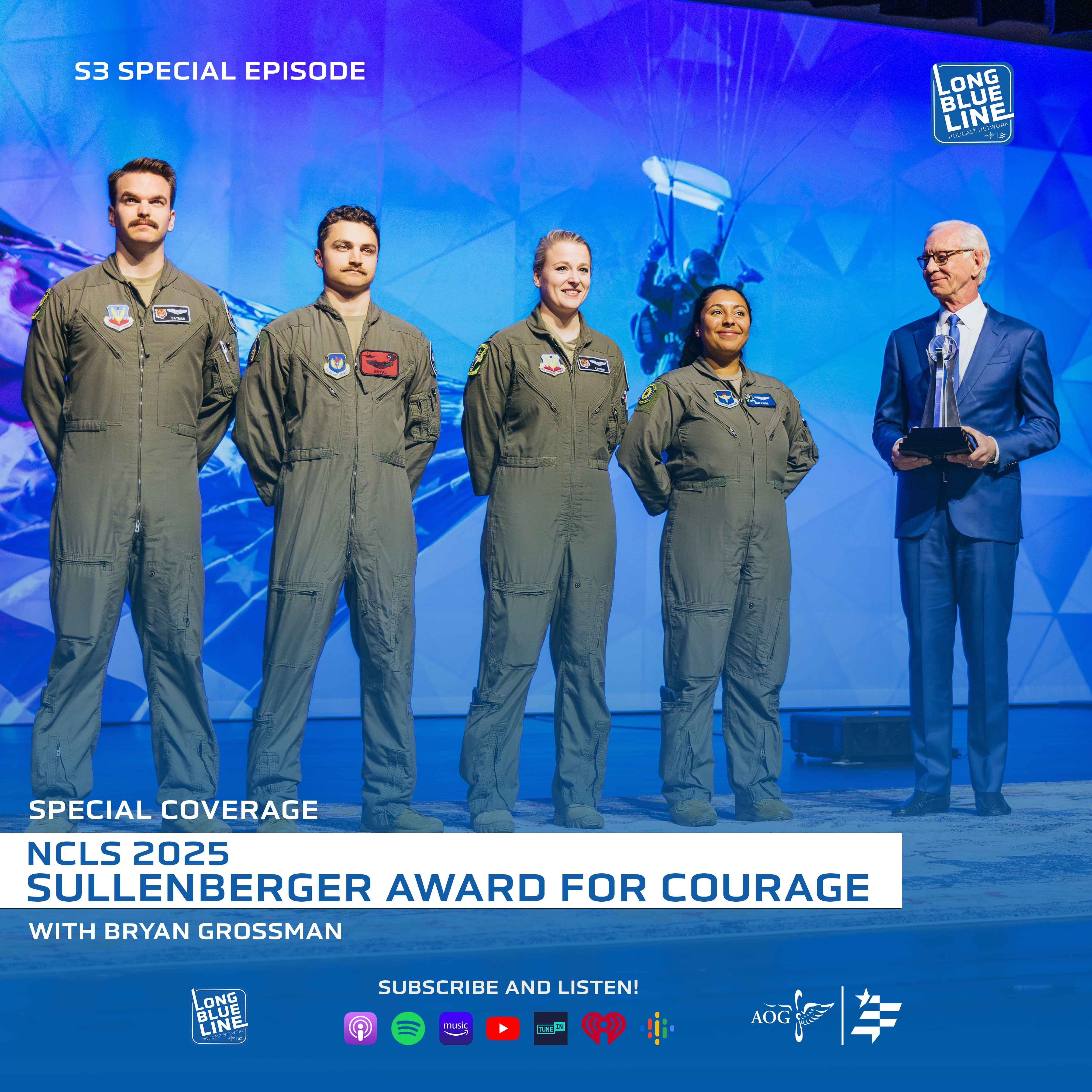
Mar 13, 2025
Mar 13, 2025
42 min
The Association of Graduates and Air Force Academy Foundation just dropped a special episode of Long Blue Leadership, featuring our continuing coverage of the 32nd National Character and Leadership Symposium.
Feb 18, 2025
Feb 18, 2025
41 min
Dr. Heather Wilson, a 1982 Air Force Academy graduate, formerly the 24th Secretary of the Air Force, and first USAFA graduate to hold the position, discusses her unexpected journey to the role, emphasizing the importance of integrity, service, and leadership.

Jan 7, 2025
Jan 7, 2025
41 min
In this episode of Long Blue Leadership, Co-Hosts Naviere Walkewicz and Wyatt Hornsby reflect on the leadership lessons shared by accomplished graduates of the U.S. Air Force Academy over the first two seasons.
SUMMARY
The hosts highlight key moments and insights from various guests, emphasizing the importance of personal connections, resilience, and the role of mentorship in leadership. They discuss the unique experiences of leaders like Coach Troy Calhoun, Brigadier General Gavin P. Marks, Nicole Malachowski, Madison Marsh, Lieutenant General BJ Schwedo, and Carl Falk, showcasing how their journeys can inspire others in their leadership paths.
SHARE THIS EPISODE
LINKEDIN | FACEBOOK
TAKEAWAYS
- Leadership is deeply personal and requires understanding your people.
- The importance of resilience and the ability to bounce back from setbacks.
- Mentorship plays a crucial role in developing future leaders.
- Building relationships is essential in leadership roles.
- Knowing your craft enhances credibility and effectiveness as a leader.
- Leadership is about doing good and positively impacting others' lives.
- Embracing vulnerability can lead to personal and professional growth.
- It's important to risk failure in pursuit of big dreams.
- Support from family and mentors can shape one's career trajectory.
- Leaders should encourage others to pursue their passions and dreams.
CHAPTERS
00:00 Celebrating Leadership Lessons from the Air Force Academy
02:11 Highlighting Coach Troy Calhoun's Leadership Philosophy
08:09 Insights from Brigadier General Gavin P. Marks
12:59 Nicole Malachowski: Overcoming Setbacks and Embracing Dreams
19:09 Madison Marsh: A Journey of Resilience and Purpose
23:27 Lessons from Lieutenant General BJ Schwedo on Future Conflict
28:23 Karl Falk: The Importance of Support and Grit in Leadership
ABOUT THE HOSTS
BIOS
LT. COL. (RET.) NAVIERE WALKEWICZ ’99
Senior Vice President, Engagement
With over two decades in leadership roles, my current focus at the Association of Graduates - U.S. Air Force Academy is fostering a robust network of 50,000+ alumni. This commitment involves igniting a culture of engagement and inclusivity, underpinned by a strong foundation in support of our Air Force Academy.
- BIO COPY CREDIT: LINKEDIN.COM
MR. WYATT HORNSBY
Senior Vice President, Marketing & Communications | Executive Editor & Writer
Wyatt Hornsby is passionate about developing marketing and communications talent and cohesive, high-performance teams. He is senior vice president of marketing and communications at the Air Force Academy Foundation and the Association of Graduates. He leads the work of the foundation and alumni association marketing and communications division, while also coordinating with various Air Force Academy offices, including Public Affairs and Strategic Communications.
- BIO COPY CREDIT: LINKEDIN.COM
ALL PAST LBL EPISODES | ALL LBLPN PRODUCTIONS
AVAILABLE ON ALL MAJOR PODCAST PLATFORMS
CONNECT WITH THE LONG BLUE LEADERSHIP PODCAST NETWORK TEAM
Send your feedback or nominate a guest at: socialmedia@usafa.org
TED ROBERTSON: Ted.Robertson@USAFA.org
Multimedia and Podcast Specialist | LBL Podcast Network Producer and Editor
RYAN HALL: Ryan.Hall@USAFA.org
Assistant Director of Multimedia Production | LBL Podcast Network Director
BRYAN GROSSMAN: Bryan.Grossman@USAFA.org
Senior Director of Strategic Communications and Publications | LBL Podcast Network Copy Editor
WYATT HORNSBY: Wyatt.Hornsby@USAFA.org
Senior Vice President, Marketing & Communications | Executive Editor & Writer | LBL Podcast Network Executive Producer
FULL TRANSCRIPT
SPEAKERS
Co-Hosts: Lt. Col. (Ret.) Naviere Walkewicz ’99 | Mr. Wyatt HornsbyGuests: Coach Troy Calhoun ’89; Brig. Gen. Gavin P. Marks ’96; Col. (Ret.) Nicole Malachowski ’96; 2nd Lt. Madison Marsh ’23; Gen. BJ Schwedo ’87; Mr. Karl Falk ’98, Mr. Ted Robertson
Naviere Walkewicz 00:20
Welcome to our Long Blue Leadership retrospective. We're celebrating our first two seasons and the countless leadership lessons shared by some of the most accomplished United States Air Force Academy graduates.
Wyatt Hornsby 00:31
Naviere, seasons 1 and 2 have showcased amazing leadership stories and takeaways. From the very start, Long Blue Leadership has given listeners an inside look at real experiences, insights and advice from seasoned leaders, as well as those just beginning their leadership journeys. These deep dives have explored how leaders not only face challenges head-on but also find ways to inspire and empower those around them.
Naviere Walkewicz 00:58
Yes, what really sets this podcast apart is the mix of our guests’ perspectives on leadership. These discussions have touched on teamwork, perseverance, humility, excellence and service before self.
Wyatt Hornsby 01:12
In this edition of Long Blue Leadership, we're sharing a few of our favorite moments. Not easy, because there are so many. Plus, we'll give you a preview of Season 3, which launches soon.
Naviere Walkewicz 01:23
And so, without further ado, Wyatt, let's get into our Long Blue Leadership podcast.
Wyatt Hornsby
Let's do it, Naviere.
Naviere Walkewicz
Some of our favorite moments. This was not easy to do at all.
Wyatt Hornsby 01:33
Indeed, it was not easy. Two seasons — and Naviere, while we're at it, I just want to congratulate you; awesome job on hosting Long Blue Leadership, and also a little plug for our friend Doug Lindsay as well for doing a great job as host.
Naviere Walkewicz 01:46
It’s been an amazing journey, and I think the biggest thing for me has been just being able to share some of the stories of our graduates. So, like we said, picking just a few of them was really hard, but it's been just a beautiful transformation of where we started and where we're going in Season 3.
Wyatt Hornsby 02:01
It's been wonderful storytelling, and I hope that our listeners have been able to take away some great actionable insights for their own leadership journeys, whether they're Academy graduates or others seeking to develop as leaders.
Naviere Walkewicz 02:13
I know I personally took some things away from all of these conversations. I think some of them we’ll highlight today.
Wyatt Hornsby 02:18
Wonderful. Let's do it. Looking forward to it.
Naviere Walkewicz 02:21
So, I think you might have the first one you wanted to highlight.
Wyatt Hornsby 02:24
So Naviere, as we said, I mean, it's so difficult to find our favorites. I mean, there are just so many across seasons 1 and 2. But I'm going to tell you, I was so struck by Coach Troy Calhoun, Class of ’89. That conversation was absolutely awesome. And a couple of things stood out to me, and we'll listen to a clip from our conversation with Coach Calhoun, but a couple things that stood out to me was, I think a lot of people, when they think about Coach Calhoun and him coming on to do a conversation, they're probably going to expect him to talk about the Xs and Os and strategy and how the Falcons are looking for the season. But in this case, what Coach Calhoun did was he came in and he talked about his own leadership journey all the way from the beginning growing up in Oregon. And I just think that throughout the conversation, we learned a lot about him as a person, his family, his formative experiences. And really what I took away from it additionally, was the unique importance of athletics at the Academy, and how Coach Calhoun and his program, like all sports at USAFA, are developing leaders of character for our Air Force and Space Force. Just an awesome conversation.
Naviere Walkewicz 03:37
It was an awesome conversation. I think it really talks about — one of the things that stood out, I think, in the clip that you picked up is really about how he views leadership and taking care of people. Let’s give it a listen.
Wyatt Hornsby
Indeed.
Troy Calhoun 03:49
You need to be doing something that you love, that you're passionate about. And the other part is, again, just the involvement that you have with your people. And, you know, to get in there, literally, where you're hip to hip and shoulder to shoulder. And I think sometimes, whether you're in a leadership role or maybe you have a certain rank, you think, “Well, I can't do that in order to maintain my distance professionally.” And I wholeheartedly disagree. I think you have to be able to operate from different perspectives as a leader. I think, clearly, you can still articulate and live the standards that are a part of your operation or your unit or your football program. But again, it's about people.
Naviere Walkewicz 04:46
Well said. It really is.
Wyatt Hornsby 04:47
Well said. Earlier in the conversation too, he had a point where he talked about three things, his philosophy of leadership. You talked to him about his philosophy of leadership. He talked about, as he said in that clip, being right there alongside your people. He talked about knowing your craft incredibly well — not just strategy, but also tactics. And as he mentioned in that clip really well, getting to know your people as humans and what makes them tick. It’s easy to, listening to that conversation, it's easy to see why Coach Calhoun has been here for such a long time and been so successful as head football coach.
Naviere Walkewicz 05:25
I think one of the lines I remember him sharing about when we talked about leadership was — I think I asked him, like, “It seems like it's really personal,” and he says, “Absolutely, leadership is personal.” It's about being… understanding who, you know, what's going on in their lives, because if you can understand what they're going through, then you can help them through some challenges and move them to, you know, whatever everyone else is working through together. And so, I really appreciated that he talks about getting to know his people on a personal level, and he challenges all of his coaches to do the same. I think there was a point where he even shared that if he knew some of the team members better than the coaches did, then that was a problem, right? And so, I think he wanted to make sure that being a good leader is knowing who your people are and what they need.
Wyatt Hornsby 06:07
That's right. It's just so instructive and inspiring to those of us who are developing as leaders. And I mean, it goes without saying, college football is changing. It's changing a lot. But I think for Coach Calhoun, he just talks about, as you said, that importance of relationships. And amid all those in college sports, staying focused on the relationship aspect, getting to know his players and his coaches, and remaining hyper-focused on that mission, developing leaders of character for the Air Force and Space Force.
Naviere Walkewicz 06:38
What was something that you took from that personally, that, you know, maybe has evolved the way that you lead or are thinking about leadership?
Wyatt Hornsby 06:46
You know, I'm developing as a leader every day. I've had some tremendous mentors in my life, but I really — I enjoyed what he talked about, about knowing your craft. I think that's really important, because I think it helps you build credibility with those that you lead. Of course, you can't know everything about everything that you lead, but knowing your craft, understanding not just the strategies and the tactics, and I think that helps you build credibility with your team and provide the right leadership to set the vision and the priorities for your team.
Naviere Walkewicz 07:21
I love that. I think what I took from that conversation was really about being humble. I mean, to be where he at is in his career, and I just felt across the table someone who was so humble in every day, learning from everyone around him and trying to really kind of give back in that way. That's something I always want to try and strive to do.
Wyatt Hornsby 07:41
I agree completely. And by the way, he talked about his younger sister, a 10-time all-American, which is pretty incredible. She's also an Academy graduate. And I think if I recall, he said that he looks up to his younger sister. So, I took that away, too. Just a humble, humble leader.
Naviere Walkewicz 07:59
I love that. Well, I'd like to go into one of my favorite moments, and it was with Brig. Gen. Gavin P. Marks, Class of ’96, the commandant of the Air Force Academy currently. And this one was special for me, Wyatt, for multiple reasons. I have two cadets, as you know, that are going through the Air Force Academy under his leadership, but he was also my basic cadet commander. So, when I was at the Academy as a four-degree, he was leading us through Basic Cadet Training. And a funny story I'll share with you: When I was later in my career as a civilian working at Offutt Air Force Base. He was the wing commander at office Air Force Base, and I was working at STRATCOM, Strategic Command. I turned around a corner, and I immediately go, “Huh, Gavin P. Marks!” and he started laughing, and he goes, “What year are you?” And I said, “’99,” and he said, “It's good that you still remember my middle initial.” But it stuck out to me and then the funny thing after that, I said, “I never knew you had so many teeth,” because he would scare us. But the reason why this podcast was so special was because I think it brought me to a new level of understanding that — in remembering that we're all human right, and so we all have things that we go through. And so, to hear him from his humble days, talking about his mom, I really just enjoyed his perspective on, you know, his career, which wasn't necessarily a trajectory that he was planning. He certainly had some goals of he would love to have been the commandant at the Academy, but it certainly, you know — it kind of moved in a way that we'll talk about in this clip. And so, I'm interested to hear your thoughts on that conversation before we jump into the clip.
Wyatt Hornsby 09:35
He has extraordinary presence — Gen. Marks does. And it came through not just in the podcast conversation. We had a reunion, several reunions, where he provided a senior leader briefing, and you can just feel that presence and that commitment and that dedication to the USAFA mission. And I'm really excited to hear this clip and then also share another thought on something from the conversation that really stuck out to me as well.
Naviere Walkewicz 10:00
All right. Well, let's roll the clip.
Brig. Gen. Marks 10:03
But as you command at higher levels, while the impact — and I probably should have said it this way: The impact that you would have on so many individual airmen's lives lessons, the impact that you can have on an individual airman's life magnifies based on rank. It is significant also, and I always — one of the things that I tell people all the time is, it's an oversimplification, but the only reason to have rank is to do good, is to do good things, to make things happen in a positive way that affect positively mission and benefit airmen's lives. That's it. That's all. And if rank becomes something different than that for you, you're in the wrong business, or we've given it to the wrong person. If I'm being honest with you.
Naviere Walkewicz 10:55
What did you think about when you heard that?
Wyatt Hornsby 10:56
I am glad that he is the commandant of cadets at the United States Air Force Academy. And I think that I would go so far as to say that what he said there probably reflects how many Air Force — probably all — Air Force Academy graduates feel about leadership, that it's an opportunity to do good for other people, to improve lives, to move people forward, to elevate performance, to lift others. So, super powerful.
Naviere Walkewicz 11:24
I think what was also really great about our conversation was how he talked about the importance of family. And I think when you — sometimes when you think about a leader that's made it to such levels in their career, you think, “Well, it's career above everything else.” But he actually talked about how there are a couple of times when he might have retired had he not had the support from his wife and from his family. And I thought that was really insightful as well, where he really consulted them on some of his biggest decisions.
Wyatt Hornsby 11:52
That's right, perhaps his closest and most valued partners in life.
Naviere Walkewicz 11:56
Yes, I think that's something that our listeners can really value. I know I took that to heart as well, because while it is important, and obviously our professional lives are such a huge part of our lives, our lives are much more holistic than that, right? I think having your networks of support and leadership are really important.
Wyatt Hornsby 12:14
I agree. And Naviere, while we're talking about Gen. Marks too, I gotta put in a plug, and I know we're not gonna listen to this clip, but he told an awesome story about a $20 bill and the Honor Code.
Naviere Walkewicz
Yes.
Wyatt Hornsby
And as I recall, he really talked about how that was one of the experiences that made him see this United States Air Force Academy — it's a unique and different kind of place.
Naviere Walkewicz 12:38
Absolutely, and so if you missed that, it's a great time for you to go back to longblueleadership.org and listen to that clip in its full entirety.
Wyatt Hornsby 12:48
That's right. Let's talk about Nicole Malachowski, Class of 1996. This conversation — it was a recent conversation that you had with her — really stood out to me on a couple of different levels. Even as a child, she set her sights on what she wanted to do in life, which was to become a fighter pilot. She was focused on that, and at the height of her career, she had a very difficult setback that she spoke I thought very openly and vulnerably about. I just really appreciated that. But in this clip that we're going to play, Naviere, and I'd love to hear your reaction before our good friend, producer Ted rolls it, I would love to just hear your thoughts about this clip and just really important advice that a mentor provided to her at a key moment.
Naviere Walkewicz 13:33
I think you teed it up perfectly. I would say, from sitting across the table, what I felt when I heard that was just a sense of pride in remembering that we all bring something to the table, and empowerment in not being afraid to go forward with it. So, let's give it a listen.
Nicole Malachowski 13:51
I remember thinking, “Thank God I didn't put myself out there. Thank God, Nicole,” you know… now I'm a 30-year-old captain, so I'm still a young person. “Thank God you didn't risk failure. Who are you to think you could be a Thunderbird? Silly girl.” Right? And in that moment, the weirdest thing happened, and I tell this story on stage sometimes. The door opened to the Officer’s Club, and in walked the wing commander, Brig. Gen. Mark Matthews. And in that moment, over walks my squadron commander, a wonderful man by the name of Dan DeBree. His call sign was “Trash.” Get it? Trash, debris. Trash walks over, super excited, very supportive of my application, and he's like, “Hey, general, did you know Nicole's applying to be a Thunderbird?” Man, I mean, you could have slowed down time. I was like, “Ix-nay on the underbird-tay,” like, “This is terrible.” Neither of these guys knew that I had removed my application, and Dan's standing there all proud. He's my squadron commander, supporting me — a great man, again. And Mark Matthews looks down at me, Gen. Matthews, and he goes, “That's great. How's your application going?” And I'm like — I looked at him, and here's what happened. I said, “You know, so it's hard to be a Thunderbird, but I probably won't get picked. They haven't had a woman, so I don't want to waste anybody's time.”
Naviere Walkewicz
Oh, you said everything.
Nicole Malachowski
I said it. I said all of it, and this is kind of an embarrassing story to tell, but I'm just, this is the truth, right? This is the vulnerable truth of how this happened. And he looked down at me, and I will never forget this, and I hope folks listening who have big dreams and gnarly goals remember this. He looked down at me and he said, “Nicole.” Actually, he said, “Fifi.” My call sign. “Fifi, nobody wants to lead a scripted life.” And he walked away and left me in extraordinarily uncomfortable silence. And those words, “…nobody wants to lead a scripted life…” have become my life's mantra. Every time I get the knot in my stomach that says that dream is too big or that idea is too innovative, don't rock the boat. I remember what he said, because those words, like, they lifted the weight of the world off my shoulders, told me it was OK to dream big. It was OK to buck the status quo. It was OK to be different. He was telling me it's OK to risk failure in pursuit of personal, professional growth. And it's not so much I think he's telling you and me to write ourselves into the script. What he was saying was, don't ever write yourself out of the script, and as leaders and teammates, don't you ever write anybody else or their wild ideas out of the script either.
Wyatt Hornsby 16:08
That is so powerful. I mean, I know that I have that inner critic, that voice that sometimes tells me, “Write yourself out of the script. You're not good enough. You're not going to make it. Why did you do that?” And probably a lot of us do. Naviere, what do you think?
Naviere Walkewicz 16:24
Oh, definitely. I mean, even up to that, she had had that voice in her head, and she shared, right before that clip, she finally got the courage to go into the group commander's office to submit that package. And, you know, the person working at the desk said, “Well, he really only has one, you know, one slot to give so we don't want to waste it on you.” And I think those very specific words make that inner voice, that inner critic, even louder and just kudos to the wing commander for really kind of right setting, I think a perspective that has clearly shaped her life.
Wyatt Hornsby 16:59
I agree completely. And we just talked about Gen. Marks and how he talked about doing good for others as a leader. And I think that's what we saw here with Gen. Matthews and the story that Nicole shared.
Naviere Walkewicz 17:11
Yes. There were so many amazing moments in her session with me, in her podcast, and so another one that I wanted to call out, because I think many may not know until they listen to her full story, but she actually battled a pretty critical, life-changing disease, and, frankly, she talked about resilience and how resilience is important, but really for her, it was about resurgence. I thought that was pretty powerful in that podcast as well. Did that kind of speak to you in any way?
Wyatt Hornsby 17:42
It really did. And I actually think it kind of goes back to “no one wants to lead a scripted life.” I don't think Nicole definitely had that in the script, her health challenge. But it came, and she spoke very honestly about it, about how difficult it was. She had some really, really difficult days, and she found a way forward. She wrote that new script for what she was going to do with the rest of her life. So, that moment really stuck out to me too. Super powerful conversation, and I got the sense too as I was listening to Nicole — and you did such a great job with that conversation — was that she knows who she is. You can tell that she has thought deeply about who she is as a person, as a leader, and she wants to go out and engage with and inspire other audiences and other leaders. So, really came out beautifully in this conversation.
Naviere Walkewicz 18:34
That was, in fact, I think one of her giving nuggets to others that were listening was really take the time to know who you are and know what you believe in, what you stand for, and then the rest kind of fills in the blanks.
Wyatt Hornsby
Well said.
Naviere Walkewicz
Well, the next one that I want to speak about is 2nd Lt. Madison Marsh, Class of ’23 and Miss America.
Wyatt Hornsby
Miss America.
Naviere Walkewicz
Miss America. Can we just say that? But what was so great about this particular podcast was, yes, she is Miss America, but we spent so much time getting to know her. And really, I think the depth of who Madison Marsh is, it really kind of blew my mind.
Wyatt Hornsby 19:11
Yes. And similar to Nicole Malachowski — Madison Marsh, she had something really difficult happen to her that she's going to go into in the clip that we talked about, and no one should have to go through what Madison did, but she found a way forward. And I think just her story is remarkably inspiring.
Naviere Walkewicz 19:33
I actually don't want to give it away. I think we should just roll the clip.
Wyatt Hornsby 19:35
Let's do it.
Madison Marsh 19:36
I basically printed out all of my essays that I knew that people had to submit in the past for the Academy. I did resumes. I came with my GPA, everything, and I walked right up to my congressman and I handed it to him, and I said, “I want to go to the Air Force Academy, and I want to be your nominee.” And I'm sure he was like, who's…
Naviere Walkewicz
…I love every bit of this…
Madison Marsh
So, I was very firm early on, and so we were able to start an incredible relationship with one another. And so, because I did that — I think that was maybe my junior year, early on in my junior year — when it came time my senior year, he fought for me all of the time to get my application in front of people, because I was his principal nominee, and we had a very, very special moment. So, he called me on Oct. 31 and told me that I had gotten early acceptance to the Academy, and so I got to tell my mom, and the next morning she passed away. So having an experience like that is — that's why the Academy and Congressman Womack are so special to me, because that was my dream for years, and my mom got to know before she passed away. And it's just everything happens at the right timing, and you never know until afterwards. And so, now I get to be here; now I get to wear the uniform. And even though she hasn't gotten to see it, she got to know about it. And it just because of those first instances where I marched up to him and I said, like, I want to be here. I got to have experiences like that. And now I get to have wonderful experiences of now serving post-Academy life.
Naviere Walkewicz 21:04
I mean, I think that clip still gives me feelings of in that moment where she shared that because I had known that her mom had passed away. But I think what was so powerful about her sharing that story was in the bit of, you know, believing in yourself, going full for something, and then having someone believe in you and champion you to the point where, when you actually get there, and having her mom spend that with her before she passed. I just — that moment was something really special.
Wyatt Hornsby 21:34
It really is powerful. It must have been an honor and a privilege to have been able to share that moment with Lt. Marsh.
Naviere Walkewicz 21:41
It really was, and I think her whole conversation — what really inspired me, first, the fact that she actually started a foundation in her mom's name, the Whitney Marsh Foundation, but also more so that it actually shaped how she was as a cadet. She talked about, when she had the opportunity to champion others, so, you know, as she progressed in her cadet years, she wanted to make sure that other cadets had someone that they could talk to, so that she would be a voice for them, that she would hear them, and she would see them. And I think that was really powerful, because sometimes she was saying how she had felt lost and how she didn't have that support. And so, she turned it around and made sure that she was that person for someone else.
Wyatt Hornsby 22:19
Another example, Naviere, of someone who uses leadership opportunities to do good for others.
Naviere Walkewicz 22:25
Absolutely. And I thought, what was also fascinating, as such a young officer, she also — to Nicole Malachowski’s point — took some time to know herself because she had been groomed, or maybe not groomed is not the right word, but she had, since early times of wanting to go to the Academy, had thought, I'm going to be a pilot and had been working towards her hours and her private pilot's license to get to the point where she could go to pilot training and become a pilot. And said, “Maybe this, this isn't my trajectory,” and looking into policy and so I think to the point of knowing who you are and knowing what you know you're really passionate about. Also, to what Coach Troy Calhoun said, they all kind of weave together. I thought that was really powerful.
Wyatt Hornsby 23:06
Agree. I thought it was very powerful too. And I'm really excited — I'm sure you are too, and a lot of graduates — just to see what she does with her life. I think that she's going to do some great work, and I think we're going to continue to hear about the amazing work that Madison Marsh is pushing forward, whether it's with cancer research and treatments or some other very, very important, worthy cause.
Naviere Walkewicz 23:29
Absolutely. No doubt about that.
Wyatt Hornsby 23:32
All right. Naviere, this next one, this was early Season 1, and our friend Dr. Doug Lindsay hosted this conversation. Doug is Class of 1992. It really stood out to me, and it was a conversation with Lt. Gen. (Ret.) B.J. Shwedo, Class of ’87. Remarkable conversation with the director of the USAFA Institute for Future Conflict about the role that graduates are going to continue to play in our nation's security.
Naviere Walkewicz 23:59
I agree. Gen. Shwedo is such a dynamic speaker, and every time I have a chance to hear from him, I learn something new. But maybe for the sake of our listeners, in case they haven't heard that one yet, can you talk about what the IFC is?
Wyatt Hornsby 24:10
The IFC is the Institute for Future Conflict. So, it stood up a couple of years ago at the United States Air Force Academy. And really the goal is to inculcate across the Academy — and I'm not going to do this justice the way Gen. Shwedo can — but to inculcate across the Academy a focus on preparing cadets for what they will be facing amid Great Power Competition and for them to be able to bring that holistic thinking and that multi-domain thinking to how to fight and win the nation's wars if they are called upon.
Naviere Walkewicz 24:45
It's pretty incredible, some of the things that our cadets are exposed to. I remember when I was a cadet, I couldn't imagine have been briefed by some of our combatant commanders and having top-secret clearance levels to understand, really, what the adversary looks like and what we're up against. But they're looking at it across all different domains, and it's preparing our soon-to-be graduates for what's up for them right after.
Wyatt Hornsby 25:11
That’s right. And one thing I'll mention before we roll the clip: Like you Naviere, I've heard Gen. Shwedo talk. In fact, we've been in probably many of the same talks, and graduates respond so well to what he shares, and I think it just instills even more confidence in the mission and the priorities of the Air Force Academy. So, without further ado, what do you say we roll that clip?
Naviere Walkewicz
Let's roll the clip.
Gen. Shwedo 25:34
What we got to do is make them aware of the environment we're dumping them in. And case in point, I have one cadet he raises his hand like, you know, “Hypersonic missiles — I don't understand what's the big deal about that.” And I go, “OK, well, first of all, yes, they're fast, but as you remember from Physics 110, a ballistic missile trajectory is all mathematics. That's how the Patriot works. Hypersonic missiles can maneuver. So, all your math is now dead,” and go, “Oh, by the way, when you look down the range and you see all those antennas, NORAD, for the most part, was looking up to the north, because the quickest way to get an ICBM to the United States was over the top. You can actually take a hypersonic missile, put it in a low-Earth orbit, and that attack will come out of Antarctica.” Same cadet immediately raises his hand and goes, “So the maneuvering, is that RF, command guy?” and he's immediately trying to get into it. And I'm like, “I love you, man.” Because honestly, when you start making them aware of the threats, they immediately start thinking countermeasures. So, from the leadership standpoint, they understand that piece.
Naviere Walkewicz 26:44
Yes, I think that is huge. And it really talks about understanding what you're up against. I think what I really loved about what Gen. Shwedo said, was having the awareness allowed for them to start thinking about countermeasures. And I think that really does translate to leadership. When you have awareness of things, you can make better decisions. You can think about how you take care of your people better. It just actually translates across so many levels of leadership. What do you think?
Wyatt Hornsby 27:09
I agree completely, and I think too, just spending time with cadets — you would know better than I Naviere, you have two up on the Hill right now — but so curious, so curious. And they're here for a reason. They had choices in where they could have pursued what they wanted to do after high school, and they chose the United States Air Force Academy because they want to serve our country and, if called upon, fight and win those nation’s wars. And so, just kudos to the work not only Gen. Shwedo is doing, but the cadets too, who are just so curious and so responsive to that awareness and really thinking deeply and preparing themselves for what the world is confronting the United States and our allies with.
Naviere Walkewicz 27:53
Absolutely. I think, what I really appreciate about Gen. Shwedo as well is he's another graduate that's giving back to our Academy, right? He's facilitating all of these lessons. He's helping to really promote how we can do this better. But it goes to show how our graduates are really involved with our Air Force Academy.
Wyatt Hornsby 28:12
A lifetime of service. I think that's what Gen. Shwedo would say. He came back because he wanted to continue to serve.
Naviere Walkewicz 28:18
Yes, absolutely. Well, the last moment that we'll talk about — and again, this was so hard, because there were so many good ones — comes from Karl Falk, Class of ’98 the CEO of Botdoc. And this one was special for me, not only because we were at the Academy together, but I didn't know him then, and I know him now as a parent of also a cadet at the Academy. And his story was so, so incredible. Because when you think of a CEO of anything, you think, “Wow, this person's so accomplished. They've done all of these things.” And, you know, they must be doing great, and he is, but it started from humble beginnings. And when you take the time to listen to his podcast, it will really kind of help you see that you can start from anywhere and achieve anything, just as he did. This particular clip I have picked for us to listen to, though, is about kind of having people in your corner, and when people recognize in you, maybe before you do, how they can champion you. Let's give it a listen.
Karl Falk 29:20
You know, being in Texas, there's more spotlight on football, and I had some very good coaches. My head football coach in high school, Coach Bubba Fife — everyone in Katie knows Bubba Fife — and even to this day, he's still involved in the in the school district. But he was a big advocate for me, with coaches that came by, and there's some stuff I didn't find out until out until later in life where, you know, back then, it wasn't common for the school to provide shoes and, you know, some guys had their own pads and stuff like that. And I remember my mom years later telling me that actually Coach Fife came to her with money and said, “This is, uh — get him some shoes.” Sorry. That got to me a little bit more than I thought it was gonna be. So, I guess what I can say is, there's been a lot of people, I'm where I'm today because of a lot of people throughout my entire life, and I have a lot to be grateful for. But I was very fortunate to have those coaches in my life because — there was actually a time, this is actually a crazy story. There was a time where — so, I was the big, fat tuba player too. So, I kind of did everything because I enjoyed it, but there was a point where I kind of had to make a decision, because I was actually the guy that was playing football, and then, you know, marching band and football, and that's really tough to do. And I had made up in my mind that I was going to quit football, and because, you know, I didn't have a dad around, and my mom wasn't really into sports, like, I am and my kids are now. And I made up my mind, so I went to talk to one of the coaches, Coach Schubert, and, and I told him, I said, “I'm gonna quit football and, you know, I'm gonna be in the band.” And, and he looks at me, he goes, “No!”
Naviere Walkewicz 31:22
Right there. Sometimes the best answer you can get from a boss or a mentor or anybody is, “no.” What do you think, Wyatt?
Wyatt Hornsby 31:29
And by the way, Naviere, I'm trying to figure out the logistics. How do you play football and participate in the band? I played football in high school. I just don't know how you do that.
Naviere Walkewicz 31:40
You probably didn't change your clothes. You probably wore your uniform, though.
Wyatt Hornsby 31:43
Oh my gosh, like, I don't even know how you do that. But no, this was an extraordinary conversation. And you know, one of the things I like about the conversations that you've led and hosted, Naviere, is really going back to the beginning. And my takeaway from that conversation with Karl and that clip that we just played: He's never forgotten where he came from. As you said, he's become very successful in life. He's done well for himself, but he's never forgotten where he came from and who helped him along the way. Sometimes, Naviere, it just takes a pair of shoes.
Naviere Walkewicz 32:19
Oh gosh, that conversation was like I was getting to know someone all over again, because I got to know him as a parent of a fellow cadet. Him and his sons, Alec and Arden, were cadets there at the Prep School, now in the Class of ’27, but seeing him through his own eyes, it just opened up a whole new experience for me. And I think one of the things I appreciated about his conversation as well was he talked about some of the tough times in getting to be successful. And while, yes, he had those people in his corner that helped him get there, there were times when — I think he even said, you know, “I didn't pay myself, like we might have missed a meal so that my folks could eat,” when he was still building his business. And I think it talks about the grit and kind of hard work and perseverance it takes to become successful. So, while he never forgot where he came from, he also talked about kind of the path to get there, and just the resilience and all of that in that. And I thought that was a really powerful story he shared.
Wyatt Hornsby 33:13
Agree, and I would suspect that grit and that perseverance, those were formed early in life, but then also really developed when he was here at the Academy. What do you think?
Naviere Walkewicz 33:26
Agree. And I think, and we talked about the lifetime of service that our graduates live. His company has actually given back to the Class of ’27 through various ways. And so, I think it really does kind of show how, you know, you never forget where you come from, and then when you can, you give in ways that are meaningful. I think that's really powerful too.
Wyatt Hornsby 33:44
That's right. Well, Naviere, that was an awesome conversation. I just so enjoyed revisiting those conversations, and again, just mad congratulations to you, and thanks to you and Doug for just doing such a great job. I mean, this was tough, choosing the conversations that we just talked about, because there are just so many great ones, so many great ones. And I hope that our listeners will go back and listen to those conversations from seasons 1 and 2. But while they're at it, also tell others about Long Blue Leadership. Help spread the word, because these conversations are really impactful.
Naviere Walkewicz 34:20
Absolutely, and we can really use feedback coming directly to us at socialmedia@usafa.org. That's a way they can directly let us know what they enjoyed, what we can do better and what they can look forward to in Season 3.
Wyatt Hornsby 34:32
That’s right. I mean, the podcast space, it's competitive, and there are a lot of great podcast shows out there, and so we know we just have to continue to raise that bar and elevate what we're doing. So, our listener feedback is so important and just continuous improvement and excellence in all we do.
Naviere Walkewicz 34:49
Absolutely. Well, thanks. Wyatt. Well, before we share what's coming up in Season 3, we'd like to take a moment and thank you for listening to Long Blue Leadership. The podcast publishes Tuesdays in both video and audio and is available on all your favorite podcast platforms. Watch or listen to all episodes of Long Blue Leadership at longblueleadership.org.
Wyatt Hornsby 35:11
Naviere, this was a real pleasure. I really enjoyed talking about these awesome episodes from seasons 1 and 2. And while we're at it, let's also thank our good friend Ted, who's done just remarkable work in helping to produce this show. And our listeners may not get to hear much from Ted, but he is behind the scenes doing awesome work on the show.
Naviere Walkewicz 35:32
He really is. Ted makes us look great, and when you say congratulations to me, it's only because Ted has been right alongside me all this way, and Doug, and anyone else that's been part of this podcast. It really has been us working with Ted.
Wyatt Hornsby 35:46
So, Ted, I'm going to put you on the spot. Share with us a little bit about maybe a couple of your takeaways from seasons 1 and 2, and what this process, what this experience has been like for you.
Ted Robertson 35:59
I can think about the first day I walked in the door, had my first eyes on the studio, and I'm thinking,
“We're gonna have some fun here. We're gonna touch some lives, and we're gonna do some great things.” And it's been a real privilege to be a part of the communications team. And I talk a lot about the people that I work with, but Naviere, you've become a partner, and together, along with everybody else on the team, we're looking forward to bringing some more of these moments to our listeners and just sharing what leadership is all about. And we want to make it global. So, Season 3 coming and lots of great things to come in Season 3. I hope that sort of answers your question. The highlights for me are working with all of you.
Naviere Walkewicz 36:50
Aww, thanks, Ted. And speaking of what Ted was talking about, Season 3 is coming up. Should we share some of the amazing guests we're gonna have on the podcast?
Wyatt Hornsby 36:59
I think we should, Naviere, I mean, I am like you. I am so excited about Season 3. We've got some amazing names and Naviere. One of our guests is going to be Dr. Heather Wilson, Class of ’82, 24th secretary of the Air Force. And she's also currently the president of the University of Texas, El Paso. So cannot wait to have the secretary — I don't know whether to call her Secretary Wilson or Dr. Wilson.
Naviere Walkewicz 37:23
I’m sure I'm going to find out, because I'm so excited to have that conversation with her as well.
Wyatt Hornsby 37:27
Likewise, and Naviere, I think also, we have a classmate who we’re going to be talking to?
Naviere Walkewicz 37:31
Oh, we have a couple of classmates, actually. So, one of them, Joel Neeb goes by call-sign “Thor,” — Class of ’99, Gold Will Shine — who has been a tremendously successful fighter pilot. He's authored some books, a former CEO, but he dealt with some very specific, I think, health challenges that shaped a new trajectory for him. And I'm not going to give it away. I think that's what they'll learn about in the podcast.
Wyatt Hornsby 37:56
I've had a couple of opportunities to spend time with Thor, and I'm excited about this one too. I think it's going to be an awesome conversation.
Naviere Walkewicz 38:03
Yes. And his is one where it really is about family too. I think we're going to hear some of that. And then my other classmate is with the FBI, so Mark McCulloch, Class of ’99, and I think you've actually done a story on him recently on your team.
Wyatt Hornsby 38:17
I think we did a story on him in Checkpoints a couple of years ago, written by Jeff Holmquist. Yeah, I can't wait for this one too.
Naviere Walkewicz 38:26
It's amazing what Class of ’99 is doing, but there's others. Who else shall we highlight today, Wyatt?
Naviere Walkewicz 38:43
We also have some young alumni, current board directors that will be speaking to. One of them is a Young Alumni Excellence Award winner, Emma Przybyslawski, Class of 2010.
Wyatt Hornsby 38:51
Can't wait to hear that one. And Emma — so she recently, as you said, received the Young Alumni Excellence Award. And I thought I knew Emma, and I learned a few things about her in our profile of her. So, that's going to be an awesome conversation.
Naviere Walkewicz 39:06
Can’t wait to speak with her. And then Joe Bledsoe, class president for the Class of 2011, but also working with Gen. Shwedo right now.
Wyatt Hornsby 39:13
That's right. He's a fellow up in the Institute for Future Conflict. And again, just a remarkable graduate, a fighter pilot, really looking forward to that conversation. end of year. One other that I'm really excited about, Matt Kuta, Class of 2005 co-founder of Voyager Space and a former fighter pilot, really looking forward to that conversation as well.
Naviere Walkewicz 39:36
We have so many amazing grads to share stories with, and we could go down the list, but I think that's a good one just to, you know, whet the appetite. What do you think?
Wyatt Hornsby 39:44
I agree completely. I'm just excited about Season 3 and we'll get this going.
Naviere Walkewicz 39:49
Absolutely. Wyatt, this has been a blast. Thank you so much for joining me today.
Wyatt Hornsby 39:53
And thank you for inviting me, Naviere. This was a lot of fun.
Naviere Walkewicz 39:57
Absolutely, and we thank you for joining us as well. We can't wait to share our third season of Long Blue Leadershipbeginning this February. You can expect more compelling stories from outstanding USAFA graduates, each sharing unique perspectives and practical advice on overcoming challenges and inspiring others. With a mix of thought-provoking conversations and real-life experiences, Season 3 promises to engage, inspire and empower both seasoned and aspiring leaders alike. Visit longblueleadership.org for more episodes and to subscribe. Also, nominate a guest or send us your feedback at socialmedia@usafa.org, and finally, Long Blue Leadership is available on all of your favorite podcast apps. We can't wait to see you there.
KEYWORDS
leadership lessons, season highlights, guest perspectives, teamwork, perseverance, humility, service, season three preview, Gavin Marks, Commandant of Cadets, Nicole Malachowski, Thunderbird pilot, tick born illness, Lyme Disease, Coach Calhoun, Falcons Football, Madison Marsh, Miss America, Karl Falk, Bot Doc, B.J. Schwedo, Institute for Future Conflict, leadership journey, character development, personal growth, mentorship, resilience, future conflict
The Long Blue Line Podcast Network is presented by the U.S. Air Force Academy Association and Foundation

Dec 10, 2024
Dec 10, 2024
45 min
In Episode 10 of Long Blue Leadership, Lt. Gen. (Ret.) Burt Field ’79, now president and CEO of the Air & Space Forces Association, discusses his leadership philosophy, and emphasizes the importance of continuous learning, effective communication, family, and the five core values by which he lives. Listen now!
SUMMARY
Burt Field, a retired Lieutenant General and CEO of the Air and Space Forces Association, discussed his career and leadership philosophy. He highlighted his upbringing as an Air Force brat, his academic journey at the Air Force Academy, and his early leadership roles. Field emphasized the importance of continuous learning, effective communication, and avoiding being an "asshole" in leadership. He shared impactful experiences, such as leading during the 2011 Japan earthquake and tsunami, and the significance of family support. Field also discussed the Air and Space Forces Association's efforts in advocacy, education, and family resilience, stressing the need for strong national security and defense.
LEADERSHIP BITES
Values-Driven Leadership: Burt shared his 5 core leadership values - integrity, fortitude, excellence, teamwork, and service. Defining your values and using them to guide your decisions and actions is crucial.
Continuous Learning: Burt emphasized that as a leader, you can never stop learning, whether it's about your organization, industry, or even topics outside your expertise. Staying curious and open to growth is key.
Empowering Others: Burt stressed that a leader's job is to empower and inspire their team, not try to do everything themselves. Recognizing and rewarding excellence in others is vital.
Effective Communication: Burt noted that leaders can never communicate too much or well enough. Repeatedly delivering clear, consistent messages is essential for alignment and buy-in.
Humility and Inclusivity: True leadership requires humility, giving credit to others, and making the organization successful.
SHARE THIS EPISODE
LINKEDIN | FACEBOOK
TAKEAWAYS
Never stop learning. As a leader, you must continuously learn and expand your knowledge, even in areas outside your expertise.
Define your leadership philosophy and values. Burt shared his 5 core values of integrity, fortitude, excellence, teamwork, and service. Having a clear set of guiding principles is crucial.
Recognize and reward excellence. Identify and empower those who have put in the hard work to become experts in their fields. This builds a strong, capable team.
Communicate effectively, repeatedly. Effective communication is critical, but leaders often underestimate how many times a message needs to be delivered clearly.
Burt emphasized the importance of being inclusive, giving credit, and making the organization successful rather than yourself. Avoid toxic, self-serving leadership.
CHAPTERS
00:00 Introduction to General Burt Field
01:52 Growing Up as an Air Force Brat
05:40 Choosing the Air Force Academy
10:26 Life as a Cadet at the Academy
19:09 Leadership Development During Cadet Years
23:15 The Integration of Women at the Academy
24:12 Influential Leaders in General Field's Career
28:28 Learning from Subordinates
34:15 Career Path and Leadership Philosophy
37:54 A Chance Encounter: Love and Military Life
41:13 Building Resilient Families in the Military
42:12 The Journey to Leadership: From Air Force to AFA
45:57 Empowering the Next Generation: Education and STEM
49:46 Leadership Lessons: Insights from Experience
5 FRANK KEYS TO LEADERSHIP SUCCESS
"You can never stop learning. You have to learn. And whether it's leadership or anything else, you have to always learn."
"Everything comes from your values. When I make leadership decisions, or when I look at how we're going to move forward, or what, how we're going to accomplish the mission, it should reflect those values in my decisions, how I act, how I from the biggest thing of creating a here's the strategy, or in objectives on on what we're going to accomplish, to the smallest things, like how I conduct a meeting."
"If you want to be a really good leader, you need to be really good at something. So you got to put in the work when you're young to be really good and understand how hard it is to be really good at something."
"You cannot communicate enough, and you cannot communicate well enough. So I use this example all the time. I come up with a message. I craft it, I think about it, I write it down, I practice it, and then I deliver it, and it's awesome. I was perfect. I nobody could have misunderstood me when I'm done with that, and I really think that I have hit the mark with maybe 20% I probably got to say that again, that way or differently, about another 10 or 15 times when I can barely stand to hear myself talk anymore, and I'm still not going to get everybody."
"I'm going to give the credit and I'm going to take the blame. That's how you become a good leader."
- Lt. Gen. (Ret.) Burt Field ’79, October 2024
ABOUT GEN. FIELD
BIO
Lt. Gen. Burt Field, USAF (Ret.), is President and Chief Executive Officer of the Air & Space Forces Association, leading the Association’s professional staff in its mission to advocate, educate, and support the Air & Space Forces. As CEO, he oversees operations and resourcing for AFA and its 113,000 members, including events, publications, and the Mitchell Institue for Aerospace Studies, the nation’s only think tank dedicated to air and space power.
A veteran of 35 years of Air Force service, Field retired from active duty in 2015 following his final tour, as Deputy Chief of Staff for Operations, Plans, and Requirements. Throughout his career, Field commanded a squadron, the Air Force Weapons School, three wings, a numbered Air Force, and a sub-unified command. A command pilot with over 3,400 flying hours in the F-16 and F-22, he served twice on the Joint Staff and completed a tour in the State Department as the military assistant to Ambassador Richard Holbrooke, the Special Representative for Afghanistan and Pakistan. In his last assignment, he led policy and requirements decision-making for air, space, irregular warfare, counter-proliferation, homeland security, and cyber operations. Prior to that assignment, he served as the Commander of United States Forces, Japan, and Commander of 5th Air Force from 2010-2012 where he led the U.S. military response to support Japan during the earthquake, tsunami, and nuclear disaster of 2011.
Following his retirement, he served as the Vice President of Strategic Planning for Lockheed Martin Aeronautics, developing strategies that guided and contributed to over $5 billion in growth in a five-year period. He also managed a $500 million New Business Funds portfolio for independent research and development. Since 2020, he has been an independent defense consultant, served as a subject matter expert working with and mentoring Airmen at all levels, and a member of the Board of Trustees for the U.S. Air Force Academy Falcon Foundation.
Field graduated from the Air Force Academy in 1979 and earned a master’s degree in business administration from Golden Gate University in San Francisco. He and his wife, Lisa, have two sons, both officers in the USAF.
- Bio image and copy credit: AFA.org
CONNECT WITH GEN. FIELD
LINKEDIN | FACEBOOK | AIR & SPACE FORCES ASSOCIATION
ABOUT LONG BLUE LEADERSHIP
Long Blue Leadership drops every two weeks on Tuesdays and is available on Apple Podcasts, TuneIn + Alexa, Spotify and all your favorite podcast platforms. Search @AirForceGrads on your favorite social channels for Long Blue Leadership news and updates!
TRANSCRIPT
SPEAKERS
GUEST: Lt. Gen. (Ret.) Burt Field ’79 | Host: Lt. Col. (Ret.) Naviere Walkewicz ’99
Naviere Walkewicz 00:00
My guest today is Lt. Gen. (Ret.) Burt Field USAFA Class of ’79, president and CEO of the Air & Space Forces Association. He spent 35 years in the Air Force, retiring in 2015 as deputy chief of staff for operations, plans and requirements. Gen. Field has held many positions of leadership throughout his career, including squadron command, the Air Force Weapons School and three wings. He has served as a command pilot with over 3,400 hours in the F-16 and F-22. He completed a tour in the State Department as the military assistant to Ambassador Richard Holbrooke. He has also served as the commander of United States Forces, Japan, and commander of the 5th Air Force from 2010 to 2012. In his post military career, he served as vice president of strategic planning for Lockheed Martin Aeronautics. He has been an independent defense consultant and has served as a subject matter expert, working with and mentoring airmen. He is also a member of the board of trustees for the United States Air Force Academy Falcon Foundation. Today, we'll talk with Gen. Field about his life before, during and after the Academy. We'll discuss his role in leading the Air & Space Forces Association. And finally, we'll ask the general to share advice in leadership development. Gen. Field, welcome to Long Blue Leadership.
Burt Field 01:23
Thank you, Naviere. Please call me Burt.
Naviere Walkewicz 01:24
OK, yes, sir, Burt. Will do. And I will say that was quite an introduction. You have had an incredible and ongoing career.
Burt Field 01:30
Well, frankly, and no false modesty, I was lucky to be in the right place at the right time and take advantage of the opportunities presented to me.
Naviere Walkewicz 01:39
Well, I appreciate you saying that, and I think our listeners are really going to enjoy hearing about what some of those right places at the right time kind of look like. But here's what we do at Long Blue Leadership: We like to rewind the clock a little bit and start with Burt as a child. What were you like growing up? Where was home?
Burt Field 01:56
Well, I'm an Air Force brat. My dad was a fighter pilot. I like to say his first assignment was the Korean War, flying F-86s and his last flight was in an F-4 over Hanoi. Now, didn't get shot down, but that was his last flight. So, I grew up traveling around both country and the world and went to a bunch of different elementary schools and then three high schools before I ended up at the Air Force Academy.
Naviere Walkewicz 02:27
Wow. I can imagine some of our listeners have also been some kind of service brat. As I always say, I was an Air Force brat as well. Are you an only child? Do you have siblings?
Burt Field 02:37
I have three sisters. I have one older sister and two younger sisters, which irritated me to no end when I was a kid, but now we couldn't be closer.
Naviere Walkewicz 02:49
So did you get special benefits because you were the only boy of all the girls?
Burt Field 02:53
Of course not. Now, their stories are a little different, but of course not.
Naviere Walkewicz 02:57
Understood. And did they also serve as well.
Burt Field 03:01
They did not. None of them did. My older sister’s a doctor. My next down is an accountant and CFO, and the one below that is a bunch of different medical community things and a nutritionist.
Naviere Walkewicz 03:15
Wow. So, you are the one who followed in the military family footsteps.
Burt Field 03:18
I was, but interestingly enough, I never really thought about it growing up. My dad just happened to be in the Air Force. He just happened to fly airplanes. And you know, whoever you were, your dad was a doctor, lawyer, plumber, dentist, truck driver, whatever, and now let's go play ball. And that's pretty much the extent of it. But when I was in high school, I knew that I needed to start figuring out what I was going to do, because I'm pretty sure my dad wasn't going to let me just lay around the house after I graduated. And I was definitely afraid of being bored, and nothing really sounded good — doctor, lawyer, dentist, plumber, truck driver — none of it was good. So, I came into the house one day in my junior year, and I attribute this to the Air Force Association: The magazine was laying on our coffee table, and it was face down, and on the back was a picture of the F-15, which was one of the brand new airplanes that was coming out. And I looked down at it, and for whatever reason, it clicked, and I said, “That does not look boring.” And I went and talked to my dad, because I figured he might know how to do this. So, he did some research for me, and he said, “Well, to go to pilot training…" And this was 1974 and that's the wind down of the Vietnam War and letting a lot of people out of the Air Force, “…to go to pilot training, you have to be an Air Force Academy graduate, or distinguished graduate from ROTC.” Well, my dad had retired, or was about to retire, and we were going to move to Florida for my senior year, and I was going to go to the University of Florida, like everybody in my family did, except for two, and so I knew that the Air Force Academy would provide me an avenue, and the University of Florida would provide me an avenue to be a bellboy down in a Key West hotel when I graduated.
Naviere Walkewicz 05:18
So you chose the Air Force Academy, of course. So, that's interesting. Forty-five years later, you are now the president and CEO of the Air & Space Forces Association, which was what kind of caught your eye in high school.
Burt Field 05:34
It's really kind of amazing. And the editor of the magazine — they have a bunch of back issues at our headquarters building, and he found that magazine.
Naviere Walkewicz 05:47
Oh my goodness, I hope that's framed in your office now.
Burt Field
It is.
Naviere Walkewicz
Oh, that's amazing. What a story. And we're going to talk more about that. I really want to hear more about that role, but let's stay in the childhood range a little bit. So you were going to go to the Air Force Academy. Were you already involved in sports? Was that something—
Burt Field 06:06
Yeah, so, I played baseball growing up. We moved around a lot, so it was hard to play a lot of other sports. I did Pop Warner football, played basketball, you know, on teams growing up. And I was a good athlete but not a great athlete, and so I wasn't recruited for going to come here to the Academy. But I played football, I wrestled and played baseball until my sophomore year, when I blew up my shoulder and couldn't throw anymore. Then I just wrestled and played football for the rest of my high school career, and then when I came here, I just played intramurals until a friend of mine that was a couple years older was on the rugby team, and so he kind of said, “Hey, come on out, you'll like this.” And so it was the rugby club back then, and it was a way to get out of stuff in the afternoons when you're a freshman. So I came down and I played on the rugby team for a few years.
Naviere Walkewicz 07:10
I have a lot of rugby friends, and it definitely is, it's a family, for sure.
Burt Field 07:15
It is. And it was really that way back then. It was all local Colorado sports teams. You know, the guys who were 45 and over down to other colleges around the state.
Naviere Walkewicz 07:28
Your extended family.
Burt Field
Right.
Naviere Walkewicz
So, speaking of family, how did your — I think I know how your dad felt about you wanting to come to the Air Force Academy. How about your mom?
Burt Field 07:37
She was pretty proud of me. Both of them were mad because I only applied to one place.
Naviere Walkewicz 07:44
So, it was here or a bellboy.
Burt Field 07:48
It was here or a bellboy somewhere. But they were pretty proud of me, and they were really proud, obviously, when I graduated.
Naviere Walkewicz
So, you came into the Academy. You had a little bit of an idea of what to expect, because your dad had been the military, right?
Burt Field 10:06
Well, no, nobody is prepared for the Academy.
Naviere Walkewicz
That’s true.
Burt Field
I mean, your dad went to the Academy and…
Naviere Walkewicz
They were classmates.
Burt Field
And you were not prepared.
Naviere Walkewicz
That's true.
Burt Field
Because you are immediately thrown into the deep end of a very cold, murky pool and told to start swimming. But the interesting thing: I came out with a few guys from my local area, and the way we did it back then is, you told the Academy what hotel you were gonna stay at, and they came and picked you up in a bus and they drove you onto the Academy and dropped you off at the base of the ramp, and you jumped off the bus, and all your newfound friends started telling you all the things that were wrong with you personally, with your family, your genetics, your upbringing, and how you would never amount to anything ever in your entire life. And then they take you — I wasn't really good with authoritarian figures.
Naviere Walkewicz 11:10
Well, I can imagine, with three sisters, you probably chose your own path, right?
Burt Field 11:15
So, you can imagine — as we're most of my classmates. We all are kind of like that. So, I wasn't sure that this was for me, but it was 1975 and everybody had long hair. So as soon as I got my head shaved, I said, “Well, I'm staying here at least until I get my hair back.”
Naviere Walkewicz 11:37
That was a good thing then.
Burt Field 11:39
That kept me here. And so then I kept staying. But that first day was a bit of a shock, as it is with everybody around here. But, I have a great memory. I was standing in line getting something issued to me, and the guy behind me and I started talking, and he actually graduated from the high school that I spent my ninth and 10th grade in in Las Vegas, Nevada. His name's John Pickitt. And so we became friends, and he's the godfather of our oldest child, along with Tom McCarthy, who you met earlier today.
Naviere Walkewicz 12:16
Wow. I mean, it really is… We talk about family a lot in our podcast, and family spans way beyond blood.
Burt Field 12:26
Yep, it sure does, especially with graduates of the Air Force Academy.
Naviere Walkewicz 12:31
Yes, 100%. Wow. So you jumped into that murky pool and making friends along the way. What was life like for you as a cadet? Were you really strong in your academics? I mean, obviously you were an athlete, because you were doing everything.
Burt Field 12:45
I mean, everybody did that kind of stuff. So, I got good grades in high school, and I got good grades here, except for one semester. So, I was on the supt’s list every semester except for one. That's just the way it was.
Naviere Walkewicz
That's amazing.
Burt Field
I would do it different now, if I had it to do over again, because I got on the dean's list by cramming instead of doing my homework. And so every young person that goes to the Air Force Academy, I tell them, “There's one way to success and happiness at the Air Force Academy…” I don't tell them this, not that they're going to be happy, because they're not. But I tell them, “Do your homework every night.”
Naviere Walkewicz 13:32
That’s right. I think there was a saying: “If you wait to the last minute, it only takes a minute, but then you get to see…
Burt Field
You really reap the results.
Naviere Walkewicz 13:42
Exactly, exactly.
Burt Field
So, that's no different than a lot of my friends. And back then, you’re pretty restricted to the Academy, especially your first year, and then gradually you get out more and more. So, it wasn't like we were out and about very much.
Naviere Walkewicz
Right.
Burt Field
We stayed around here. We worked out a lot. We played games, sports on the weekends, and that was it.
Naviere Walkewicz 14:07
And were you 1 and 3? What was the squadron change like? Was it 2 and 2 back then?
Burt Field 14:13
And so 1 and 3. So, I was in 35 as of Doolie, and the only squadron— 35 and 38, they're still together, but it was carpeted, and we had carpeting, and so we took a lot of heat from people just because of that.
Naviere Walkewicz
Because you had it nicer?
Burt Field
Yeah, then I went into 27 and graduated from 27.
Naviere Walkewicz 14:38
OK, and your son is also a graduate from your legacy squadron, 27.
Burt Field 14:42
He is. He graduated in 2008.
Naviere Walkewicz 14:43
Love that legacy. Great. What a wonderful legacy. So your cadet time sounds like it was pretty pleasant, or…
Burt Field 14:50
Oh yes, just like everybody's. Everybody leaves here with a love-hate relationship with the Air Force Academy and it changes over time from mostly hate to mostly love. So, that was no different with us. I had a group of great friends, both in my squadron and outside my squadron, from the rugby team and a couple other places. And so it was like — I tell everybody, 13th, 14th, 15th and 16th grade.
Naviere Walkewicz 15:24
I love that. That's a great way to put that into an analogy, yes, because you're still developing.
Burt Field 15:31
Classes, you know, five or six classes a day. I play sports after school. I go home and do homework or avoid homework and go to bed so I can't go out during the weeknights. Can't go out very often on the weekends. And, there you go.
Naviere Walkewicz 15:45
That's right. That's very much like high school, absolutely. So we like to talk about how you developed as a leader, even early on. And so we're getting to know you a little bit better. While you were cadet, did you hold any leadership positions in particular?
Burt Field 16:02
Well, I was the — what did I do? I did something as a third-classman. Oh yeah, chief of training? Or whatever.
Naviere Walkewicz 16:11
Sounds like it could be accurate.
Burt Field 16:12
Back in the day, the the guy that was in charge of training for the freshman. I was an ops officer when I was the, I mean, op sergeant when I was a junior, squadron commander when I was a senior. So nothing hugely out of the ordinary. I like that kind of role and that kind of challenge, but I wanted to stay inside my squadron. So, when I got offered a chance to, “Hey, do you want to be on a group staff or wing staff?” I declined.
Naviere Walkewicz
Tell me more. Why?
Burt Field
Because my brothers were my squadron.
Naviere Walkewicz
OK, I love that, yes.
Burt Field
So, I didn't want to leave that for six months or four months, or whatever the time period was back then.
Naviere Walkewicz 17:05
So, leadership in your squadron, and this is interesting, and this is a good topic, because some of our listeners, some of the challenges that they experience in leadership is on a peer level, or maybe, you know, how do you lead someone that you're really close with? How do you earn that trust? So maybe you can share some lessons that you have learned about yourself during that time.
Burt Field 17:24
Well, I always tell people that the hardest leadership challenge that we face is when you have no authority and you still need to lead, and regardless of what we say about cadet squadron commanders, you know, we can all think we're in charge, but we're not that in charge. And so what you had to do is you had to lead by influence and by doing the right thing. And so whether we agree with that, it's the right thing, because I don't want to do it, because it's no fun, because I'd rather do something else. Everybody knows what you have to do at the Air Force Academy on Monday, Tuesday, Wednesday, on the way through the week. And so we just went and did it. And I encouraged people to come and do it all with me, whether it's doing drill, whether it's playing intramural sports, whether, “Hey, it's your turn to be the referee for this season,” whether we want to go to these whatever it was. So you just encourage people to do that, and then you talk to people and try to empower them so that they can figure that out on their own, and then later pass that on as leaders themselves.
Naviere Walkewicz 18:44
No, those are really great examples. And I think just leadership tidbits that some of our listeners can take, and it really is some of the best ways, just leading by example and then inviting them to join you on that, absolutely. OK, so your cadet career was, I think, really important to you, because it formed you, and it formed you like you said your brothers, because you were the last class of all men cadets together. So how did that translate? And if I may be so bold, you started having women cadets there while you're at the Academy as well. Can you share some of the dynamics of that then at the Academy, and maybe some of the stories that you saw of how that really evolved into a stronger Academy that we have today?
Burt Field 19:26
Yeah, let me put some of this in perspective, and I'll start with a story. I get a large ration of crap from my friends that are in ’80 and ’81 that I'm really close with because of my role in terrorizing the women of the Class of ’80, which I said, “Exactly, what role was that?” Basically, these guys considered us the source of all evil. My perspective was different, and it's just my perspective. When I talked to my classmates, most of them — I'm talking about most of them, not all of them — we were children that grew up and came of age in the late ’60s and early ’70s, which was basically that whole protest movement, grow your hair long, protest the Vietnam War, and we really didn't care that much that women were coming into the Air Force Academy, because most of us were smart enough to know that the only reason that women were not in my class and they were in that class was an accident of birth and the accident of when the legislation passed to do the right thing in the United States of America. So there's nothing special about being the last all-male class. There's nothing special about being the first class that had women in it, other than, you know, it was the end of one way of doing business and the beginning of another way of doing business. To your point, I think it makes the Air Force stronger. It certainly makes our Academy better. While they were here, the first semester, all the women were in one part of the state, in one part of the Academy over in Fairchild Hall. And they were only in 20 squadrons, so 1 through 20.
Naviere Walkewicz
In Vandenberg?
Burt Field
In Vandenberg, I'm sorry. So we're they were only in 1 through 20 the first semester, for whatever reason. Then they came the next semester to our squadron, and you know, well, one of them I'm still friends with, so, to me, it was a no brainer. I wish I was more profound on this. This is one of the things that my friends from later classes yell at me about. But I didn't consider it to be that big of a deal. I didn't, at the time, think that this is some big historical event and change in the Air Force or the military, or anything else that we could all maybe talk about better today than I could back then. So for me and my friends that I knew, it was not an issue. I don't think I treated women any different than I treated men, and I don't think I treated women or men badly, regardless of my role and their role at the Academy.
Naviere Walkewicz
I really appreciate that perspective.
Burt Field
Yeah, so, you know, bluntly, most of us just didn't care.
Naviere Walkewicz 22:50
You were there just trying to get through the Academy, right?
Burt Field 22:53
That sounds terrible, but, I mean, I didn't spend a lot of time thinking about social implications of race, sex, gender, however you want to put it. I was just trying to get through the day without getting yelled at, like everybody else.
Naviere Walkewicz 23:12
Thank you for sharing that, because I think it's sometimes a question that people have, and it's really helpful to hear a perspective that really is, “We're all just trying to get through the Air Force Academy, we all come in, and we hope that we all graduate.”
Burt Field 23:23
Yeah, and some of them, very impressive, had huge careers. You know, Susan Helms, just one of my heroes, frankly, as a person, as an officer, that have nothing to do with her role in space. That just makes me more in awe of her. But, you know, there's a lot of great, great people out there, and a lot of them are women.
Naviere Walkewicz 23:49
Yes, thank you. Thank you for sharing that, and I appreciate that you said that. You know, Gen. Holmes is one of your heroes as well. Let's talk about some of those that maybe inspired you in leadership roles. It could be while you're a cadet, or maybe early in your career as an officer after you graduated. Maybe talk about some of those influencers.
Burt Field 24:09
Well, I had some great AOCs. My freshman AOC was a guy that was a Fast FAC in Vietnam, and actually was the guy that gave me a ride in a T-37, which was fantastic and really solidified what I wanted to do. My sophomore and junior year, my AOC was not that guy.
Naviere Walkewicz
We learned from those leaders too.
Burt Field
We'll probably talk about leadership philosophy later, and if you'll remind me, my last bullet on my leadership philosophy partly came from him. And then my senior year, we had a great guy named Ken Lawrence that came in that several of us are still in touch with. And he was both a welcome relief and a great role model for us as we spent that last year here at the Academy, before we went off. I went out in the Air Force and my first two squadron commanders, the first one was a guy named Tiny West, 6-foot-5, 270 pounds, barely fit into an F-16, and taught me how to fly fighters.
Naviere Walkewicz 25:21
I totally understand his call sign then.
Burt Field 25:24
Just a great guy. A second squadron commander was a guy named John Jumper, who ended up being the chief of staff of the Air Force and is still kind of like a second father to me.
Naviere Walkewicz
Oh, wow.
Burt Field
Let's see. And then multiple people along the way that you know, from crusty old majors and young captains that taught me how to fly the F-16 and in what we called RTU at the time, now, FTU in how we kind of learn together. Because when my class showed up at Hill in the B course, we went into the 34th at the time, tactical training fighter squadron. We were their first class, and the high-time guy in that squadron with F-16 time had 30 hours. So they were teaching all of us second lieutenants how to do this. Went from there down to Nellis and served under Tiny and John Jumper. So, that was how I started. And there's lots of great people in that time frame that obviously I'm still in touch with, and taught us how to fly. There's my squadron commander in Korea, which was my second assignment, another great role model. And then just on and on. When I came back to Nellis on my third assignment, I worked for a guy named Sandy Sandstrom. Sandy was one of my RTU instructors, also, and we became really lifelong friends. And he and his wife, Jeannie, have sadly passed away, but we, Lisa and I keep in touch with both their children to this day. Yeah. But anyway, there's a lot of great leaders, both above us in squadron commander roles, and then you watch your fellow officers and brothers and sisters, and see and you learn stuff, watching them, how they develop relationships, how they train, how they identify what's important, how they communicate, how they focus, how they connect. All of those things are important, and you can learn something from everybody around you. And if you don't, you're probably missing out.
Naviere Walkewicz 27:48
I appreciate that perspective. I think, especially as someone who is more experienced in leadership, the fact that you are looking to continue to learn and see what you can kind of pick up from those even that support you and serve under you. Can you share an example? Is there one that sticks out in your memory of someone that you're like, “Wow, that's something I really took back”?
Burt Field 28:08
Are you talking about somebody that served under me?
Naviere Walkewicz
Mmm-hmm
Burt Field
Oh, yeah, so, there's thousands of these. I'll tell you two stories. So I'm a squander commander, and I had a friend, a very close friend of mine, who was a squadron commander, and one of his guys was coming to our squadron, and he said, “This is a great guy. You're going to love him. Really good pilot…,” blah, blah, blah. It's his second assignment. And so he shows up in the squadron and we have about four or five guys about that that time in their career, and they're ready to become flight leads, which is leading flights in the fighter community. And so I put him in without really thinking this through, and one of the other guys came up and said, “Hey, I need to talk to you.” And he came in my office, and he explained to me how I wasn't looking at everybody through the same lens and was probably missing some of the things other people were seeing. And I mean, pretty blunt, pretty focused, not yelling, and just a straightforward conversation. And I sat back and thought for about five seconds, and I said, “Holy cow, Bruce Fisher is totally correct. I have missed the boat on this, and I'm never going to do that again.”
Naviere Walkewicz
Wow.
Burt Field
And so that was one guy. The second example I have is in Japan when I was a 3-star general. I was there during the earthquake, tsunami and nuclear disaster, and it was a wild time. It started on a Friday. On Monday, so Friday was the earthquake and the tsunami. Saturday was the first explosion in one of the nuclear reactors. Monday was the second explosion in another nuclear reactor. On Monday, I also went up with the Japanese minister of defense and the head of their military to a place up near the epicenter, or the center of where the disaster area was, and they stood up, for the first time, a joint task force in Japan to take to take on the role of trying to work through all the things they had to work through. So we tried to land at the airport and could not. We tried to land at one of the air bases and barely could in a helicopter, in a helicopter. So I flew over Sendai Airport, where we couldn't land, and it was totally flooded, and it looked like when you tell your 5-year-old son to pick up his room and he shoves everything over into the corner, so there's trucks and cars and toys and giraffes and boxes over in the corner of the room and he says, “I'm good.” That is exactly what this airport looked like, except those were real cars, those were real cranes, those were real age equipment that was working on airlines, all swept away into the corner. So came back, and that night, met a guy named Rob Toth. Now we were getting a lot of people in to help, and Rob Toth had actually, he was the commander of the special ops group that was down at Kadena that we had brought up to Yakota. And he said to me, “Sir, my name is Rob Toth.” He's a colonel. And he said, “My guys have been up to Sendai, and I think we can open Sendai in about two weeks.” And I looked at Rob, and I said, “Rob, no way,” except I added a word in between “no” and “way.” And he said, “Sir, I know how you feel, like, I knew you'd feel like that, but just listen to me.” And I said, “No, that thing's not gonna be open until the summer.” And he said, “Sir, hold on. Let me tell you something.” Blah, blah, blah, blah, blah. And I'm starting listening to him, I'm thinking, “OK, here's a special ops guy telling me how his experts think that they can go up and solve an enormous problem for us. They know how to do this. And I am telling him no, because I flew over it in a helicopter and it was flooded. Why don't you just ignore your opinion and say yes to a good idea?” Because all I have to do is say yes, and the worst that can happen is I'm going to be right. The best that can happen is he's going to be right and they're going to open the airport. Well, guess who was right? Not me.
Naviere Walkewicz
He was right. Oh, wow.
Burt Field
So, three weeks later, the first airplane, well, two weeks, a week later, the first airplane landed on it, and three weeks later, the first commercial airplane landed there.
Naviere Walkewicz
Wow.
Burt Field
Just say yes to good ideas.
Naviere Walkewicz 33:14
I think that's a leadership nugget right there.
Burt Field 33:16
And it's all from somebody that, you know, he had never met me before. I'm a 3-star general. He's a colonel. Took a lot of courage to tell me that, and keep persisting when I said, “Forget it,” because I was busy and didn't believe it, and I had just been there, so if you're not listening to people, you're probably not gonna make the best decisions.
Naviere Walkewicz 33:38
That’s an incredible story. Thank you for sharing that.
Burt Field
You bet.
Naviere Walkewicz
Oh, that's fantastic. So, your career was outstanding. I mean, I think you had the opportunity to really lead and impact a lot of lives by the time you put on your third star. Had you known that was your destiny? When you graduate the Academy you want to be pilot. We knew you went into the Academy to fly.
Burt Field 34:01
To fly fighters.
Naviere Walkewicz
To fly fighters.
Burt Field
Actually, to fly F-15s.
Naviere Walkewicz 34:07
OK, OK, so very specific.
Burt Field 34:08
Yeah. So I ended up going to third lieutenant to Langley Air Force Base. And I kind of, I was fortunate enough, because I traded with a guy that was from California. I was going to George. He was from California. He had the Langley slot, so we switched, and I went out there because I wanted to fly in an F-15 to make sure I liked it, because it was after sophomore year, before junior year. And I knew that I wasn't all that fired up about the Air Force Academy at the time. It was not the most fun place I'd ever been. And so I wanted to ensure that this was something I really wanted to do. Fortunately, I went to a great squadron, great people. They welcomed us with open arms, and I flew three or four times, five times during that third lieutenant and just loved every second of it. Now, of course, I didn't fly the F-15, except in the back seat a couple times later on. But I was lucky enough to get an F-16 out of pilot training. So 1980, F-16, go through that RTU with those guys, and we're all learning this together and into a squadron where we're all learning this together. Cool part about the first squadron I was in is we had… there was a squadron, which means that we had 25 people in the squadron. So squadron commander, an ops officer, and 23 other folks. And when I went in there, 12 of us were lieutenants and classmates.
Naviere Walkewicz
Oh, my goodness.
Burt Field
And so it was really cool to go through that experience with people like that. But it's 1980, the Cold War is in full swing. We're pretty sure that we're going to be in a fight with the Soviet Union, and basically I didn't want to die in that fight. And so I figure what you need to do to not die is be the best there is. And I was went to work with a bunch of other guys that felt the same way, and so we helped each other. We competed with each other. We pulled people along. We got pulled along. And we all became really good at what we did. And it was just that drive to be really good at what was important — which was flying — that drove me, and that's what drove me to try to go to the Weapons School. That's what drove me to go back as an instructor. That's what drove me to train people to be the best that they could be, so that when we went to combat, we would all come back, because anybody can lead men and women into combat. I want people that lead them home.
Naviere Walkewicz
I'm so glad that—
Burt Field
Anyway, so that's what drove me. That's what drove me. You know, because I had friends that didn't come home.
Naviere Walkewicz 37:27
So part of what you've shared with us today, and I think we're really appreciative of how much you're sharing, because I think it gives us a sense of really who you are, and the family aspect with your brothers, the family aspect with your extended family at the Academy, on your teams. When did your family come into play? Because I had the opportunity to meet your wife, Lisa, and she's lovely. When did she come into your life?
Burt Field 37:54
Well, I like to tell everybody that I met her at a bachelor party, which I did. But, we were in pilot training at Willie Air Force Base in Phoenix, and somebody was getting married, and we're going to have a bachelor party, but it already required way too much planning, and somebody had to host it, and that meant somebody had to go buy stuff for it. And basically we just went down to where we went every Friday night, and that was the bachelor party. And I met her that night, and then we just started talking on the phone, and we started dating, and then we got married. And so we got married in 1981 and she's still putting up with me.
Naviere Walkewicz 38:48
Wow. She’s literally been part of your life since the Academy.
Burt Field 38:53
Oh, yeah, so I married her a year and a half after I graduated, and so we have two sons, and both of those boys are in the military. My oldest son is a University of Florida grad.
Naviere Walkewicz 39:06
So he did follow the family footsteps.
Burt Field 39:09
But he's smart. He graduated with a high GPA, and anyway, he's a maintenance officer in the Air Force. And my youngest son is a C-130 pilot in the Air Force, and he's the 2008 grad from the Academy, and he's married to our daughter-in-law, Natasha. And right now, both David and Natasha fly C-130s for the Alaska Air Guard up in Anchorage in Elmendorf.
Naviere Walkewicz 39:36
That’s amazing.
Burt Field
So, it’s the family business.
Naviere Walkewicz
So, dad, you and your son?
Burt Field 39:39
Not only that, well, one of the reasons, when we bring up Lisa, when I met her, she said, we started talking, and I have short hair, because most people, have long hair. She goes, “Obviously, you're in the Air Force.” And she had told that to her roommate, and I said, “Yeah.” And she said, “Oh, my dad was in the Air Force.” And we said, “Where'd you all live, and what'd your dad do?” Well, her and my dad flew together and so stationed in the same places, sometimes at the same time. And when we went home and called our parents and said, “Hey, do you know this guy or this guy?” Without hesitation, both of them said, “Oh yeah, I know Dave.” “I know Burt,” and so they were in the other squadron. They didn't really hang out together, but they knew each other. So both my dad and my father-in-law were F-100 pilots and fighter pilots. And so Lisa is also an Air Force brat. So both of us are — we call ourselves nomads because we've never really lived anywhere longer than five years.
Naviere Walkewicz 40:44
I used to say that, and now I actually can. But can you claim anywhere longer than five years now?
Burt Field 40:52
No, getting close though. So I've been in five years, five years in a couple places, but never longer.
Naviere Walkewicz 40:58
Oh my goodness, what an incredible story.
Burt Field 41:00
Yeah. So anyway, this is one of the things we're doing in AFA now. And I think the Air Force is Air Force and Space Force are recognizing that if you want strong and resilient airmen and guardians, you need strong and resilient families behind them. And you need to have that kind of family dynamic that's supportive of what you do with your life and what the country is asking of you and your family to be all in and if we can work with the families to change that dynamic, to make sure that we're focused on building strong and resilient families, then the strong and resilient guardian and airmen will come out of that effort. So both the Air Force and the Air & Space Forces Association, that's part of what we're doing these days.
Naviere Walkewicz
Before I get into the last couple of questions I want to ask you, what is the best way that anyone that's listening can learn more about the Air & Space Forces Association?
Burt Field
Well, we can go to afa.org, simple as that, and do that. That shows you how to contact us. For another thing, you can join, which is what I would like you to do, and become a member, and then you get access to all of that information. And you can find out how to do that again, on that website. But joining gives you access to that information. It gives you access to what we do. It tells you where the chapters are that are close to you, that are similar-minded people doing similar things. And we have about 120,000 members right now. We have about 230 chapters in every state except Maine, and in several foreign countries where we have airmen and guardians stationed. Those chapters can do a lot of this work, whether it's working with your local government officials, with your state officials, like your congressmen or your senators, and it arms you with the things that you can deliver these messages with. It also arms you with how can I get access to these kind of programs that help with my family, my friends’ family, the people I work with, their family. Where can I direct an airman when she needs some help? Where can I put a guardian in touch with somebody that can help him get through something that he's got a problem with? So, you have a lot of resources at your disposal that can help both you and your brothers and sisters you work with
Naviere Walkewicz
That is outstanding. So I mentioned two questions. I'll start with the first and then we'll come back after a short break. The first one is, some of our listeners aspire, at some point to be a C-suite executive. What's the coolest thing that you've done, or that's happened for you since being CEO?
Burt Field
Oh, man, that's a hard question.
Naviere Walkewicz
Well, take a minute to think about that. But first we're going to take a moment and thank you for listening to Long Blue Leadership. The podcast publishes Tuesdays in both video and audio, and is available on all your favorite podcast platforms. Watch or listen to all episodes of Long Blue Leadership at longblueleadership.org. So have you had a chance to think about something cool that's happened since you’ve been CEO?
Burt Field
I would say that the coolest thing about this job is that you get some pretty good access. Because of what we try to do in support of the Space Force and the Air Force, I've been able to spend some time with the chief, the CSO and the secretary. And you know, the vice chief, the vice CSO, chief master sergeant of the Air Force, chief master sergeant the Space Force. So that part has been really interesting to me. Next week, I'm going to something with Secretary Austin, and so that that's kind of interesting. And then we do some work up on the Hill. And so I've been able to go up there and meet a few of the members up at the Hill. The good news, though, is that I knew a lot of those guys already, so, you know, because I'm old and. But it's still good to be able to listen directly from a leader on what he or she really is trying to communicate, as opposed to get it interpreted by somebody else or through some rumor or, “Here's why their vision doesn't match up with what I know we should be doing.” So, it helps us in our mission to kind of advocate for those strong forces when you know exactly what the leadership is thinking and what they're driving at.
Naviere Walkewicz
No, that's powerful, and that's transparency that you're able to bring to the members of your organization and all of their families. So, we like to leave our listeners with kind of leadership lessons, and I wanted to go back earlier in our conversation. You said, “Remind me to tell you about a leader that's shaped one of my bullets, maybe on how not to lead.” Or something to that effect. So what are your lessons of leadership that you want our leaders to take away today from you?
Burt Field
Well, so first off, you can never stop learning. You have to learn. And whether it's leadership or anything else— when I was in Japan during that disaster, I didn't know the first thing about nuclear power plants. Virtually nothing. I knew that there's some kind of nuclear reaction. They put something in water. It made steam power to turbine. Viola, you have electricity, period. There's a chance I might not even know that. So, I found a couple books that in the three or four hours a day that I didn't have work, I read so I could learn about nuclear power plants, the effect of nuclear radiation on the human body. What we can with withstand, what makes you sick and what kills you. So you have to always learn. And that goes double for being a leader, and you can never rest on your laurels. And so, I have been fortunate to be in a lot of different leadership positions and work for a lot of great leaders, most of them military, but some of them civilian as well, like Richard Holbrooke, a completely different leadership style than most military people. In fact, when I was working for Richard, my direct report was the chairman of the joint chiefs of staff, Mike Mullen. And I talked with Adm. Mullen virtually daily, and my other virtual three-times-a-week conversation was with Dave Petraeus, who was running Afghanistan at the time, because of what a Richard's job was and they always want to know what he was thinking. So, it was interesting to watch all three of those who have three distinct leadership styles and learn from take the best from all of that. It was a learning experience. But the upshot of it is, having been exposed to people like that and being able to ask them questions about leadership, why they did things, helped shape my leadership philosophy. So, one of the things that I think everybody should do is kind of define what they think leadership is and have a leadership philosophy. And so, the way I look at leadership, it's, how how do you empower people? How do you inspire people? How do you get people to get the job done? Because you can't do it yourself. You're not going to win the war, you're not going to make all the sales, you're not going to get all the gross profit, you're not going to reduce all the expenses, you're not going to fight all the fights. You're going to be part of a team if you're going to be successful. So, how do you inspire that to happen? And how do you ensure that that team that you're building has the resources that they need? And resources come in all shapes and sizes. Some of it is equipment, some of it is money, some of it is the people that are in those roles? Do they have the education, the training, the experience and access to what they need to be successful? So that's what your job is, in my opinion, as a leader. And then how you go about doing that? You need to have a list of things that you do. So I start with values. You should have a set of values. For the cadets listening, and you're going to go into the Air Force, the Space Force, and if you cross commission into something else, every one of our services has a set of values, which are your values. Now you can have more, but your values include those. But at my stage of life, I have about five, and it's integrity, which everybody knows, and most people say, “Hey, that's when you do the right thing when no one is looking.” In the last four or five years, I added a second one to that, and I call it “fortitude.” Fortitude is when you do the right thing when everybody is looking. Then excellence. You know, from Excellence in All You Do. Teamwork and service. So those are my five values. And so when I make leadership decisions, or when I look at how we're going to move forward, or how we're going to accomplish the mission, it should reflect those values in my decisions, how I act, how I from the biggest thing of creating a here's the strategy, or in objectives on what we're going to accomplish, to the smallest things, like how I conduct a meeting. So, that that's the second thing. So everything comes from that. I think you need to be really good at something. If you want to be a really good leader, you need to be really good at something. So, you got to put in the work when you're young to be really good and understand how hard it is to be really good at something. Normally, when we “grow up,” in quotes, and become leaders of large organizations, there's a whole bunch going on in that organization that you will have little or no expertise in, but you know how to recognize excellence, and you know how to recognize effort that it takes to become excellent. And so you can look for those because you've seen it in yourself. So, that's the other thing. The next one is communication. You cannot communicate enough, and you cannot communicate well enough. So I use this example all the time. I come up with a message, I craft it, I think about it, I write it down, I practice it, and then I deliver it, and it's awesome. I was perfect. Nobody could have misunderstood me. When I'm done with that, and I really think that I have hit the mark with maybe 20%. I probably got to say that again that way or differently, about another 10 or 15 times when I can barely stand to hear myself talk anymore, and I'm still not going to get everybody. So, one of the things that you have to recognize as a leader is you're probably miscommunicating. So, you have to check and recheck to make sure that the message is going out the way you think it should be heard. So, communication is really important, and probably one of the biggest things that infects an organization is somebody misperceiving what somebody else is communicating, and then they get mad, and everybody's feelings get hurt, and on it goes. And we've all seen that. I told you about the “say yes to good ideas.”
Naviere Walkewicz
That was fantastic. Burt, is there anything that I didn't ask you that you would really like to leave with our listeners today?
Burt Field
I think we pretty much covered it, and I appreciate the opportunity to come on and chat with you and watch your act, because you're very comfortable doing this, and I need to take some lessons from you.
Naviere Walkewicz
Thank you so much for that compliment. And I must just say it has been a pleasure being on Long Blue Leadershipwith you. I can't wait for our listeners to hear more about your story and the way that you will, I think, affect great change for our Air and Space Force leaders.
Burt Field
Thank you, Naviere, it's really an honor to be on here and I appreciate the opportunity to share some of the lessons that I've been able to learn throughout my career, and also what the Air & Space Forces Association brings to the table, and why our cadets and our grads and all those out there who care about strong Air Forces, strong Space Forces, a strong national security and defense in the future.
Naviere Walkewicz
Thank you so much.
KEYWORDS
Air Force brat, leadership philosophy, Air Force Academy, rugby team, squadron commander, family dynamics, career progression, leadership challenges, communication importance, resilience, Space Force, education programs, family support, military service, leadership lessons
Long Blue Leadership is a production of the Long Blue Line Podcast Network and presented by the United States Air Force Academy Association of Graduates and Foundation
Nov 26, 2024
Nov 26, 2024
40 min
Col. (Ret.) Nicole Malachowski ’96 shares her insights on leadership, resilience, resurgence, perseverance, advocacy, and how she continues to serve her country, even after her military career.

Nov 12, 2024
Nov 12, 2024
1 hr 6 min
In this episode of the Long Blue Leadership Podcast, Cadet First Class Andrew Cormier opens up about his inspiring journey from growing up in Massachusetts to becoming a squadron commander at the U.S. Air Force Academy. He reflects on the early influences that shaped his values, the value of community service and service before self, sharing the leadership lessons he’s learned along the way.
SUMMARY
Andrew also talks about launching his own podcast, designed to help fellow cadets explore their career paths and grow as leaders. Throughout the conversation, he highlights the importance of understanding diverse career opportunities, the personal growth that comes from podcasting, and the power of community engagement. With a focus on national pride and perspective, he emphasizes that true leadership is about serving others—putting the team first rather than seeking personal recognition.
5 QUOTES
"It's not about you. It's not about you. It's about the team."
"When you're a leader, it's your job. There shouldn't be any extra, you know, kudos given to you. Everyone has their own piece in the puzzle, and just because your face is more prominent than others does not mean that the mission is any less doable with like one piece missing or another piece missing."
"I just really urge people to try to understand other people's perspectives and listen more than they talk, because those pieces for me, like I'm a Pretty staunch capitalist, but I recently bought the Communist Manifesto. I want to understand where these ideas stem from."
"American ideals are amazing, and they need to be protected. And in order for me to have any say in that, I need to have skin in the game. And that's what I look at my service as is me gaining skin in the game."
"It's not difficult, it's just super time consuming and kind of annoying. And so, I mean, it even like stays true to today, everything I have to do isn't necessarily difficult. I'm a management major. I don't know what the Astro or aero people are going through. I'm sure that's very difficult. But for me, it's more just like getting the reps in it, and it's very gradual."
- C1C Andrew Cormier ’25, October 2024
SHARE THIS EPISODE
LINKEDIN | TWITTER | FACEBOOK
CHAPTERS
00:00: Introduction to Cadet Andrew Cormier
02:52: Andrew's Early Life and Background
05:52: Discovering the Military Path
08:46: Community Service and Humanitarian Efforts
12:10: Transitioning to the Air Force Academy
15:07: Experiences in Basic Training
17:57: Leadership and Followership at the Academy
20:47: Becoming a Squadron Commander
24:11: The Role of a Squadron Commander
27:12: Starting the Podcast Journey
34:54: Understanding Career Paths in the Air Force
39:30: The Impact of Podcasting on Personal Growth
44:45: Engagement and Value in the Cadet Community
52:36: Navigating Post-Graduation Decisions
01:00:05: The Importance of National Pride and Perspective
01:04:53: Leadership Lessons: It's Not About You
ANDREW'S 5 KEYS TO LEADERSHIP SUCCESS
Leadership is not about you, it's about the team. As a leader, your job is to represent and protect your people, not focus on personal privileges.
Seek to understand different perspectives and listen more than you talk. Don't take American ideals and freedoms for granted - they need to be actively defended.
Balance future planning with living in the present. Don't become overly fixated on the future at the expense of enjoying the moment.
Perseverance, critical thinking, and resourcefulness are key to success. Rely on these core strengths rather than trying to control everything.
Diverse experiences and mentorship are invaluable. Seek out advice from those who have walked the path you want to follow, and be open to learning from a variety of backgrounds.
ABOUT ANDREW
BIO
C1C Andrew D. Cormier is a cadet at the U.S. Air Force Academy (USAFA) in Colorado Springs, CO. Cadet Cormier is the commander of squadron 15, the Mighty War Eagles. C1C Cormier is originally from Fitchburg, MA and entered the Air Force Academy in June of 2021 following his lifelong passion to “serve others.” Throughout his cadet career he has held the squadron position of Diversity & Inclusion NCO and Spark Innovator, but on an unofficial level has hosted the “For the Zoomies” podcast interviewing over 75 officers to better understand their experiences in the Air Force for the sake of helping cadets make career decisions, as well as been a widely trusted barber in the dormitories. C1C Cormier plans to complete his Bachelor of Science in Business Management in May 2025. Immediately following graduation he intends to commission as a Second Leiutenant in the U.S. Air Force and become an Acquisitions Officer.
- Copy and Image Credit: Andrew Cormier
CONNECT WITH ANDREW
LINKEDIN | INSTAGRAM | TWITTER
RECOMMENDED LISTENING: FOR THE ZOOMIES PODCASTwith C1C Andrew Cormier
LISTEN NOW!
ABOUT LONG BLUE LEADERSHIP
Long Blue Leadership drops every two weeks on Tuesdays and is available on Apple Podcasts, TuneIn + Alexa, Spotify and all your favorite podcast platforms. Search @AirForceGrads on your favorite social channels for Long Blue Leadership news and updates!
FULL TRANSCRIPT
SPEAKERS
GUEST: C1C Andrew Cormier | HOST: Lt. Col. (Ret.) Naviere Walkewicz ’99
Naviere Walkewicz 00:00
My guest today is Cadet 1st Class Andrew Cormier, USAFA Class of ’25. Andrew stands out among the finest examples of those who have taken the service-before-self aspect of their work as developing leaders very seriously. In Andrew's case, he helps and supports his fellow cadets by guiding them to their optimal career paths through the guests and their experiences on his podcast. This is a new approach for Long Blue Leadership, and one we think you'll appreciate, because we're looking at leadership through the eyes of one who both follows and leads, thriving in both spaces. We'll talk with Andrew about his life before and during his time at the Academy. We'll ask where he's headed when he graduates. We'll discuss the role he's taken on as a podcaster, and we'll ask how he's successfully led and followed. We'll end with Andrew's takeaways and leadership tips. Andrew, welcome to Long Blue Leadership. We're so glad you're here.
Andrew Cormier
Thanks for having me, Naviere.
Naviere Walkewicz
Absolutely. So it's got to be a little bit different being on the other side of the podcast mic.
Andrew Cormier
Yeah, no, it's definitely interesting to be here. I've done a few before, but they weren't in person, and this was like the highest quality, so I have a little bit of imposter syndrome, not gonna lie.
Naviere Walkewicz
Oh goodness. Well, we'll learn from each other, right? I think that's the best. We can always be learning; we can always get better. So, I'm excited to take in some of the things that you do as well. Feel really good about that. Well, one of the things we like to do on Long Blue Leadership is we rewind the clock a little bit. Some clocks are further rewound back than others, and so I'm really excited to kind of get to know. Where were you before the Academy? Where'd you grow up? What was life like?
Andrew Cormier
OK, I'm not as chronologically advanced, like, relative to maybe my experience in high school. I grew up in Fitchburg, Massachusetts, lot of pride coming from the East Coast. My parents, my dad, he worked as a general contractor, so I spent a lot of summers laying tile, you know, doing framing houses, all that sort of stuff, just like, you know, a general laborer. Honestly, just like sweeping up a lot of dust and mess, as he actually did all the hard work. And then I went to a tech school, Montachusett Regional Vocational Technical High School. That's a mouthful, but I went there mostly because my brother went there. I wasn't a huge decision maker back then, like I consider myself somewhat now. And I studied machine technology, and working on metal pieces like running lathes and mill machines and electronic discharge machines, just to — I didn't really know what preparing for the future was like, but that was the kind of path I was on. But then, I grew up playing hockey and lacrosse, and I realized that I had an opportunity with that somewhat, and I was traveling the East Coast playing lacrosse. Think it was after a tournament in Ashton, Pennsylvania, me and my dad got a phone call from Coach Wilson, the Air Force Academy lacrosse coach, saying, “Hey, we saw you play this weekend. We'd love to have you out.” And so that's like a really quick rundown of where I come from, but I guess moral of the story: I really appreciate the background, the kind of blue-collar experiences that I've had when it comes to growing up in Massachusetts.
Naviere Walkewicz
No, that's awesome. And I think it's, it's great know that you're not afraid to get your hands dirty, to work hard and grit. I mean, that kind of is also synonymous with hockey. I feel like you work hard, you dig. So let's talk about that a little bit more. Older brother then. So you're one of two? Any other siblings?
Andrew Cormier
Yeah, just me and my brother.
Naviere Walkewicz
OK, and so what was it like growing up with an older brother? You know, were you always the one that he got to test things on? Or what did that look like?
Andrew Cormier
No, my brother — he's about three and a half years older than me, so we never really were in school at the same time. He was always, four grades ahead. So we went to all the same schools, but he was leaving just as soon as I was arriving. But no, he was a great big brother. I was more of like the wild child, me and my mom will sometimes look at the family videos, and it's me kind of just being this goofball, like not appreciating things, like complaining, whining, all this stuff while Zach's over here, trying to help me. Like, I remember this video: We lived in this house where the driveway was very steep, and so we would just like drive our little like plastic carts down the driveway right, and my brother was over here, like, trying to push me up the hill, and I'm over here, like yelling at him—
Naviere Walkewicz
Go faster!
Andrew Cormier
No, I was like, “Stop, Zach, stop!” Like, looking back, I'm like, wow, I was just a goofball. He's over here trying to help me, right? But no, he was. He was a great big brother. And to be honest, growing up, I consider myself to have, like, a really spongy brain in terms of, I want to learn things through other people's experiences so that I don't make the same mistakes myself. And so when I would see my brother do all these things, he got into lacrosse. I got into lacrosse. He went to Monty Tech. I saw what cool opportunities there were with that. I went there. And so it was kind of like he tested the waters for me, and then I ended up, following suit. And it's, it's kind of changed since then, I've come to a little bit more of like an independent person. But, you know, growing up, you kind of always look up to your big brother.
Naviere Walkewicz
Yes, I love that. And so, aside from being recognized through your lacrosse sport, how? How did the military come into play? Was that something always on the radar? Is it somewhere in your family, maybe not with your dad or your mom, but elsewhere?
Andrew Cormier
Yeah, um, my family wasn't big on the military, not that — you know, we grew up pretty disciplined, but the on my mom's side, her parents are immigrants from Canada. There's not a whole bunch of military history there. But on my dad's side, my Pepe, his dad, was drafted for the Korean War, and so he did communications for four years, and then he got out. But beyond that, I mean, he passed when I was young, so I never really got to really — he never really had the opportunity to instill lessons into a sentient person, more or less. So, yeah, I felt more or less like I was doing this for the first time, like it wasn't a huge military thing. But in high school again, my brother, it was an open house. I was in seventh or eighth grade. I get brought to the Marine Corps Junior ROTC program at my high school. And I was really like, what's going on here?
Naviere Walkewicz
In an excited way, or?
Andrew Cormier
Kind of. It was more like, intrigued, not super— my first question after he gave his little pitch was, “So do I have to serve?” And he was like, “No, no, no.” And I was kind of relieved. So that's kind of my initial impression. I go to school, I'm not enrolled initially, and to be honest, I don't remember what urged me to enroll in the program, but I ended up enrolling. I loved it.
Naviere Walkewicz
What year was that?
Andrew Cormier
It was freshman year, so I did all three years, because I transferred to a different school my senior year, but I did it all three years, and I loved it, mostly because of the service aspect of it. We did a lot of — it wasn't like, I feel like ROTC, especially at the Academy, because, you know, if other cadets see this, they’re probably gonna flame me for it. But this has, it has this perception of collecting badges and ribbons and, cadet general, all that sort of stuff. And that was so far from what my program was all about, we were doing a bunch of community service. Like, you know, in Fitchburg, we would go near the Boys & Girls Club and pick up trash in the area. Obviously, picking up the trash wasn't fun, but just like, going out and do something with your buddies on the weekend, that was fun. Countless Salvation Army collections, like we'd sit outside the grocery store—
Naviere Walkewicz
Ring the bell?
Andrew Cormier
Yeah, collect money. All those sorts of things were what really pushed me on. And then I think the culminating thing that really pushed me to want to pursue this was, my sophomore year, we did a humanitarian trip after Hurricane Harvey hit in Texas. So we went down to Wharton, raised a whole bunch of money, took 50 of the about 100 cadet corps, and we posted up in this Boys & Girls Club gymnasium, all on cots. We'd march to breakfast at Wharton Community College, and then we'd spend the day going back and forth in teams, in our vans, either bringing cabinetry to houses, flooring to houses, drywall to houses. And then we'd install it, because it was all flooded up to pretty much the knee from Hurricane Harvey. And so that week that we spent down there was super impactful to me, especially at the end. There was a bunch of little projects, but centrally, there was a big project, because this house was basically destroyed. And coming from a tech school, we have a bunch of plumbers, carpenters, cabinet makers, all the all these different trades coming together, and they ended up doing something really good for this one family. And so they left for a week, and then they were able to reintroduce them on that Friday, and it was super heartwarming. I don't know how I feel saying that word, because I emasculated myself, but, that sort of feeling. It was like, “Wow, we really, like, helped a family,” and it was impactful to me. And so, you know, now at the Academy, I'm like, I haven't had time to do community service, and I feel bad about it, but that's kind of what really got me interested in it.
Naviere Walkewicz
Well, I think it's fascinating how, you know, your ability — you worked with your dad, so I think you brought some of those skills, and then again through school. But I think a heart of service is kind of the theme that we're hearing early on in this conversation. What I think we're going to even talk about more. So you were discovered through lacrosse, the little — you went on a, probably an intercollegiate, tour of the Academy. And were you like, “Yes, this is it,” or was it still like a “Well…”
Andrew Cormier
Yeah, so backtrack a little bit. My senior year I ended up transferring to Northfield Mount Hermon. It's a college preparatory school, so I was boarding there. And I say that because when I came here, I was really interested in old schools that have a lot of heritage, a lot of tradition. My school, it was like, I — all my fellow “Hoggers” are going to be disappointed that I forget the year that it was founded by Dwight L. Moody, but it's a very old school. Lots of traditions, a lot of fun stuff to like, you know, students are looking forward to and seeing what a lot of the freshmen had to do in my trip here, despite it being a relatively younger school compared to West Point and Annapolis, I was like, “That's cool.” Like, I like the hierarchy structure of it. I really like seeing it. The chapel was out, so I got to see, ya know, it was one of those sort of situations where I was really looking for a school that had fit the criteria of getting able to, you know, serve tradition. And I really wanted to play college lacrosse and at that time it looked like it was gonna fit those descriptions.
Naviere Walkewicz
Yeah, so the Academy it was, and what was day 1 like for you?
Andrew Cormier 12:41
A few disclaimers: I want to say that, one, I didn't end up making lacrosse team, so I don't want to be, you know, claiming I made it and I didn't. And two, so…
Naviere Walkewicz
…so let's pause there a second. So you were initially recruited, but you got and you had to do the whole application and get in on your own, because you ended up not being a recruited athlete?
Andrew Cormier
Yes, and I got denied my first time.
Naviere Walkewicz
OK, let's talk about that.
Andrew Cormier
Yeah, so I, I applied Well, trade school, education, trade one week, education, other week. So you can see I might be slightly deficient in in certain academic realms. And so that's why I transferred to college Preparatory School, because I wanted to, you know, go all in on my academics, hopefully, you know, get me in. It worked in terms of really opening my perspective, but didn't work in terms of getting me into the Academy the first try, which I was initially a little bummed about, but now looking back on it, I'm like, that was, you know, the Falcon Foundation, shout out to him, or shout out to them, and Gen. Lorenz, everyone. We actually had the dinner last week that was super fun. But I didn't get in. But I got offered Falcon Foundation Scholarship, and I ended up going to again, picking schools off of tradition, Marion Military Institute, which is the oldest one on the list of options. And yeah, I went there for a year during COVID, and that's where I guess the gap is because I'm a Class — I was Class of 2020 in high school, graduating Class of ’25, there's that gap. I hope I answered your question.
Naviere Walkewicz
That's fantastic, actually. And, and I think for those listeners who may not be aware of the Falcon Foundation. You know, we have a number of different college preparatory, military preparatory programs that are affiliated with our Academy. And I think it's a wonderful testament to — you apply for the Air Force Academy. You don't apply for a preparatory school, but the Academy recognizes when we have areas that are maybe just under the cut line, but someone we're really interested in, and how do we get them there? And so I think it's fantastic that you were able to get a Falcon Foundation Scholarship. And I don't call that a gap. I call that just an extra year of preparatory So, yeah, it's wonderful.
Andrew Cormier
I was definitely prepared more.
Naviere Walkewicz
Yes, OK, so you came in on day 1 feeling pretty good then, because, you know, where others might have been the whole basic training experience, just kind of, you know, knock their socks off. You're like, “All right, we know this military thing.” Is that true?
Andrew Cormier
Yeah. And, I mean, I guess in terms of, I know how to make a bed, I know how to wear a uniform, that was less daunting. I'm a management major. I don't know what the Astro or Aero people are going through. I'm sure that's very—
Naviere Walkewicz
I'm glad you put that caveat in there. OK.
Andrew Cormier
Yes, I'm a management major. All the assignments are more or less easy, but it's more just like getting the reps in and it's very gradual. So I don't want this to make it sound like the Academy is easy by any means, because what's difficult about it is the task-saturation they have you doing. It's like stuffing 10 pounds of sand in a 5-pound bag, that sort of deal. That's where it's difficult, at least for me. And so coming into it with hearing those sort of perceptions, that's how I went into it feeling, and I was kind of right. I mean, basic training wasn't super rigorous.
Naviere Walkewicz
You were fit.
Andrew Cormier
I was, you know, I was able to memorize things.
Naviere Walkewicz
Good, your mind is a sponge, so that was probably helpful.
Andrew Cormier
Yeah, I had all my— my bed making skills were already down pat, so all the really tactical things were taken care of, and I understood that I was going to get yelled at no matter what. And coming into it with that, I was just like, OK, this is a game of attrition, and I just can't quit.
Naviere Walkewicz
I love that. So how did you translate what you felt was maybe not as difficult and you saw others struggling? Have there been times where you've had to step up and take on a role of being more of a support or a leader amongst your peers?
Andrew Cormier
Yes, of course. I mean, in my baby squad, we had — I wasn't the only, not only preppy, but also they call them prepsters. I was technically a prepster because I didn't go to the “P” but, you know, I was still did a prep year, and we had a prior enlisted person, and so the four or five of us had already seen all this stuff before. And when it came to studying the Contrails, showing people how to, you know, make their closet and all those sort of things. And also when it came to just being away from home, I had been away from home since I was about 17, and I got there when I was 19 or 20. And so acclimating to living away from home is kind of difficult challenge. And so just being there for the people that are like, “I miss home, I miss my mom, I miss my dad, I miss my home food” and all this sort of stuff. You know, there, there aren't a lot of opportunities for chit chat during basic training, at least towards the beginning, but towards the end, I'm like, you know, “You got this, let's power through.”
Naviere Walkewicz
And yeah, I love that. So let's talk about, while you've been a cadet, maybe some of the ways that you've been a follower and some of the ways that you've been a leader, aside from the one you just kind of shared, what have been some ones that have stood out to you as you're continuing to develop your leadership skills?
Andrew Cormier 18:48
OK, following — very much freshman year you're following. Trying to think of some concrete examples. I think credibility, like understanding where you fall on the credibility hierarchy is somewhat a dictator, an indicator of where you should be in terms of leading and following, and I understood that relative to the rest of my baby squaddies, I might have been slightly above the average in terms of credibility, but in terms of the entire squadron, lowest of the low.
Naviere Walkewicz
Tell me why. Let's talk about that. What do you mean?
Andrew Cormier
Well, I mean, I remember freshman year when we were getting quizzed on our shoulder board rankings. It's a ground-cloud horizon, and freshmen just have the cloud because their heads in the clouds. They're, very unfamiliar with this place. And you know, it's true, not only do you not know what it's like to have a bunch of GRs in a week as a freshman, just coming out of basic training, but you also don't know what it's like to understand an organization. I didn't understand what a reporting structure like — you know, I didn't understand a lot of these intricacies, and I tried my best to have some humility and understanding that and just keeping my ears open for it. And with that credibility spectrum I was confident in the sense that I could be self-sufficient NS take care of what I needed to take care of on the academic front, the knowledge, the K-test front, athletic front. But when it came to, oh wow, I’ve never been in a 100-person organization before and at the bottom of it, this is a time to take some notes. I think that’s definitely a theme’s that’s definitely followed through with the podcast especially. I kind of avoided giving a concrete example of the followership.
Naviere Walkewicz 25:00
You had mentioned you thought it was a whole bunch of KPP, so what is the role really like as a squadron commander?
Andrew Cormier 25:07
It's different than I thought it would be. You know, I think there's this perception of leadership at the Academy, amongst cadets, that leadership is land-naving through the athletic fields and like Jacks Valley. You know what I mean? Like, leadership is these super tactical things, like, how can you be as close to George Washington as possible? But, one, there's not many opportunities. And if you're doing that, opportunities for that sort of stuff, and if you're doing that stuff, you're probably not delegating as you should. And so I think the biggest takeaway that I've gotten from this position is like representation of your people and protection of them.
Naviere Walkewicz
Talk about that.
Andrew Cormier 25:57
So even this past week — I don't want it to be tainted that he's a very good friend of mine, because I would have done this for anybody in my squadron. But he received some paperwork from somebody else, his supervisor. He works a group job, so the paperwork was coming from a wing person, and it was outlining how he had failed to do this and all this stuff, and then at the end, it had said something about his like, — I'm super cool. People mess up all the time. I mess up all the time. That's understandable. Mistakes are gonna happen. But the last paragraph rubbed me the wrong way, because it said something about his character, that, knowing him, well, I didn't really — it seemed very out of character. And so, you know, I've had cadet squadron commanders in the past that are just like, you know, hey, I'm going to trust everything that that the wing person said, issue all of the demerits, tours, paperwork that comes with the recommendation and leave it at that, but my attempt to really take this position seriously is to get the perspective of my friend, see what his opinion on it was like. Maybe let me gather a little bit more evidence. And upon doing that, the statement that was at the bottom of it was completely not apparent in the evidence. And this really raised an alarm for me, because if I weren't to do that, not only was it sent to me, but it was sent to permanent party. I'm like, this is, you know, kind of throwing some dirt on his reputation, and it's not true. And so what happened was I immediately texted the guy. It was cool. I worked with him over the summer on wing staff, and I went to his room, and I was like, “Hey, so, you know, just trying to get some understanding. I'm not here to press you about this, but I want to understand what's actually going on here. This is what is outlined in the Form 10. This is the evidence that I gathered from my friend, and they don't really seem to be congruent.” And then he starts giving his case, and I don't disagree with any of the things where he actually, you know, failed to do things. But then, when it came to the part about his character, he was like, “Yeah, so that's the issue. I did that out of anger of somebody else.” Because I remember seeing the group chat and the message was sent, and then my friend responded super politely, super respectfully, and then his co-worker was like, you know, kind of escalatory, aggressive. And then, as a result, both of them got negative paperwork. And I believe that only the negative character should have been put on his co-worker, not on my friend. And he admitted to that, and he was like, “I'm willing to walk that back, because it doesn't give an accurate representation of his character.” And so, you know, my friend was super appreciative, because, you know, we ended up having a permanent party conversation the next day, and we cleared everything up, and they were like, “Thank you for investigating this a little bit more. Because if you didn't, we probably would have just ran with the guy's recommendation and maybe thought a little bit less of him.” So, um, I guess when it comes to protecting my people, maybe that's now thinking back on it, maybe that's a first sergeant job to handle, like the discipline stuff, but maybe that it was my friend that took a little bit more ownership of it, and wanted to make sure it's correct. But that's more or less an example of protecting my people, or representing my people, I guess they kind of go hand in hand on. I guess, another note of protecting—
Naviere Walkewicz
Or even what you've learned since being in the role of squadron.
Andrew Cormier 30:04
Yeah.
Naviere Walkewicz
Peer leadership is hard, wouldn’t you agree?
Andrew Cormier 30:04
It is very difficult. And I think maybe part of the reason why I was selected was because I have a relatively good reputation in squadron to be friendly. Last semester I was D&C. So, you know, I'm outside of the formation, making corrections –
Naviere WalkewiczWhat is D&C?
Andrew Cormier
D&C: drilling and ceremonies. So I'm outside of the squadron making corrections as people are marching. And it's not an easy thing to do when it's somebody older than you as well. And I'm over here cracking jokes with them and making sure that I do it to everyone, not just certain people. I dig in a little bit more to my friends who I know can accept it, and then it might ease the tension of all the other people who might be not doing it right. And then I go talk to them, like, “Hey, chest up a little bit,” or, like, “'Fix your dress.” But yeah, I think that that was a big piece of me getting picked for it, because I have to uphold a standard, especially in today's Cadet Wing. I don't know if the listeners are privy to all the change going on in the Cadet Wing, but there's a much larger emphasis on standards. “Hey, I'm low key doing you a favor by correcting you so that you don't end up in a three-star’s office.” And so as much as it's made cadet life as a whole, somewhat more difficult, it's made my job as a squadron commander, supposed to enforce these standards, a little bit easier, because they know that I'm not like the highest person that's like enforcing this. This isn't me power tripping. This is me trying to look out for people. That perception makes a big difference.
Naviere Walkewicz
No, that's really helpful, and probably more than you thought we were going to be talking about, because you were probably thought we spending a lot of time talking about For the Zoomies, and I'd like to get there. So let's, let's talk about that right now. So, when did it start and why?
Andrew Cormier
The reason changed over time, but I started it. I came out of CST, combat survival training, after my freshman-year summer. So it was approximately July timeframe. And I've always been an avid podcast listener. Loved hearing conversations, new ideas, learning, you know, while I just drive. I might think I'm a little bit more productive, like multitasking. And so I've always wanted to start one, but I wanted to be meaningful, not just me and my friends just yapping in some microphones. So what I did was, after freshman year, all of the fever dream of it was over. I could start projecting into the future, not just living in the present. I started projecting into the future, and I'm like, “Oh crap, I have an active-duty service commitment. I actually have to think about that decision for a little bit.” And I was scared because I didn't want to be a pilot. We had Career Night, which is one night every year, and then Ops, which was a whole year out. So I'm just like, I'm not the type to just sit back and let things happen to me. And so to address this issue, I went ahead and was like, you know, Col. Rutter. I went asked him, “Hey, is this feasible? What sort of problems you think I could run into? You know, like, PA, whatever?” And he was like, “Dude, go for it.” And so I started off just interviewing AOCs around base, getting — he was my first episode, talking about A-10s, even though I didn't want to be a pilot, you know, even though I don't want to do that, I'd like to learn more about it. Same thing, maintenance, acquisitions — being a management major was something I was very exposed to in the classroom, and then, you know, it just kind of like expanded. I covered a decent number of AFSCs, and then I started getting to the point where I had this better picture of not only what job I wanted, but also a holistic understanding of how these jobs and career fields intertwined, and it gave me a better picture of what the Air Force does as a whole. And so that was like a big learning piece for it, but it transitioned to, “OK, I don't want to just interview people and like, “Oh, this is what a maintenance officer does the entire time.” People get out after five years. And the reputation right now is that if you want to be a president, go to the Naval Academy. If you want to be a CEO, go to West Point. If you want to be a FedEx pilot, go to the Air Force Academy. And I heard that joke plenty of times, and as funny as it is, I'll admit it, I laughed at it, but like, I don't want that to be the perception of this place, because we produce much, much better leaders than just, pilots, not to poo-poo pilots, but like, CEO versus pilot, like it's, a different game. And so my idea was, how can I highlight that being an airline pilot, a cargo pilot, whatever it is, is not the only avenue to take after commissioning, what else can we do? And that's where I started picking up more perspectives, both on leadership, “What is it like to be a consultant?” I did, you know, definitely lean more towards things that I was interested in, but like equity research, private equity — all these different things, like podcasts, specifically about getting an MBA out of a service academy, all these sort of, like, super tangible things that, because I'm the target audience, I felt would, felt like it would resonate with the cadet wing, and so that was kind of like the motivation moving forward. And you know, it's had so many opportunities for me, like last week. Shout out Ted Robertson behind me, invited me to interview Dr. Ravi Chaudhary, and I'm getting all these super cool opportunities to expand my network and learn what it's like to do things at a more strategic level. And so it's been this really interesting, evolving project over the past two years, and I'll even share this little story. So this summer, I worked a cadet summer research program at Lockheed Martin in D.C. And one of the last days that we were there, they had this quarterly face to face, because it's a global, the corporate strategy arm is a global thing. So they have a like an in person thing every year — or every quarter. And how they started it was, we're gonna talk about just things that you've picked up, whether it's personal life, listen to a podcast, read a book that you wanna share with people. And so I was at the end of this big circle, and I was like, “What am I gonna say?” You know, like, all these people are spouting off this knowledge and wisdom, and I'm sitting here as this intern, trying to come up with something that would be useful to them, and then I actually started thinking. I was like, you know, this podcast changed my perspective on a lot of things, and I get a lot of praise for it, but as much as, like, you know, I acknowledge it was a good thing to help other people expand my own knowledge base of this, it had some downfalls and drawbacks as well. Namely, being I became super fixated on the future, and I was unable to really focus on the present, living in the moment like, get a little dark here, I was a little existential at certain points of time, because I was just constantly thinking future, and I'm like, What am I doing like right now? And it became like a frustrating thing for me, because not only was I interacting with a lot of older people, it was kind of making me feel unrelatable to my peers, and that was bothersome to me, because, you know, I never want to be perceived as this person who's a sycophant, like, just brown-noser and all that sort of stuff. And so it was definitely some drawbacks. And then I, like, brings me to the point of the reason why I started this was that fear. I started because I was scared of not knowing what the future was going to entail. It was this fear of uncertainty. And, you know, reflecting upon that I came into the Academy this, like this confident person and like, where'd that go? Am I not confident? Like the two things that I think if anybody can have will be successful in any realm of life, is perseverance and critical thinking. Those two things, in my opinion, will carry you anywhere. And I felt like I had those things, but I was just discounting them so heavily, to the point that I was like, I need to figure all this stuff out, or else I'm gonna be screwed, when in reality,why am I not just relying on these two things that I know, that I have, you know, maybe you can work in resourcefulness, but I have these two things. Why am I discounting those? And I think that was the big reflection point that I was able to share with the people in this room at this, you know — face to face. And I was like, you know, I had this really big pendulum swing to trying to control everything. And I really don't perceive myself to be a control freak. As, like, a micromanager. I think if you talk to anybody in the squad, they, they won't perceive me that way. But when it comes to my own future, like I want to — in the past — I'm trying to correct it. I'm still not perfect, but I was trying to correct for this. And I'm like, No, that's it's not right. That's not a long term, feasible thing I'm gonna end up burning out, never really living in the moment, never really enjoying things. And so, like that was a big learning lesson from this whole idea.
Naviere Walkewicz
And you learned that when you're sitting in that circle, or did you learn that — was that when it kind of culminated into how you articulated it? Or had you already felt that way?
Andrew Cormier 41:40
The cadet experience, like I said, is very task-saturating, and so I never feel like I have a time to reflect during the semester. This was about July, like this past July, and so although I was working, it was like four day weeks, so I had a decent amount of time to reflect. I always treat my Christmas breaks and my summer breaks as points to reflect, and because that's the only time I have, like, the bandwidth to. And like that whole time period, like I was just so locked in on — like all this work I have my my notion planner and checking boxes, Life is checking boxes. And it took me, you know, shout out to Cylas Reilly, 100% because as much as we're different — like, he's much more, like, happy go lucky, like super high energy guy — being with him on the C-SERP at Lockheed, he, allowed me to put my hair down a little bit like, just take a little road trip, talk about stuff, not be so analytical about everything. And so I guess that's that point where — I had about month, because this was at the end of it. I was leaving the next day. And so we had about a month to talk about things. I had a month to reflect on it, and then this was something that was — like it had been the first time I'd ever put it to words, I'll say that. It wasn't the first time I was trying to process it, but it was the first time that I was putting it into words.
Naviere Walkewicz
How did you feel after you said that?
Andrew Cormier
Uh, slightly cathartic. I don't know it is. It's weird because as soon as you put something to words, then you can, like, I feel like understanding is like, if you can talk, if you can think about it, that's like, the lowest level of understanding. If you can talk about it, that's slightly higher. But then writing about it is the highest level. And so, like, I always keep a journal, and I've been trying to write about it, to put it into more concise words. But that was a big — it was kind of like a breakthrough of like, I'm having a higher understanding of this lesson that seems to be apparent in life.
Naviere Walkewicz
Wow. And I think that's something that our listeners can — and those watching too — can really gravitate toward, because, you know, sometimes we get so caught up in the churn of the “what's next?” and the “do this” and “get here.” And I think an important lesson you just shared with us, and I love that you've learned it earlier on, is the key of reflection and really assessing “where am I?” and “how do I feel about that?” and “what's next?”. So For the Zoomies. Let's talk about that. First off, I mean, you've gotten a lot of praise for it, because they're fantastic, your episodes. What has the cadet wing — how have they embraced it?
Andrew Cormier 44:31
You know, I wish Spotify had a little bit better of the data. I can't attach an IP number to a listen. But to be honest, I was never looking for listens. But then as soon as I started growing, I'm, you know, a little bit more tied to it. It's kind of like seeing a lot of likes and stuff on Instagram or whatever.
Naviere Walkewicz
Affirmations are wonderful.
Andrew Cormier 44:53
Yeah, but so I think it was received somewhat well. And I always try to add value to the cadet wing. Some of them I admit are a little bit selfish. They're mostly for me, like I really want to talk to this person. But then I had an episode with the Office of Labor and Economic Analysis about a change in how cadets were going to get matched their AFSCs, and I was thankful that — shout-out to Maj. Ian McDonald. He's the person who reached out for me. He is a representative from OLEA who was like, “Hey, I heard about your podcast. This might be a good episode idea.” And I'm like, “You're a genius. You're a genius.” And so we sat down — him and Col. Joffrion in the economic department. They were—.
Naviere Walkewicz
Justin Joffrion?
Andrew Cormier
Yes, classmate, my upper-classmate. He's ’98.
Andrew Cormier
OK, OK. And so we sat down and we walked through how cadets — because the initial, or I guess the legacy system, was OPA, your class, rank, your major, and then your preference. Those were the three things that would get put into this algorithm, this black box, and then you'd be spit out your AFSC. Now, and I think it's still in pilot. Maybe it's confirmed for a Class of ’26 but at least for the ’24/’25 those were, you know, where it was being tested, and it was much more like an open job market, where you actually able to submit a narrative about things that you projects that you've worked on, capstones, research that you've done, and it was super impactful. Because one, I really appreciate the new system, to be honest, because the military can be very — I’ve studied a lot of Austrian economics in my time, so I'm very of the mind, like, free markets, don't tell people what to do, like, they'll pick what's right for them. And so seeing this moving more towards a market structure, I was like, this is a good idea. But being able to share that with the Cadet Wing — that's the highest-listen episode, because I think it really, like, drives value. People don't want to, they want to know how the system works so that they can game the system. And one of my questions on the episode was like, “So, are you worried about people gaming the system? Because they know how it works?” And they're like, “Do it. We want you to get the right job.” And so, yeah, it's been super impactful to me that cadets valued the product that I put out there. And they would value it because it was useful to them. I wouldn't want it to be artificially inflated just for the sake of that affirmation, even though it feels good, but, yeah, it felt good to be able to contribute in that way.
Naviere Walkewicz
I love that. So that's the most listened from the cadet perspective, what was been the most rewarding from the podcast seat, from your side of it?
Andrew Cormier
Like, most rewarding in terms of—
Naviere Walkewicz
Either a guest episode or just the experience of podcasts, okay, I'll let you take it where you'd like.
Andrew Cormier
I have a lot of people pose this sort of question to me a lot about, like, who's your favorite episode? Like, who's your favorite guest? And, you know, they, like, kind of hint at, like, all, like, Gen. Clark, like, or anyone with stars was probably a really cool episode. And, you know, it is an honor and a privilege to be able to get an hour on their calendar because they're super busy. They're strategic thinkers. They don't usually have a whole bunch of time on their hands, but they were able to open up their calendar to me, and so it's an honor, and usually I do come away with a lot of practical knowledge from those things. I shouldn't say that those are always the most enjoyable. One of my favorites thus far has been with Julian Gluck, Cosmo. Because, you know, we sit down, same thing with Sam Eckholm, we sit down and we just — it is a little bit of yap-sesh, so maybe it's more for the people who are looking for entertainment than advice or information on the Air Force as a whole. But we just sit down and talk about cadet life. And I really enjoy the evolution of the Academy experience, year over year. And Sam Eckholm, being a relatively recent grad. Cosmo being — I think he's 2010, so it's like, you know, in these sort of 10-year chunks, and then even…
Naviere Walkewicz
Is he ‘08 or ‘10?
Andrew Cormier
He might be — in that timeframe. Yeah. And even Dr. Chaudhary, which was super fun, because for the first half of the episode, we were just talking about spirit missions. And so usually, with these senior leaders, it's more of “What's the strategic landscape?” “What can cadets take away from this?” But with him, it was like, you know, talking about chickens on the freaking football field and like, going up on Flat Iron. And so I always enjoy those episodes from a personal perspective of really having institutional pride, is seeing the evolution of this place and seeing the ebbs and flows of it. And it's like telling that — it makes me understand that the difficulty of this place and like the perception that the cadet wing is getting softer. It's not something that's been this ever since ’59 it's been this gradual decline, persistently. It's a thing that comes and goes and honestly, we're more-or-less on an uptrend than not, relative to the adversaries that we're facing. So I guess that's a big piece of it is, as much as I really enjoy learning and getting different people's perspectives on, “Oh, what base should I choose given these goals?” Or, you know, “What does a maintenance officer do at Red Flag?”
Naviere Walkewicz
Yes, oh, my goodness. Well, I think one of the things that you've highlighted in and this journey of yours is, yes, it's about impact. Yes, it's about, you know, taking care of one another. But there's also this intrinsic piece which is really about relationships, and that's what I hear when you talked about the ones that you really enjoyed most. I think it was that human connection. That’s that thread that connects us.
Andrew Cormier
Yeah, I think you hit the hammer on that thing. You know what I’m trying to say.
Naviere Walkewicz
Yes, no, I'm with you. So, Andrew, what's next for you? Upon graduation, we know you're not going to be a pilot. What are you going to be doing?
Andrew Cormier 52:29
I dropped 63 Alpha Acquisition Manager.
Naviere Walkewicz
And that's what you wanted?
Andrew Cormier
Yes, first pick.
Naviere Walkewicz
So you gamed the system properly?
Andrew Cormier
Yes. I gamed it properly, yes. And I think the narrative piece of it, I included how I went to Lockheed, and they're very — the project I was working on, was very acquisition-oriented, so I think I really put a lot of emphasis on, “Give me this.”
Naviere Walkewicz
“I really, really want this.” I’m so happy for you.
Andrew Cormier
Thank you. Thank you. But so we just put in base preferences. That was a pretty long conversation with a lot of people that I had to have.
Naviere Walkewicz
Including Chloe. Is she…?
Andrew Cormier
Yeah, no, she was the main stakeholder outside of me. We probably had three different conversations about it. I'd talk to her first, go get some other input from grads. Talk to her again, more input. Talk to her, and then finally, input. And so, you know, I talked to my sponsor, Maj. Bryce Luken. And the reason I talked to a lot of people that I wanted to be somewhat like, like, I envision myself as them somewhat in the future. You know, they're reservists, entrepreneurial, very like — not sit back 9 to 5, but how are we gonna, you know, improve national security and have our own spin on things, have autonomy over, you know, what we do and our time and so, like, those are the criteria over, like, who I was talking to, so I had a conversation with him. He's like, “You should go to L.A.” I'm like, “Air Force people aren't going to L.A. That's Space Force…” Like, Boston. And so he's like, “Dude, you should go to Boston, MIT, Lincoln Lab.”
Naviere Walkewicz
Hopefully you talked to Cosmo as well.
Andrew Cormier
I actually haven't, but yeah, I should let him know I ended up putting in Hanscom. But you know Col. Misha, I saw him at the Falcon Foundation dinner, Forrest Underwood. Yes, they were giving me the same like urging me go to Boston. You're a young professional who wants to get his hands dirty. Don't go to, you know, Langley, where — you know you can still be industrious down there, but you'll be under-resourced compared to if you went to Boston.
Naviere Walkewicz
See, and that's great feedback that you know maybe others aren't thinking about in their decisions. So I think that's a really great process in the way you approached it. People that are in the ways of where you want to go. And also the important people in your life that you want to make sure stay important.
Andrew Cormier
Yeah. I mean, at the end of every single episode on the podcast, I always ask for advice for cadets looking to pursue a similar path. Emphasis on “pursue a similar path.” I get a lot of advice, and not that I think anyone is, you know, basing their advice off of maybe an incomplete conclusion. But when you're getting advice, you really have to understand, what are what is their envisioning or like, how are they envisioning your outcome, and is their envision outcome the same as like, what you want? And so I think getting to your point, I really look — I got the advice. Same thing. This past Sunday, I called up Chase Lane, who went to Langley first. And I think that's why he really stuck out to me. But he urged me to go to Boston. And also, kind of like, walked me through. He's like, you know, Chloe works at Space Foundation. She really wants to be in the space world. And so, she's like, “Let's go to Patrick. Right near Cape Canaveral, Cocoa Beach.” Super cool location, you know. I mean, prayers out to the people in Florida right now. I hope that they're all right. But like, you know, that'd be a good spot. Uh, relative, you know, Boston, wet snow every single day. But you know, he kind of like, Chase, walked me through how I should approach a conversation like this. And so, you know, the other night when I sat down with Chloe, as much as you know, I want to value her perspective and wanting to value all inputs, understand where those inputs come from, and find a middle point, a middle ground for everybody, because the team won't last if we're only valuing certain inputs. And you know, it does take a little bit of convincing, but also more of like, open your eyes to what the opportunity really is. Are you making assumptions about this? Am I making assumptions about this? Let's clear those up. And so that's a sort of conversation that we ended up having. And, you know, she's on board with Boston now and so.
Naviere Walkewicz
I think that's wonderful. I think communication is key. Luckily for you, you're big on communication, And no, I think that's wonderful for our listeners, even. You know, yes, there's probably times when you have to make a decision, there's a lead decision maker, maybe in in a partnership or in a relationship, but when you take in all of those perspectives, like you said, I think the end of the day, when you're coming to that decision, you're in a place of transparency and, yeah, you kind of go for it together. So I think that's great lessons for all of our listeners. Andrew, we're going to get to some of the key thoughts that you have, and I also would love for you to share, and you have a limited to think about this, but something that is, you know, unique to you, that you would love our listeners to kind of hear or learn about you. I think that's one of the things that we've been able to pick up in Long Blue Leadership, is it's kind of neat when people just know what's relatable or what they think is really cool. So, give you a second on that. But before we do, I'd like to take a moment and thank you for listening to Long Blue Leadership. This podcast publishes Tuesdays in both video and audio, and is available on all your favorite podcast platforms. Watch or listen to episodes of Long Blue Leadership at long blue leadership.org
Naviere Walkewicz 58:38
So Andrew, here we are, and we can go in either order. I think, you know, we always like to make sure our listeners kind of have a way to encapsulate the leadership lessons you want to leave them with that's close to you. But also just kind of, what's the thing you want to leave them with that's all about, Andrew?
Andrew Cormier
It's weird talking about myself, to be honest, because I bet I'm always on the other side of the microphone.
Naviere Walkewicz
Yes. It's much easier asking the questions.
Andrew Cormier
Yes. I think one thing that I really wanted to talk about that I guess wasn't outlined in this, was
the regular question of “Why'd you come?” versus “Why'd you stay?” And like I mentioned before, the service piece was why I came, but seeing how I haven't done community service really since high school, the reason why I've been staying is because American ideals are amazing, and they need to be protected. And in order for me to have any say in that, I need to have skin in the game. And that's what I look at my service as, is me gaining skin in the game. And, you know, I just, I am by no means a scholar of American history. Massachusetts Public Education did not teach me about the Alamo, unfortunately, so when I went to San Antonio for the first time, I was learning it. But what they did teach me was about our founding fathers. And, you know, being from Massachusetts, Plymouth Rock, it's where the Pilgrims landed, and what it really took for people to come across an entire ocean, fight tyranny. Like ask me, “How do you think I like my tea?”
Naviere Walkewicz
How do you like your tea?
Andrew Cormier
In the harbor. You know what I mean? Yeah, like, there's this sort of state and then largely national pride as — it's audacious what has transpired over the past 250 years, and I just want Americans not to take that for granted. I recently watched Civil War. Have you seen that movie? It's like, kind of a journalist’s take on what would happen if, you know, states seceded. And it's like a, it's like a reminder of, “Oh, this actually happened. There was a civil war,” but like, you know, we were able to remand it, and like those reminders, tell me that this, this should not be taken for granted. And so, you know, with the kind of, like national landscape, the whole climate, I just really urge people to try to understand other people's perspectives and listen more than they talk, because those pieces for me, like I'm a pretty staunch capitalist, but I recently bought TheCommunist Manifesto. This is probably gonna get clipped or something, but I bought it, and I still haven't started reading it yet, because this semester’s been crazy. But I want to understand where these people are coming from.
Naviere Walkewicz
Critical thinking.
Andrew Cormier
I want to understand where these ideas stem from. And I want to listen, and I want other people to listen as well. I want a more general understanding of the ideas that are guiding all of this change. What are they actually rooted in? And I think that understanding will make it much more clear as to like, a direction that we should all head in rather than, you know, all this public descent over very more or less menial things that are petty and not worth having the uproar that is ensuing. So I don't know, I guess. I don't know exactly where I was going with that, but my national and state pride gives me this urge to go, in some way, shape or form, defend these ideals and to encourage other people to look at — you know, I didn't mention a whole bunch about Northfield, Mount Herman, but I went to four schools in four years, Monty, Tech, NMH, Marion Military Institute and then here, all four different years, Massachusetts, Alabama, Colorado — in, you know, Massachusetts, my hometown, it's blue collar, NMH, super liberal. I was very international. I was in class with a Malaysian prince. I was exposed to very different perspectives there than I was when I was in Alabama. Here, there's people from all corners of the United States, and so there's this expanding perspective that allows me to be like, what we have here really shouldn't be taken for granted. I think I'm just beating a dead horse at this point, but I just really want Americans to think a little bit more and, like, listen a little bit more and understand a little bit more. I'm off my soapbox.
Naviere Walkewicz 1:04:27
I'm really glad you shared that perspective. I mean, I think it's an insight into you know, your deeper calling, and, like you said, why you stay but the threads of everything you've shared have played into that part of that of who you are at the fabric of Andrew. So, any additional leadership nuggets you want to leave with our listeners?
Andrew Cormier 1:04:53
I don't want to defer to other things that I said earlier in the conversation, but it's not about you. It's not about you. I have a couch in my room. It's like,
Naviere Walkewicz
Tell me more about that.
Andrew Cormier
It’s a squadron commander privilege. I have my own room. I have all these like privileges. I have up top parking. It's very like ivory tower-centric. And that's like the perception of this. But it's not about me at all. It is about going and defending my friend. It is about when permanent party is directing frustration towards me, how do I not pass that frustration onto them? How do I make sure that the voices below me are heard. How do we reopen Hap’s? Those are the jobs that are mine, and that involves no, like — it's my job, that I think that's the main thing. When you're a leader, it's your job. There shouldn't be any extra, you know, kudos given to you. Everyone has their own piece in the puzzle, and just because your face is more prominent than others does not mean that the mission is any less doable with one piece missing or another piece missing. So I guess it's not about you, it's about the team.
Naviere Walkewicz 1:06:23
So, For the Zoomies, just to kind of recap, where is it headed, and how can they find it, our listeners?
Andrew Cormier 1:06:33
Spotify podcasts, or Apple podcasts, I guess that's where you can find it. I'm not gonna lie; it's been on a little bit of a hiatus. I've been returning to posting, but had to give myself a break at the beginning of the semester. To be honest, I'm looking to just get to 100 episodes upon graduation and calling it a repository. I'm looking forward to some of the upcoming guests. I reached out to Gen. Mike Minihan the other day on LinkedIn, and he got back to me, and I was like, wow, so maybe he might be on the show by the time this is released. But yeah, I kind of want cadets to understand more. There's a lot of things that are advertised about pilots, but there's more out there. And I want this also be a testament of you don't need to do something in your extracurricular time that is an Academy club. Cadets can do their own thing. Yeah, I hope that answers the question.
Naviere Walkewicz
That's outstanding. Is there anything that I didn't ask you that you want to share before we close out this amazing episode?
Andrew Cormier
No, I think, I think I'm good. I've been talking way too long.
Naviere Walkewicz
Well, it's that, well, we want you to talk because you've been our guest. But Andrew, it's been a pleasure.
Andrew Cormier
It's been a really — I didn't say this in the beginning, but really, thank you for having me on. It means a lot to me that, you know, I'm the first cadet here, and I don't know what the plan is moving forward, but it means a lot to me that you saw enough in me to put me in company with all the other guests that you have on the show so far, and so I just hope you know it's pressure for me not to do anything to let you guys down.
Naviere Walkewicz
Well, I think you being who you are, you've already not let us down. You're amazing. Thank you so much.
KEYWORDS
Air Force Academy, leadership, cadet experience, community service, podcasting, military career, personal growth, mentorship, squadron commander, humanitarian efforts, Air Force Academy, leadership, career paths, podcasting, personal growth, cadet community, national pride, decision making, leadership lessons
The Long Blue Line Podcast Network is presented by the U.S. Air Force Academy Association and Foundation

Oct 29, 2024
Oct 29, 2024
49 min
Dr. Ravi Chaudhary, Assistant Secretary of the Air Force for Energy Installations and Environment, is a leader who has taught his team to, "Eat no for breakfast." He lives by a value he learned from his mother at an early age: "If you do your full duty, the rest will take care of itself."
SUMMARY
In this edition of Long Blue Leadership, Dr. Chaudhary discusses his role in modernizing and reoptimizing Air Force installations to withstand kinetic, cyber, economic, and extreme weather threats. He emphasizes the importance of ruggedizing installations for the Great Power Competition. Dr. Chaudhary shares his background, including his upbringing in Minneapolis and his parents' immigrant journey, and highlights the values instilled in him. He also discusses his work on the implementation of microgrids and microreactors to enhance energy resilience at critical installations like Eielson Air Force Base.
5 QUOTES
"If you do your full duty, the rest will take care of itself." - This quote from Dr. Chaudhary's mother reflects the importance of dedication and doing one's job well.
"We eat no for breakfast." - This quote highlights Dr. Chaudhary's team's determination to not accept limitations and push boundaries.
"Love what you do. Love our nation." - Dr. Chaudhary emphasizes the importance of passion and patriotism in leadership.
"America is not about what goes on entirely in Washington. It's about neighbors. It's about what you do for your neighbors." - This quote reflects Dr. Chaudhary's belief in the power of community and service.
"Get out of the way and let them in." - Dr. Chaudhary's advice on enabling the next generation of leaders to excel.
SHARE THIS EPISODE
LINKEDIN | TWITTER | FACEBOOK
CHAPTERS
00:00 Introduction to Dr. Ravi Chaudhary and His Role
03:07 The Importance of Air Force Installations
06:08 Dr. Chaudhary's Early Life and Family Background
09:03 Lessons from Family: Service and Community
11:52 Reflections on the Air Force Academy Experience
14:54 Leadership Lessons from Cadet Days
18:01 The Role of Innovation in the Air Force
20:48 Strategic Imperatives for Future Operations
23:59 Optimism for the Future of the Air Force Academy
25:07 A Lifelong Dream: Becoming a Pilot
27:31 Launching Innovations: The GPS Program
28:36 Inspiring the Next Generation of Pilots
30:14 Adapting to Modern Challenges in Aviation
32:40 Navigating Change: The Evolution of Standards
34:57 Learning from Failure: A Personal Journey
35:42 The Role of the Assistant Secretary
38:55 Preparing for Great Power Competition
41:09 Innovative Energy Solutions for the Future
44:58 Leadership Lessons and Final Thoughts
5 KEYS TO LEADERSHIP
Embrace failures as opportunities for growth. Dr. Chaudhary shared how his failures, like failing a check ride, ultimately helped him grow as a leader.
Keep moving forward, even in the face of adversity. Dr. Chaudhary emphasized the importance of keeping your "legs moving" and not giving up when faced with challenges.
Leverage the bonds formed with your team. Dr. Chaudhary highlighted how the bonds he formed with his classmates at the Academy carried over into his missions, demonstrating the power of camaraderie.
Empower and enable the next generation. Dr. Chaudhary expressed optimism about the capabilities of the current cadets and emphasized the need to get out of their way and let them excel.
Maintain a service-oriented, patriotic mindset. Dr. Chaudhary's passion for serving his country and community was evident throughout the interview, underscoring the importance of this mindset in effective leadership.
ABOUT DR. CHAUDHARY ’93
BIO
Dr. Ravi I. Chaudhary is the Assistant Secretary of the Air Force for Energy, Installations, and Environment, Department of the Air Force, the Pentagon, Arlington, Virginia. Dr. Chaudhary is responsible for the formulation, review and execution of plans, policies, programs, and budgets to meet Air Force energy, installations, environment, safety, and occupational health objectives.Dr. Chaudhary most recently served as the acting Deputy Assistant Secretary of the Navy for Energy. Prior to this role, he served as the Director of Advanced Programs and Innovation, Office of Commercial Space Transportation, at the Federal Aviation Administration. He provided technical leadership and oversight for the commercial space industry, to include research and development activities to support Department of Transportation and White House National Space Council initiatives.Prior to this role, he served as Executive Director, Regions and Center Operations, at the FAA. In this role, he was responsible for leadership, integration and execution of aviation operations in nine regions nationwide. Dr. Chaudhary served as second in command to the Deputy Assistant Administrator and was responsible for providing Department of Transportation and FAA-wide services in the areas of operations, safety, policy, congressional outreach and emergency readiness for the National Aerospace System.Dr. Chaudhary commissioned in the Air Force in 1993 upon graduation from the United States Air Force Academy. He completed 21 years of service in a variety of command, flying, engineering and senior staff assignments in the Air Force. As a C-17 pilot, he conducted global flight operations, including numerous combat missions in Afghanistan and Iraq, as well as a ground deployment as Director of the Personnel Recovery Center, Multi-National Corps, Iraq. As a flight test engineer, he was responsible for flight certification of military avionics and hardware for Air Force modernization programs supporting flight safety and mishap prevention. Earlier in his career, he supported space launch operations for the Global Positioning System and led third stage and flight safety activities to ensure full-operational capability of the first GPS constellation. As a systems engineer, he supported NASA’s International Space Station protection activities to ensure the safety of NASA Astronauts. Dr. Chaudhary is a DoD Level III Acquisition Officer and has published numerous articles in future strategy, aircraft design, business transformation and space operations.
- Bio Copy Credit to AF.MIL
CONNECT WITH DR. CHAUDHARY
LINKEDIN | INSTAGRAM | TWITTER
ABOUT LONG BLUE LEADERSHIP
Long Blue Leadership drops every two weeks on Tuesdays and is available on Apple Podcasts, TuneIn + Alexa, Spotify and all your favorite podcast platforms. Search @AirForceGrads on your favorite social channels for Long Blue Leadership news and updates!
FULL TRANSCRIPT
OUR SPEAKERSGuest, The Honorable Dr. Ravi I. Chaudhary ’93 | Host, Lt. Col. (Ret.) Naviere Walkewicz ’99
Naviere Walkewicz 00:00
My guest today is the assistant secretary of the Air Force for energy installations and environment, the Honorable Dr. Ravi Chaudhary USAFA, Class of ’93. Against the backdrop of Great Power Competition, Dr. Chaudhry leads the modernization and reoptimization of the Air Force to ruggedize our installations across the globe against what he describes as kinetic threats, as well as non-kinetic cyber, economic and extreme weather threats. He has served as acting deputy assistant secretary of the Navy for energy; the director of advanced programs and innovation, Office of Commercial Space Transportation at the Federal Aviation Administration; and he has led in the commercial space industry research and development in the support of the Department of Transportation and the White House, National Space Council. We'll talk with Dr. Chaudhry about his life before, during and after the Academy. We'll discuss his role, modernizing and re-optimizing initiatives and strategies for the Air Force. We'll touch on leading through new and changing threats and making decisions with climate in mind, and we'll discuss Dr. Chaudhary's work with the secretary of the Air Force and leadership at the base, command and warfighter levels. Finally, we'll ask Dr. Chaudhary to share advice for developing and advanced leaders. Dr. Chaudhary, welcome to Long Blue Leadership. We're so glad to have you.
Dr. Chaudhary 01:18
Navier, thank you so much. Thank you for that way too kind of an introduction, and I only have one regret. On this weekend, did you have to mention that I was in the Navy for a little while? You just about blew me away. I know you've got some white clear liquid here. I'm just about ready to find out what the clear liquid is.
Naviere Walkewicz
Cheers.
Dr. Chaudhary 01:40
Off we go, and we'll let our audience speculate, and depending on how it goes, we'll critique ourselves. Just an honor to be here, and congrats to you on your career of service in the Air Force.
Naviere Walkewicz
Thank you so much. This is truly a pleasure. And I think what we love about Long Blue Leadership is it's really about our listeners getting to know you. And we have so many different listeners that are really excited. So let's start with the hat. I've noticed we've got a hat on right here. “Air Force Installations: Best in the World.” Let's talk about it.
Dr. Chaudhary
Yeah, let's talk about that. Because we do have the best installations in the world. Our installations are power projection platforms. Every Air Force installation has a mission that begins and terminates with it. If you go all the way back in our history, Gen. Hap Arnold had this to say about our installations: “Air bases are the determining factor in air operations.” Think about that. Think about why we need to make sure that our installations are ready to go, and why we invest in them as an Air Force. It's because you can't get the jets out of town unless they have a good runway that works, unless they are hardened and ready to absorb the types of blows that have come to us in the past. And I'm telling you right now that we've got to be ready for this future, in a decade of consequence in Great Power Competition. We've got to focus on ruggedizing and ensuring that our installations are as survivable as they ever have been.
Naviere Walkewicz
Absolutely. Well, I can say that that is certainly true, having been at bases where we've seen some challenges, it does halt and sometimes stop operations. So yeah, you're right. Yeah. So it's incredible the work you're doing, and we're going to talk about that today. But before we get there, can we rewind the clock a little bit?
Dr. Chaudhary
Please don't rewind it too far, but I have a feeling you will.
Naviere Walkewicz
Just a little bit. Just enough to kind of get to know who Ravi was as a young boy. What were you like growing up? Tell us about your family and where you grew up.
Dr. Chaudhary
That's cool. So, I was born and raised in Minneapolis, Minnesota. I grew up there all my life. My parents came from India in 1960s and they always dreamed to do the unusual, it was the American Dream that brought them to this country. And they had kids, you know, and growing up as a South Asian American, you know, people in community would be like, “Hey, you know, why are you going to join the military? Why are you going to, you know, once you just be a doctor or engineer or lawyer or something like that?” Kind of fit the stereotype. But I always thought about it this way: If my parents would give up everything they wanted in their life, their language, their culture, everything to pursue their dreams, wouldn't they want that for their children as well? And so off I went to the Air Force Academy, and the values that my parents instilled in me rang true just about every single day. In fact, when I grow up, my mom would always tell me this. She'd say, “You know, if you do your full duty, the rest will take care of itself.”
Naviere Walkewicz
That sounds very familiar to me.
Dr. Chaudhary
And she would say, in the Sanskrit word for that — and my faith tradition is Hinduism — the Sanskrit word for that is “dharm.” If you follow your dharm, everything will take care of itself. And lo and behold, I'm getting choked up a little bit, because when I showed up and opened that Contrails and saw that quote, I knew that Mom and Dad had prepared me, had prepared me for the challenges that would come, not just the Academy, but everything from 9/11 to deploying to Iraq to raising a family and making sure they have everything they need to prosper. So, all that brought me to an institution that honestly brought out the flavor and gave me in the same opportunity that this country gave my father. So, it's just been a pinch-me career, and it's just an honor to be here with you today and with the entire AOG team talking about this.
Naviere Walkewicz 05:36
That's amazing. I mean, I, thinking about what you just said, that your parents came and they pursued a dream. What was that like in your household? What did that look like?
Dr. Chaudhary 05:45
Here's what it looked like. My dad — he actually came to this country with about $165, $80 of which went to his tuition. He was at University of Missouri, and then he eventually went to University of Minnesota. The rest he used to get a house and fill the fridge. And so, when he was looking for an opportunity to serve, he wanted to be in the U.S. Department of Agriculture and serve as a fed and so he didn't get that chance. So, what he did, he literally drove, put me and my brother and my mom in a car and drove to Washington. When he drove to Washington, he dropped us off at the Lincoln Memorial and walked up the stairs of the Capitol. Two senators from Minnesota, one was walking out, Sen. Walter Mondale. He said hello to him. He didn't know him from Adam. And then he went to the office of Hubert Humphrey and he sat down with him, and he told his story to Hubert Humphrey and Hubert Humphrey said, “This is what America is all about.” And he was kind enough to give my dad a shot in Minneapolis. And he spent his entire career, 25 years, as a federal inspector in the U.S. Department of Agriculture.
Naviere Walkewicz
My goodness.
Dr. Chaudhary
It's an incredible story. But you know what? It all came together about a year and a half ago when I was confirmed and during my swearing, and it was honored to have Sec. Kendall swear me in, but to have my dad walk up the front steps of the Pentagon with my mom and I. We go up the stairs, and I said, “Dad, would you turn around for a second?” And he turned around. I said, “You know, you can see the Lincoln Memorial and you can see the Capitol.” And I said, “Look what you've done in one generation.” That is the embodiment of the American dream. And as he was kind of — I'm getting choked up — he wiped the tears from his eyes. He realized that that that what this country has given to us is something that we've got to always think about giving back and giving back, and that's really what my career has always been about, giving back to the country that has given my family everything.
Naviere Walkewicz 07:59
That is amazing. Wow. I mean, I'm almost without words, because I can see what your dad has instilled in you, made possible, but instilled in you as a servant leader as well. I'm just… that's pretty impressive. So, tell me about your mom, because it sounds like she also instilled some pretty incredible traits in you and some beliefs in how to treat people. What did that look like in, her leadership in your life?
Dr. Chaudhary 08:26
What can I say about my mom? She's a pillar of the community back in Minneapolis. She runs a nonprofit called Seva. In Hindi, seva means service, to serve, serve your fellow citizens, serve your nation. And again, I told you about her, her enduring quote, “If you do your full duty, the rest will take care of itself.” So, in that nonprofit, she is actually bringing cultural-specific services, health services, to the Asian American community. One thing she did during Covid was incredible. She pulled together a meal team, and she served somewhere around 20,000 seniors. And it wasn't just Asian Americans, anybody in the Minneapolis community that was struggling, that couldn't get food, that was having a tough time. And then, as you know, after the George Floyd tragedy occurred, the town, the city went through a tough time, and there was an area right around one of the police stations where the riots were going on and everybody was fleeing when. When the community was fleeing, she was mobilizing her team to go in. They were going in and they were rescuing people from shelters to get them to a safe place. And two days later, she brought a team into the community that was still smoldering and set up meal stations to just give people sandwiches, bread, whatever — to just make everybody feel good and move forward, and that's what America is about. Sometimes we get so wrapped up in the times and differences, but we realize that America is more than just Washington. America is about neighbors and neighbors caring for each other. So, where did I learn that? I learned that from my mom, but the Air Force Academy brought it out, and I applied that every single day, whether it was a mission launching GPSs, doing engineering — tough engineering problems, or flying missions into the CENTCOM AOR, where we had to bring crews to bear to execute incredible missions. And so, reflecting on that — boy, you're really tearing me up today…
Naviere Walkewicz
No, not at all…
Dr. Chaudhary
…because you're bringing this all out of my heart, and it's just an honor to be here and humbling to tell the story. But I know that there are thousands and thousands of grads out there that have just as inspiring stories, and that's why I love to come to AOG. That's why I like to spend time with our cadets today, which was just as incredible. I went down to Jacks Valley and got to see the assault course as well. Luckily, I didn't have too many flashbacks.
Naviere Walkewicz
I was going to say, did you have your rubber ducky with you?
Dr. Chaudhary
Yeah, I did not. They didn’t push me through it, but the demo was incredible. And I know our secretary was equally impressed with the cadets and the caliber of students that are here, the caliber of our cadets, and how I'm so optimistic for the future of our Air Force and Space Force.
Naviere Walkewicz 11:33
Absolutely. And I can share, based off of what you shared about your mom and dad, there's no reason why you're [not] able to take on a job that almost seems impossible with the scope and breadth of what you're responsible for. So, I can't wait to get into that as well. Can we go to when you're at the Academy? I want to know more about you as a cadet, because as interesting as you are as an adult, what were you like as a cadet?
Dr. Chaudhary 11:54
There’s a lot that I really shouldn't disclose. Okay, so we've got to be really, really careful. So, me and my classmates, we have this thing called “mutually assured destruction.” You know stories about me, I know stories about you. Just leave it there. But let me tell you, the Academy was just the honor of a lifetime. But you know what — going through it with your classmates is something. I was just having lunch with our cadets today. I was a grad of Delta Tau Deuce, and to spend time with them and tell them stories, and hear about their stories, about what Deuce is like these days, was absolutely just, I was just blown away with it. But yep, I was primarily in Deuce. I had the just pleasure of beaing a squadron commander and having peers that really care for each other, peers that I keep in touch with. To this very day, I have them up on text.
Naviere Walkewicz
Oh, wow.
Dr. Chaudhary
And we share with each other. We have challenges. We go through it together, but I will tell you one story about why your cadet story matters, and you don't realize it until the balloon goes up. When I graduated from pilot training, I graduated essentially the day after 9/11 and I was actually in the planning room when 9/11 happened, and within a few weeks — I did my check ride that day — within a few weeks, I was at Charleston Air Force Base, and my squadron commander had me look out the window and said, “We don't have time to mission qual you. We don't have enough pilots. We're going to marry you up with a crew to go down range.” And you know what he did? He married me up with two people, one who was my classmate from the Class of 1993,
Naviere Walkewicz
Really?
Dr. Chaudhary
Two was a member of my squadron from Deuce, and he was a new aircraft commander. We had an experienced first pilot, and I didn't know nothing from nothing. I was a brand-new co-pilot. And so, getting ready for that, for those missions, a new environment for me, required something that our squadron commander knew that if I put three Academy graduates together, the bond that they've had in their years was going to carry them through toughest conditions, in unknown conditions. And sure enough, we clicked and did well. But to anybody who's a current cadet and listening in and wondering, “Hey, is this bonding — is what's going on now, the time that we have together here in the Academy going to amount to anything?” I'm here to tell you, it does and through my own life experiences, and quite honestly, in a number of missions, we fly working it together as a team. The bonds we create as cadets carry over for decades.
Naviere Walkewicz 14:54
So maybe you can share some of those bonding moments at the Academy. You said you were a squadron commander. What were some of the lessons you learned from a leadership aspect, in leading your peers, but also while still trying to bond with them?
Dr. Chaudhary 15:08
Yeah, when you look back, sometimes you're separated by age and rank, right? You got age and you got rank and your peer groups kind of set you that way. At the Academy, it's completely different because your peers, as a senior, you're all peers and colleagues, and to take on a leadership role is what I would say is the toughest challenge of all. To lead a team of peers and colleagues can be challenging. And there's challenges that really kind of come with everything like that, but to me, you can't do it without collaboration, without consulting folks and being inclusive in how you give people a voice. Now the jury is out — I'm not going to judge whether I was successful or not. Probably not, you know? But I will say we did one thing: It was gonna be we were gonna be the athletic squadron of the year. We were a beast. In fact, we decided that we were gonna go for one thing: We were the athletic squadron. And so, we did.
Naviere Walkewicz
That’s impressive!
Dr. Chaudhary
We kicked some serious buttt. So, back in the day, you do what was called a sweep. So, if you swept all your sports and intramurals that day, you would, the next day, you would get Mitch’s Mountains. And so, the lore of Mitch’s Mountains was incredible. And today, interestingly enough, we had what I would call Mitch’s Mountain version 2.0 — probably half the calories and twice the caffeine. I don't know what it is. But I actually whipped out a picture of an old Mitch’s Mountain. And I show them, they're like, it was really funny, because to see the look in their eyes and to see an original Mitch’s Mountain, it was like, oh, you know they looked at and they're like, “That's what a Mitch’s…” And they're like, “There's an Oreo cookie on top!” I'm like, for us, “Ok, this is a nice 2.0” and everything, like you gotta go back to…
Naviere Walkewicz 17:05
So, how many of those did you get? If you were actually the athletic squadron, you must have swept multiple days.
Dr. Chaudhary 17:12
You see the love handles on me right now? That was the one challenge. Because, you know, [you‘ve] got to stay in shape. But we kicked some serious butt; we would sweep all the time. I was actually on the water polo team…
Naviere Walkewicz 17:25
…we share that. I did not enjoy it. It sounds like you might.
Dr. Chaudhary 17:30
I don't know. So, I'm a decent swimmer. I'm pretty good. Grew up in Minnesota, tons of lakes. I could say I'm a decent swimmer, but I can tell you I am not a water polo player. So, what they used me for in water polo…
Naviere Walkewicz
Were you the buouy?
Dr. Chaudhary
I was the anti-buoy, because whoever was the good player, they'd say, “Go and put your arms over that one and get them underwater,” so that our fellow water polo teammate could go in and score. And so, probably one of my most beloved plaques in my life is my water polo plaque because we were Wing champs.
Naviere Walkewicz
Oh, my goodness!
Dr. Chaudhary
We ran the tables and were Wing champs, and that plaque still sits on my desk. It’s one of my most beloved things. You know, my wife, she's getting ready to toss it. I'm like, “No, no, not that!”
Naviere Walkewicz
Not the water polo plaque!
Dr. Chaudhary
She's like, “Oh, what about this graduation plaque from the Academy?” You can get rid of that, but don't get rid of my water polo plaque. That is beloved. So anyways, I was asking cadets today, “What's Deuce like?” I'm like, “So are you guys a training squadron?”
Naviere Walkewicz
What are they like?
Dr. Chaudhary
They're like, “We're the standards squadron.” And I'm like, “Wow, that's impressive.” I'm like, “What about Mach One? Are they the training?” So, they're like, “Mach One. Nah, not really.” They're like, “We're No. 1 in SAMIs. We're No. 1 is…? I'm like, “Oh, wow, they still have SAMIs and stuff like that.” Have fun. Yeah, that was a haze for me. Triple threats were always a haze, yes, so I never liked that, because well…
Naviere Walkewicz 18:49
Maybe the Deuce team does now.
Dr. Chaudhary 18:53
Mach One, they loved it. I’ve got friends from Mach One. They're gonna kill me, but yeah, they love it. They're all into it. Cleaning their rooms and Deuce would be on the corner going, “Would Mach One please go to bed?” So anyway, sorry. But yeah, it was an interesting time, you know, talking with some of our cadets.
Naviere Walkewicz 19:26
I love these stories. So, were you this happy as a cadet?
Dr. Chaudhary 19:31
No, I was not a happy cadet. I was a surviving kid. I was trying to get through the next day. And honestly, to me, it was always a wonder to be there, and I was always grateful for being there to serve. I was in a tough major, aero major, and honestly, it didn't come right away to me. And so I was not one of those sterling cadets that just rocks the house and everything. I was on the Comm List for a good portion of the time, but the academics took some time for me. I spent a lot of time in the aero lab. And, you know, the cool thing is, … I did projects and drag reduction, and we we tested these winglets on the tips of wings, and we did flow visualization. I had this professor. His name was Tom Yechout, and I was talking to some aero majors today. They're like, “You know, Tom Yechout?” And I'm like…
Naviere Walkewicz
He's still there.
Dr. Chaudhary
“He teaches controls here” I go, “Well, he taught me flight controls as well.” But he supervised me, and one time, I think, maybe at the last reunion, he brought me to the cabinet, and he opened up the cabinet and he showed me the hardware that we used for our project.
Naviere Walkewicz 20:39
From your class?
Dr. Chaudhary 20:43
Yeah.
Naviere Walkewicz
That’s amazing!
Dr. Chaudhary
And here's why I'm telling you that: When in my interview with Sec. Kendall, he sat me down and he was talking about, “Hey, in your in your team, we're doing some drag reduction activities.” And he's like, “What do you know about blended wing body aircraft?” And it turns out, not only had I done some research on that, I had done a project at Staff College and to me, you know, my message to cadets out there who are working on a project who are wondering, “Hey, is this going to amount to anything? Does this matter?” I'm here to tell you that it does, because the type of work that goes on at this Academy is literally out of this world. We got folks who are working with SpaceX. I went down and that we're actually doing a project called the blended wing aircraft, which is like a big flying manta ray. It's going to reduce fuel consumption by roughly 30% to reduce fuel for fuel consumption across our Air Force and extend our range.
Naviere Walkewicz
How are we going to do that?
Dr. Chaudhary
Well, we're going to build a prototype in 2027. One of my sections is operational energy, and we have a team dedicated to reducing drag on aircraft, finding efficiencies. Why is this important? Well, it's because in Great Power Competition, we know that our adversaries are going to come after our logistics and fuel — our resources. And as a logistician, you know that. Our adversaries are targeting our installations, they're going to target our fuel resources. So, what's the best thing we can do? We can be as efficient as we can with our fuel and flying C-17s, is one thing you get to know real quick that if you land at an austere location, you're going to drain that fuel bladder almost instantly. And what does that mean? That means less sorties. That's less fire missions if you're flying Apache’s out of there. That means less fuel for generators if you lose power. That means less ability to get your CAPs in the air, and we've got to embody that as a department and be ready for what that challenge holds for us. So getting efficient with our field, to me, isn't something that we're going to do because we're nice. We're going to do it because it's going to be an imperative. It's going to be a strategic imperative, and we've got to be ready for that. And so, we've been working hard at those things. The blended wing body aircraft is a long-term thing that it's been out there for a long time, but we've got to proof it. And so, it's really cool…
Naviere Walkewicz
It’s almost full-circle for you.
Dr. Chaudhary
Yeah, it's incredible. And we just were at this, at the plant for Jet Zero. We did a visit there to spend some time with them and look at look at their production facility. And what do I see when I walk in the conference room? Five cadets sitting on the end of the table, learning, taking notes, interacting with the top systems engineers. And interestingly enough, one of those cadets had come and visited me and spent the summer — actually, three of them. She was part of a team of three that came and visited my organization and worked on the impacts of strategic temperature changes and how it will affect payloads for tanker aircraft. And so, they did this research, presented me this paper, and now here I am seeing them at industry being on the leading edge. And to me — let me tell you that filled me with so much optimism and excitement for the future, and most importantly, what we're producing here at the Air Force Academy, a top-notch engineering school that is regarded across the industry. So, a little turn to academics there, but big shout out to what we're doing across our academic programs. I just think we're on the right track, and we need to keep up the momentum.
Naviere Walkewicz 24:30
No, that's huge. I was actually going to ask you, how are you leveraging some of our cadets in some of the things you're doing? But it sounds like they're already doing it.
Dr. Chaudhary 24:40
Check! Done. They're rocking the house. Just, just leading the way. It's awesome.
Naviere Walkewicz 24:43
That's amazing. Yeah. So, let's talk about — and I'm really curious — so, after you graduate the Academy, did you know you always wanted to be a pilot, by the way? Did you know you wanted to fly?
Dr. Chaudhary 24:50
I can't remember a day where I wasn't drawing airplanes. And you're asking me about when I was younger. You know, “What kind of kid were you?” I was a kid who was drawing airplanes. OK, I was the kid with the airplane books. I was a kid who was checking out every single airplane book and library and learning about them and trying to understand them and wanting to know more. And so naturally, it was just — I can't think of a day where I didn't want to be an aerospace engineer, be a pilot. And you know, sometimes the ebb and flow of demand for the Air Force —there was a time of reduction in pilots for the for the Academy, and I didn't get that opportunity then and it was a bummer. But you know, if you do your full duty, the rest will take care of itself. And so, I landed at Los Angeles Air Force Base where we launched this program. I got to launch rocket programs. And you may have heard of this particular payload: It's called GPS.
Naviere Walkewicz 25:44
I might have heard of that one, yes…
Dr. Chaudhary 25:47
…and it was the first time we were doing it. And we're young lieutenants, and we're at Los Angeles Air Force Base, and I was getting the responsibility for third-stage engines and ordnance systems and some of the avionics, and my boss said, “We don't have time. We're launching rockets every single month. I need you to go out to this corporation called Thiokol, and I want you to buy that rocket.” And by the way, he said it in a way that was like, “Don't screw this up,” right?
Naviere Walkewicz
The undertone was there.
Dr. Chaudhary
Yeah, we’ve had that don't-screw-it-up moment. And so that was one of them. And so, the one thing that I remember is that our Academy demands a lot, and it demands a lot for a reason. Because leaders will be demanding a lot of brand new officers. Now the jury's out as to how well I did, but we had three we had three successful missions, and we delivered full operational capabilities for our department. And to me, I look back on that. I, believe it or not, still keep in touch with the captain who welcomed me, who brought me on the team and, in 2018, I got the incredible opportunity to let the last Delta II rocket go. And I brought my wife and my daughter with me, and that kind of brought the whole band back together. And it was cool to have kind of the old space cowboys and in the room again going, “Well, let's, let's let this rocket go for one last time.”
Naviere Walkewicz
That is really cool.
Dr. Chaudhary
And the best part of it was, after that rocket went and you felt the rumble — the rumble of a rocket, there's nothing like it in the world. When you feel the rumble go into your stomach — I leaned over my daughter. I go, “What do you think?” She said, “I am doing that.”
Naviere Walkewicz 27:34
I was just going to ask you, did it bleed over into your daughter?
Dr. Chaudhary 27:38
Now, she's a cadet at Georgia Tech. She just finished field training, and of course, like every good Academy graduate should do, buck the system. So, she bucked the system with her dad and said, “I'm gonna do ROTC and go to Georgia Tech. So, good luck this weekend against Navy. I'll kind of vote for you, but just want to let you know the Academy is a lot easier than Georgia Tech.” So, she and I jaw back and forth, but watching her grow has been really cool. And I got a chance to take her up and fly and get her ready for her career. She wants to be a pilot. And let me tell you, we got nothing on this next generation. They are ready for technology. They are ready for the leading edge, and we've just got to enable them. Honestly, we've got to get the hell out of the way and let them in. There's one situation, we had new avionics on the aircraft. I won't bore you with the details, but it allows you to deconflict from traffic. It's a GPS-based instrument, and I was kind of flying with her one time a few years ago, and I said, “All right, well, this is what is so, you know that little piece, you know 2,000 below you, positive means 2,000 above you. It's closing it…” She's like, “Dad, Dad, Dad, stop, stop!”
Naviere Walkewicz 28:58
She knew…
Dr. Chaudhary 29:00
She knew how to interact with that technology, and honestly, I didn't. I was learning how to interact with that technology. So, we've got to really make sure that we're blazing a path for our next generation, but at the same time, make sure that that we're not getting in their way. And I think sometimes we do that as grads. We’re like, “I was like this when I was there…” You know? I was at Mitchell Hall today, and I saw the 0-96 up there and it's memorialized. And I walked by that thing…
Naviere Walkewicz 29:32
Did you scan the QR code to fill one out?
Dr. Chaudhary 29:33
Yeah, I did not do the QR code. I was like, that's too much for me. But when you look at it, you know, I thought, I'm like, that's probably where that thing ought to be right now. It's a great remembrance of why it's important, why standards are important, and then the example of how it paid off in combat conditions and saved a life was pretty important. But I'll be honest with you, we find other ways today with this next generation. I can remember flying one mission and we lost SATCOMMS with a particular field, and we were roughly maybe six hours out for Iraq in the combat zone, and we didn't know the status of the field. And one of the things you need to do is make sure the field's not under attack. So, before we did that, we're like, “Hey, how do we get our 30-minute… You know, it just wasn't happening. But you know what we're doing. We had brevity codes. And all along the line, all the C-17s that were lined up miles after miles going all the way back to Azerbaijan at 30,000 feet. We're all on. We're communicating. … We're using brevity code, so, we're not giving anything away. We're using our brevity code, and we're saying this is the status of the field. And we're relaying, we're literally relaying a half world away. That's a testament to our pilot corps, testament to duty. And so it's really in the spirit of that 0-96 there that we've adopted. So, when people say, “Oh, that tradition is going to ruin us, you know, we're going to lose standards.” I could tell you that, even though we got rid of that thing, that we're still an effective force. And I think we have to understand that a little more and as we kind of move through a period of change at USAFA — I was talking to our cadets about, “Hey, what do you think about the changes?” and, “Yeah, well, restrictions, but I understand on the importance.” I'm going to hearken back to 1991 or so, when the first Gulf War kicked off, and we were cadets when that thing kicked off, and almost instantly we moved into BDUs. We started wearing those every day. We started creating the warfighter mindset. We sealed off to make sure that we had good security. We canceled a lot of passes, and you know what we did? We moved from a fourth-class system to a four-class system. Sound familiar? Sound familiar? That was after the war kicked off. Think about that. After the war kicked off. Our superintendent is trying to do it before the war kicks off, to make sure that we're ready, ready to fight the fight and get into it. So, I have a lot of respect for our superintendent and taking this step. I do agree that we've got to get execution right. Sometimes you get some growing pains with those things, but I think we've got to step back in the grad community and digest a little bit and get behind some of the changes that have been going on. And I was talking to some cadets last night, I go, “What do you think of this?” And they're like, “We understand it. It hurts a little bit.” Because the expectations … the environment that we're in has now changed. And you know, honestly, I'll shoot straight from the hip and say that sometimes it feels like the goal post is being moved on you, because you meet one standard, and then they move again. Yeah, you know, things get tough, but we're a resilient institution, and when you get down to the brass tacks of who we are as grads, the core of what we do and execute our mission will never go away. And we've just got to blaze a path for our next generation to be successful.
Naviere Walkewicz 33:24
Absolutely. Well, speaking of blaze a path — and I think some of our listeners want to hear sometimes, you know they have times when they fail at things in leadership. How do you grow from that? Can you share a time when you experience failure and what it looked like, to help inspire them through that.
Dr. Chaudhary 33:42
Yep. Well, worst day of my life was when I failed a check-ride. I failed a simulator check-ride in the C-17. And it hurt. It hurt bad. I had aspirations in my career. I was like, “What's this gonna mean for me?” But you know some really smart folks, and that's when you turn to people who you really go to for advice, and it's like, you know, “Ravi, there are those who have and those who will.” So honestly, I just needed a smack in the head. They're like, “Get over it, man. You know, whatever you failed check-ride. Go out there, clean that thing up and those ups and downs in a flying career occur.” I'm being 100% honest with you, my failures are stacked up right next to my successes. And so, I think, to me, the failures were the things that helped me grow, grow through things and sometimes you think, “OK, well, that failure was unfair. I got, you know, I got a raw deal out of that.” Maybe I did, maybe I didn't, but you keep moving forward. Keep taking one step after another. Now I'm not a football guy. I love football. Watch about I never played football, but I do know what running back coaches say. I think, I'm not sure, they say, “Above all, always keep your legs moving. Don't ever up when you're running. Keep your legs moving.” And so, to me, I've always taken that advice. I've given that advice to other people too, especially when they come to me with challenges.
Naviere Walkewicz 35:09
That’s great advice. So maybe we can talk about your role now a little bit. And so, can you actually explain what you do? It might actually be shorter to say what you don't do, because when I look at the description, it's quite a bit. We have listeners that are parents and that maybe don't have a lot of military background and really understand. So, I think it's wonderful to share with the full community.
Dr. Chaudhary 35:31
Yeah, let me talk about the position. So, the job is one of those long titles. It's the assistant secretary for energy, installations and the environment. First thing first. I'm not a military member. I am a presidential appointee, so my job is as an appointee, a Senate-confirmed appointee. That means that you go through a hearing like you see in TV, and you get voted on, right? You get the vote. I was lucky enough to have after a period of being held, I had a bipartisan vote. And so that was pretty neat to have that. But my role specifically is to ensure that our installations are ready for the fight, for the future fight, and for current conditions. Things that I lose sleep over: Right now we're in a decade of consequence that our secretary and chief regularly say that decade of consequence includes great power competition in which China and Russia seek to shape the world order in ways that that work to their advantage, in autocratic manner, and so we've got to be ready for that, and that includes establishing an important deterrence. So, my job is to make sure installations are strong and present an approach of deterrence, and when deterrence failed, be ready to win. So, what does that mean for us? That means ensuring that our installations have power capabilities, that have strong runways, that have strong hangars, strong facilities, and included in which — families live on installations as well — to ensure we have top-notch housing. So, you'll see me reaching across all those areas, but importantly enough, making sure that those installations have the right power is critical. Our adversaries have declared their intent and have the capacity to go after our critical infrastructure, and that's the one thing that keeps me up at night: making sure that we have critical redundancies and opportunities to if somebody comes after our infrastructure tries to cut our power, we have redundant capabilities, that our control systems are cyber hardened. And you mentioned earlier, both kinetic and cyber threats. So roughly in the past two decades, as China has modernized our CENTCOM theater has really shaped an environment in which CONUS installations are under threat a little bit, but not entirely. We could be relatively confident that Grand Forks would be generally safe from ISIS from a major attack. In Great Power Competition, all of that goes out the window. Our adversaries, to include Russia and China, know how to go after critical infrastructure. They know how to employ cyber capabilities, and that's why we've got to make sure that we are pursuing cyber hardened energy control systems that protect you from those threats, and the ability to island from the local grid when we need to. So, here's one thing we're doing. I'm on a march over the next five years to bring 20 or so micro grids across our most critical installations. A micro grid — it's kind of like a power bar. You plug it in the wall and you can plug in renewable energy, you plug in wind, geo, you know, all kinds of things into that — solar — to build critical redundancies. So ultimately, building those redundancies allows you to harden your capabilities at the installation and micro-reactors give you the ability to manage and distribute power where you need it. Now we can also put in battery storage. So, battery storage allows you to — when the balloon goes up, boom, put in a firewall with the local community and get the jets out of town. Keep your employed in-place mission moving and build critical redundancies. Then once the jets are out of town, plug back in and share that power with a local community, because we know that our adversaries are going to be driving civil disruption to affect the efficiency of our installations as well, too. So that dynamic is really complex.
Naviere Walkewicz
Wow, and the time is compressed.
Dr. Chaudhary
And the time is compressed, so we won't have time to react as quickly. So, we've got to prepare for an all-new environment in our installations. And it goes right back to the Hap Arnold quote. We've got to make sure that they're ready to ensure our operations are effective. And I was recently at Eielson Air Force Base, and what we're doing at Eielson is really novel. We're going to put in a small, modular micro-reactor, a small baby nuclear reactor.
Naviere Walkewicz
Is there a small version of that?
Dr. Chaudhary
Yeah, there is a small version, but it hadn't been developed yet, and we decided that we're going to push on with this new capability and bring it to Eielson Air Force Base. The key is to now — back in the day, we used to do something, proof it military-wise, and then see if it's viable in the in the commercial market, right? Not anymore. We're going to do it all concurrently. So, we're going to pursue a Nuclear Regulatory Commission license. We've been engaging the local community. They love it, including tribal nations, who know that power advantages are going to be important for sharing in the community. And so that will be the first micronuclear reactor in any installation. We're looking to award in the spring or sooner, and then get this thing up and running in 2027. Why is this important at Eielson? And you're like, “Whoa, it's way up in Alaska.” Eielson is a critical entry point for the INDOPACOM theater.
Naviere Walkewicz
I was gonna say, where it's located…
Dr. Chaudhary
It's where the one of the highest concentrations of our 5th-gen fighter force is at. It’s where we do air defense, and it's where our mobility forces will be moving from Fort Wainwright all the way down range. So that's a critical node, and there's a few more of those that we've got to really, really stay focused on. So, energy and, by the way, a happy Energy Action Month as well. This month is Energy Action Month where we're looking at how we can improve power consumption across our Air Force and be more efficient. And bringing these micro-grids online is going to be a crucial, crucial aspect of that.
Naviere Walkewicz 42:07
Well, something I've learned about you is that you're not afraid to push the envelope, push the speed, but do it, like you said, concurrently and to find some solutions. And I don't know that there's anyone else that could do it just like are you're doing it.
Dr. Chaudhary 42:19
It's not me, it's my team. I have an incredible team of folks that refuse to accept anything [less] than excellence in our department. In fact, we have a saying in our organization that, “We eat no for breakfast.” So, I dare you to tell us no and that we can't do something. One of our coolest announcements recently that we were told “no” to for roughly three years, was a new apartment complex at Edwards Air Force Base. So, some folks may not know this, but Edwards Air Force Space is very isolated, and it's located in the desert, and so it takes roughly 45 minutes to get to the base once you get through the gate. And so, isolation of our military members, especially our junior enlisted, has been around for roughly four decades or more. And when we said, “Hey, let's do a venture-backed business model that allows us to bring state of the art departments not in MILCOM timeline like right now, timeline…” And so, we just announced an all-new venture commercial apartment complex that we just broke ground on, and we're going to start building, hopefully done by 2026 and these are timelines that allow us to move the Air Force forward aggressively. Another thing that we're doing is, I just announced a $1.1 billion investment in our dormitories and CDCs. As you know, quality of life is so critical. Back to this: If we're going to be, say that we're the number, have the number one installations in the world, we've got to live up to it, and that means our families need that too, as well. So, you've heard a lot about the GAO reports, everything from mold to decrepit housing. We're going to fix that, we're going to get ahead of it, and we're going to stay ahead of it. And so that's why our secretary, in our most recent president's budget, announced this. All we need is a budget now, yeah, and so, so our secretary is pressing hard for that, and we know that once that budget is approved, we can get working on these things and start changing quality of life and start upping our game in our installations.
Naviere Walkewicz 44:23
Well, I'm gonna take one of those leadership nuggets as “just eat no for breakfast,” but we're gonna learn more about your final takeaway lessons. Before we do that with you. Dr Chaudhary, I wanna thank you for listening to Long Blue Leadership. The podcast publishes Tuesdays in both video and audio, and it's available on all your favorite podcast platforms, watch or listen to all episodes of Long Blue Leadership at longblueleadership.org. Dr Chaudhary, this has been incredible. If you might leave our listeners with one thing, what would you like to share with them when it comes to leadership, or maybe just some lessons or anything about you that you'd like to share?
Dr. Chaudhary 44:57
Love what you do. Love our nation. I love my country because it's given me and my family everything. And I want everybody to believe that, you know, sometimes we get in these periods where we feel divided right across the spectrum, and it doesn't matter what your affiliation is, sometimes you just feel that. But I want folks to remember that America is not about what goes on entirely in Washington. It's about neighbors. It's about what you do for your neighbors. And to me, that's our biggest strength as a nation. You know, many years ago, our forefathers felt that the values of equality, fair treatment and self-determination would be enough to topple an empire, and it is. We should believe that too, and I want everybody to know that. So, it's an honor to be here. But before I go, I want to say thank you for just an intriguing hour. It's an honor to be here, and I want to give you my personal challenge coin…
Naviere Walkewicz
Oh my goodness…
Dr. Chaudhary
…and say thank you so much. It embodies a lot of what we do, military family housing, airfields, of course our beautiful 5th-gen fighter aircraft and our wind power and capabilities as a symbol of what we've got to do for installation school.
Naviere Walkewicz 46:16
That is an honor, sir. Thank you. Thank you so much. Oh my goodness, thank you.
Dr. Chaudhary 46:20
It was a great hour, and just a pleasure to spend time with…
Naviere Walkewicz 46:26
It was my pleasure. There’s so much I wanted ask you and I know we’re limited on time … Is there anything we can do for you?
Dr. Chaudhary 46:36
Just keep doing what you do. Keep making sure that our grads out there have a voice, have a say, and can contribute to all this institution has to offer our nation. And so, you're doing it, and I can't thank you enough for it.
Naviere Walkewicz 46:49
Thank you very much.
KEYWORDS
Air Force, Dr. Ravi Chaudhary, leadership, installations, energy, community service, innovation, military, great power competition, sustainability, Air Force Academy, leadership, aviation, innovation, energy solutions, GPS, pilot training, military standards, personal growth, resilience
MORE FROM DR. CHAUDHARY ON THE FOR THE ZOOMIES PODCAST with C1C ANDREW CORMIER ’25
The Long Blue Line Podcast Network is presented by the U.S. Air Force Academy Association and Foundation